

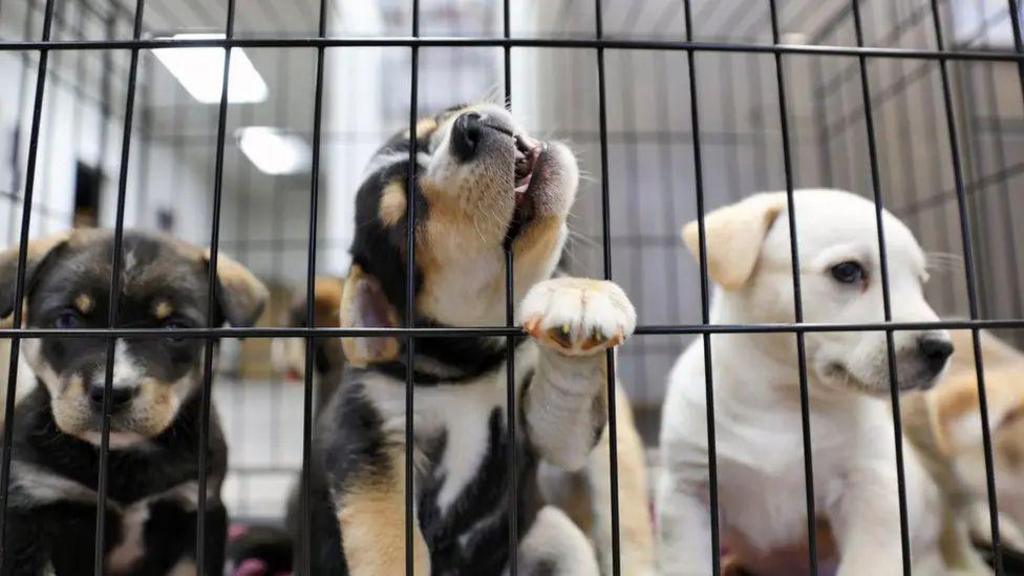
A new animal welfare strategy, set to be unveiled by the government on Monday, pledges to combat puppy farming and potentially outlaw the use of electric shock collars on dogs.
The comprehensive strategy encompasses new legislation, regulatory reforms, and proposals, and will also advance Labour’s commitment to prohibit trail hunting in rural areas.
While the RSPCA has expressed its support for the plans to eradicate puppy farming, the Countryside Alliance has criticized the proposed ban on trail hunting as “another attack on the countryside.”
Environment Secretary Emma Reynolds told the BBC that consultations would be held regarding the trail hunting ban, acknowledging that it is “sometimes used as a smokescreen” for illegal fox hunting.
Puppy farming is characterized by breeders prioritizing profit over the health and well-being of animals, often confining numerous dogs in cramped spaces and using them to produce multiple litters annually.
Current dog breeding practices will be reformed to address puppy farming as part of what the government is calling “the biggest animal welfare reforms in a generation.”
However, the full implementation of the strategy is projected to extend until the end of 2030.
David Bowles, head of public affairs at the RSPCA, stated that the animal welfare charity was “delighted” with the strategy, adding that the proposed ban on puppy farming “could be a real game-changer.”
“Puppy farming is one of the most insidious problems that the RSPCA faces.”
“The government will need to draft the legislation on that in this coming year, and the RSPCA will collaborate with them to ensure that there are no loopholes,” he said.
The government is also considering banning the use of snare traps in the countryside and confirmed on Sunday that it will conduct a consultation on the proposed ban on trail hunting in the New Year.
Trail hunting involves laying a trail with a rag scented with a natural odor, which is then followed by hounds, although live animal scents can inadvertently be picked up by the pack.
The secretary of state told the BBC that while Labour had previously banned fox hunting in 2004, “we have seen that people are trying to circumvent that ban by using trail hunting in some cases.”
“Obviously, that’s also a problem of enforcement, it’s not just the legislation, but we are determined to go further, which is why banning trail hunting is in the animal welfare strategy,” she said.
“We know sometimes it is used as a smokescreen for fox hunting.”
However, Tim Bonner, chief executive of the Countryside Alliance, expressed disbelief that the government would allocate more parliamentary time to hunting.
He stated: “Revisiting this pointless and divisive issue is completely unnecessary.”
“People across the countryside will be shocked that after Labour’s attack on family farms and its neglect of rural communities it thinks banning trail hunting and snares used for fox control are a political priority.”
Conservative chairman Kevin Hollinrake characterized the ban as an “attack on rural Britain and British culture,” accusing the government of “punishing the law-abiding majority who support legal trail hunting.”
The government is also exploring ending the use of “confinement systems” in farming, including caged hens and pig farrowing crates, which are used to confine sows during birth and nursing.
The use of slow-growing chickens will be promoted over the use of controversial so-called “Frankenchickens,” a term used by animal welfare campaigners to describe fast-growing breeds.
Anthony Field, head of Compassion in World Farming UK, stated that the government was “raising the bar for farmed animal welfare.”
The National Pig Association stated that it would be “following the next steps closely” on farrowing crates and was itself looking towards more flexible systems.
The British Poultry Council have been approached by the BBC for comment.
The government says the practice is being used as a “smokescreen” for the hunting of wild animals.
The dog was uninjured and “very happy to be reunited with its owners”, rescuers say.
The seal pup was underweight, dehydrated and covered in mud when it was rescued near Seatown.
Stark spent six years with the force but had recently retired along with his handler Paul Hopley.
A three-year-old cat is now in foster care after it was listed for £30 by the seller.