

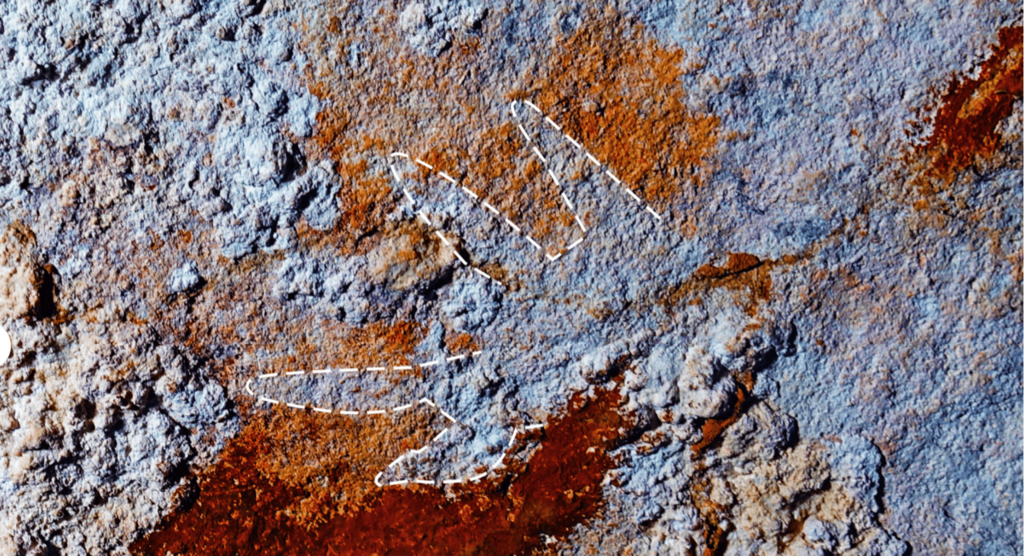
Researchers have identified a stenciled hand outline discovered on the Indonesian island of Sulawesi as the world’s oldest known cave painting.
The artwork depicts a red hand stencil, featuring reworked fingers that form a claw-like motif, indicating an early display of symbolic imagination, according to the research team.
Dating back at least 67,800 years, the painting predates the previous record holder—a contested hand stencil in Spain—by approximately 1,100 years.
This discovery bolsters the hypothesis that Homo sapiens had migrated to the broader Australia–New Guinea landmass, known as Sahul, roughly 15,000 years earlier than some researchers suggest.
Over the past decade, a series of findings on Sulawesi has challenged the long-held belief that art and abstract thought emerged suddenly in Ice Age Europe and subsequently spread from there.
Cave art is considered a pivotal indicator of when humans began to engage in abstract, symbolic thinking—a cognitive capacity that underpins language, religion, and scientific inquiry.
These early paintings and engravings demonstrate humans not only reacting to their environment but also representing it, sharing narratives and identities in a manner unique among species.
Professor Adam Brumm of Griffiths University in Australia, who co-led the project, stated in an interview with BBC News that the latest discovery, published in the journal Nature, reinforces the evolving understanding that human creativity did not originate in Europe. Rather, it was an innate characteristic of our species, with evidence tracing back to Africa, the cradle of humanity.
“During my university years in the mid to late 90s, we were taught that the creative explosion in humans occurred in a small part of Europe. However, the emergence of modern human behavior traits, including narrative art in Indonesia, challenges this Eurocentric perspective,” Professor Brumm explained.
The oldest known Spanish cave art is a red hand stencil located in Maltravieso cave in Western Spain, which has been dated to at least 66,700 years ago, although the dating remains a subject of debate among experts.
In 2014, hand stencils and animal figures dating back at least 40,000 years were discovered in Sulawesi. This was followed by the identification of a hunting scene at least 44,000 years old and a narrative painting depicting a pig and human, dated to at least 51,200 years ago. According to Professor Maxime Aubert of Griffiths University, each of these discoveries has pushed the timeline of sophisticated image-making further into the past.
“Initially, we established minimum ages of at least 40,000 years, comparable to those in Europe. However, by focusing on the pigment itself, we have extended the timeline of rock art in Sulawesi by at least another 28,000 years,” Professor Aubert stated.
The latest discovery was made in Liang Metanduno, a limestone cave situated on Muna, a small island off the southeastern coast of Sulawesi. The art was created using a spray-painting technique: an ancient artist pressed their hand against the cave wall and then blew or spat pigment around it, leaving a negative outline on the rock when the hand was removed.
Analysis of thin mineral crusts overlying one fragmentary hand stencil revealed a minimum age of 67,800 years, making it the oldest reliably dated cave art in the world.
Crucially, the researchers note that the artist did more than simply spray pigment around a hand.
Following the creation of the original stencil, the outlines of the fingers were carefully modified—narrowed and elongated—to create a more claw-like appearance. Brumm argues that this creative transformation is “a very us thing to do.”
He notes the absence of such experimentation in the art produced by Neanderthals in their cave paintings in Spain around 64,000 years ago, although the dating of those paintings remains contentious.
Prior to this recent discovery on Muna, all known paintings in Sulawesi were located in the Maros Pangkep karst region in the island’s southwest. The presence of this much older stencil on the opposite side of Sulawesi, on a separate island, indicates that creating images on cave walls was not a localized phenomenon but was deeply ingrained in the cultures that spread across the region.
Brumm notes that years of fieldwork by Indonesian colleagues have uncovered “hundreds of new rock art sites” in remote areas, with some caves used repeatedly over tens of thousands of years. At Liang Metanduno, other, much younger paintings on the same panel—some created as recently as about 20,000 years ago—demonstrate that this cave served as a focal point for artistic activity for at least 35,000 years.
Given Sulawesi’s location on the northern sea route between mainland Asia and ancient Sahul, these dates have direct implications for assessing when the ancestors of Aboriginal Australians first arrived.
For many years, the prevailing view—largely based on DNA studies and most archaeological sites—was that Homo sapiens first reached the ancient Australia–New Guinea landmass, Sahul, approximately 50,000 years ago.
However, the firm evidence that Homo sapiens inhabited Sulawesi and produced complex symbolic art at least 67,800 years ago significantly increases the likelihood that controversial archaeological evidence indicating human presence in northern Australia approximately 65,000 years ago is accurate, according to Adhi Agus Oktaviana of Indonesia’s National Research and Innovation Agency (BRIN).
“It is highly probable that the individuals who created these paintings in Sulawesi were part of a larger population that subsequently dispersed throughout the region and eventually reached Australia,” Oktaviana stated.
Many archaeologists once posited a European “big bang” of cognitive ability, based on the apparent concurrent emergence of cave paintings, carvings, ornaments, and new stone tools in France and Spain approximately 40,000 years ago, shortly after the arrival of Homo sapiens.
The spectacular Ice Age cave art found in sites such as Altamira and El Castillo supported the notion that symbolism and art emerged almost instantaneously in Ice Age Europe. However, the discovery of engraved ochre, beads, and abstract markings from South African sites like Blombos Cave, dating back approximately 70,000–100,000 years, has demonstrated that symbolic behavior was already established in Africa long before.
Coupled with the very old figurative and narrative paintings from Sulawesi, a new consensus is emerging, suggesting a much deeper and more widespread history of creativity, Aubert told BBC News.
“The evidence suggests that humans possessed this capacity for a very long time, at least when they left Africa—but likely even before that,” Aubert concluded.