

With the commencement of the world’s premier football tournament just a month away, attention is increasingly focused not only on the competing teams and venues but also on the anticipated weather conditions.
Across the United States, Canada, and Mexico, the host nations for the tournament, summer weather patterns typically include heat, thunderstorms, and potential air quality issues stemming from wildfires.
Humidity is expected to be a significant factor that could lead to disruptions during the World Cup.
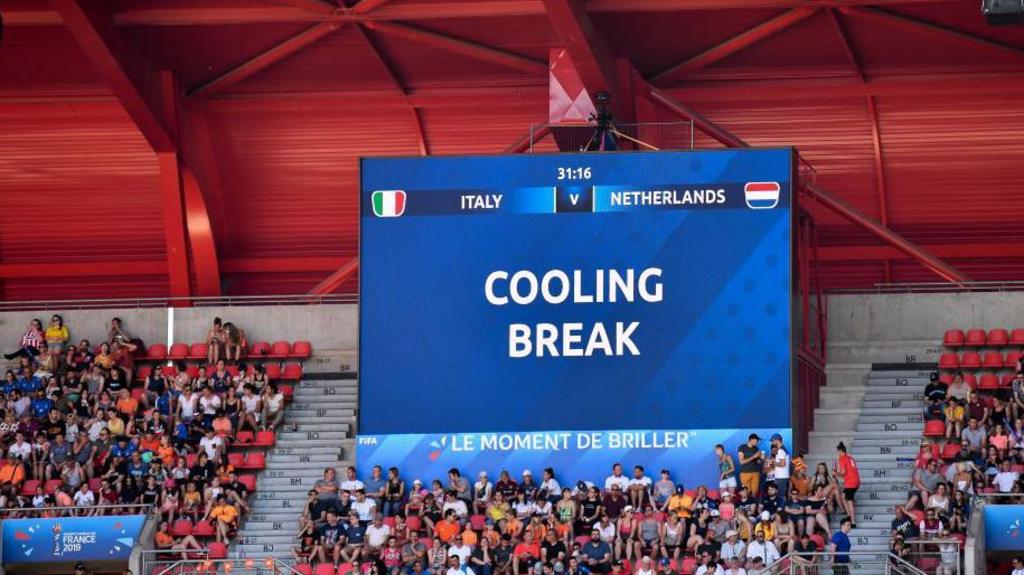
Fifa has acknowledged the potential challenges posed by high temperatures and, in line with its “commitment to player welfare,” has mandated three-minute cooling breaks in each half of every match throughout the tournament.
Thunderstorms previously caused multiple game delays during the Fifa Club World Cup in 2025.
During last year’s Fifa Club World Cup, six matches experienced disruptions due to heat and thunderstorms, including a two-hour delay during a match featuring Chelsea and Benfica. This led Chelsea’s manager, Enzo Maresca, to suggest that the US is “probably not the right place to do the competition“.
Many of the host cities frequently experience high summer temperatures.
In regions of the southern United States and northern Mexico, average daytime highs generally range from the low to mid-30s Celsius (mid-90s Fahrenheit), with temperatures occasionally climbing toward 40C (104F) during hotter periods.
Considering factors such as temperature, humidity, wind speeds, and solar intensity, players competing in these World Cup host cities face the highest risk of experiencing extreme heat stress on their bodies.
The addition of humidity further exacerbates the situation, impeding the body’s natural cooling mechanisms and causing conditions to feel even hotter.
Two heat indexes are expected to be frequently referenced throughout the summer.
The first is the “feels like” temperature, which reflects how the heat is perceived by the body rather than the actual thermometer reading. For instance, in Miami, a typical air temperature of 32C (90F) in summer might regularly feel like 43C (109F).
The second is the Wet Bulb Globe Temperature (WBGT), a metric used to assess physical heat stress on the body. A WBGT of approximately 28C (82F) is widely recognized as a threshold at which heat stress becomes a significant concern for elite athletes.
A 2025 study published in the International Journal of Biometeorology concluded that “14 out of the 16 host locations exceeded WBGT’s of 28C (82F) in a summer afternoon, external.”
‘Heat danger’ warning about 2026 World Cup venues
The World Cup line-up is complete – here’s what you need to know
There are six host cities—Miami, Houston, Dallas, Monterrey, Kansas City, and Atlanta—where the WBGT could plausibly reach at least 32C (90F) during the afternoon, representing a state of extreme heat stress that severely challenges the body’s ability to regulate its temperature.
To mitigate these risks, matches are generally scheduled to avoid the hottest times of the day, with many kick-offs set for late afternoon or evening. For example, Scotland’s Group C match against Brazil in Miami is scheduled for 18:00 ET (23:00 BST).
Some venues, including stadiums in Houston and Dallas, are equipped with retractable roofs and climate control systems to moderate conditions.
Summer heatwaves are also common in North America and Mexico, potentially causing temperatures to rise 10C (50F) or more above average, which could create significantly more challenging conditions for both players and fans.
In New York, where this year’s World Cup final is scheduled for 19 July at 15:00 ET (20:00 BST), a typical heatwave could lead to air temperatures in the mid-30s Celsius (mid-90s Fahrenheit) and a WBGT of around 30C (86F), indicating extreme heat stress.
Thunderstorms will cause immediate pauses in play at US host cities for at least 30 minutes.
Thunderstorms pose a considerable risk of visibly disrupting matches.
Summer thunderstorms are widespread, particularly in cities such as Miami, Houston, and Atlanta, where warm, humid conditions can trigger frequent afternoon and evening storms.
According to US official recommendations and standard practice, if lightning is detected within 10 miles of a stadium, play must be suspended until 30 minutes after the last lightning strike.
Recently, the Miami F1 Grand Prix was brought forward by three hours due to the risk of thunderstorms and lightning.
The circuit is located near Hard Rock Stadium, which is scheduled to host multiple World Cup matches.
While match times can be adjusted, the inherent unpredictability of thunderstorms makes them a significant challenge for organizers.
Wildfire smoke caused very poor air quality at SoFi Stadium in Los Angeles last year.
The 2026 wildfire season has started early in the US, with an above-average number of wildfires already burning.
In 2023, extensive wildfires in Canada led to smoke spreading across much of North America, affecting cities thousands of miles away.
Air quality reached hazardous levels in parts of the United States, including New York, leading to widespread disruption and the cancellation of sporting events.
There is no fixed Fifa threshold for air quality that mandates the suspension of matches, so any decision to delay or suspend play would be based on real-time conditions and local public health advice.
For players and organizers, managing extreme weather will be an ongoing aspect of the tournament. For fans, the effects may be felt in various ways.
High temperatures could make conditions in stadiums and fan zones uncomfortable, while thunderstorms could lead to delays or temporary evacuations.
Delays and postponements could also disrupt transportation plans, with matches finishing late into the night and potentially affecting hotel bookings.
For fans watching at home in the UK, the time difference already means many matches will take place in the evening or overnight—any weather-related interruptions could extend viewing times, making it a very late night for some.
What to expect from next Fifa World Cup in 2026
Could dangerous weather impact the Fifa World Cup this summer?