

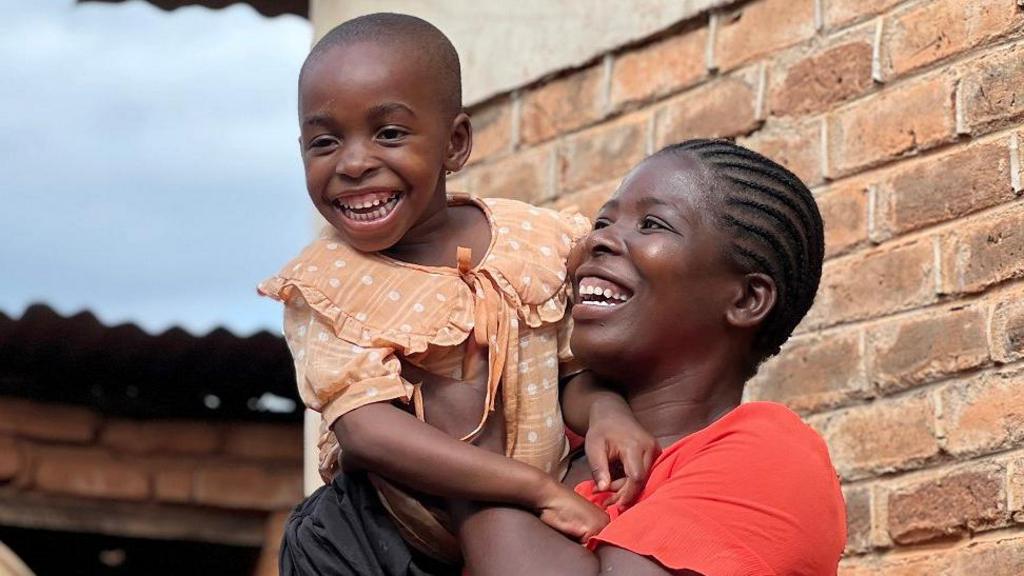
Martha Ongwane gazes affectionately at her energetic, giggling four-year-old, struggling to reconcile her present joy with the despair she felt just two years prior.
Her daughter Rachael, diagnosed with autism, was non-verbal, prone to biting, and unable to sit still. These challenges slowly overwhelmed Martha, plunging her into desperation and depression.
In their community in Malawi, East Africa, neighbors ostracized Martha, blaming her for Rachael’s behavior and advising her to confine the little girl indoors.
Compassion was absent, as was a fundamental understanding of autism and its appropriate management.
Martha recounts a harrowing moment when she poured poison into a cup, intending for Rachael to drink it.
“I convinced myself it would be a relief if she died, ending our problems and allowing her to rest.
“[But] my heart wouldn’t allow it. I reconsidered and wept uncontrollably,” she recalls softly, her gaze lowered.
Two years later, witnessing the loving bond between mother and daughter, it’s difficult to fathom the depths of that earlier despair.
Rachael clambers onto Martha’s lap as they sit on the floor of their home in Mzuzu, northern Malawi.
The girl laughs, embracing Martha’s face, while the 33-year-old prepares vegetables to accompany nsima, a traditional maize porridge, for lunch.
This remarkable transformation is largely attributed to the family’s access to specialized care.
During one of their many visits to Mzuzu Central Hospital, Rachael was referred to Saint John of God, an organization dedicated to assisting children with disabilities.
Supported primarily by the Catholic Church, the organization provides community-based mental health services and operates a school for children with special educational needs, becoming a vital resource for the family.
Martha and her husband also received counseling.
Once isolated and stigmatized, the couple found a supportive community and educators equipped to address Rachael’s specific needs.
However, such support remains elusive for many in Malawi.
According to World Health Organization statistics, Rachael is among the over 60 million individuals globally on the autism spectrum.
Autism spectrum disorder (ASD) is a neurodevelopmental disability affecting brain development and influencing communication, social interaction, and sensory processing.
ASD presents on a spectrum, affecting individuals differently and to varying degrees.
Many autistic individuals exhibit specific characteristics, including intense focus, strong memory, and innovative thinking.
However, in countries where mental health and behavioral disorders are not prioritized, often only individuals with extreme behavioral differences are recognized, leading to stigma and discrimination.
In Malawi, for example, there are only two developmental pediatricians for a population exceeding 22 million, and three consultant psychiatrists.
The word “autism” lacks a direct equivalent in Chichewa, the country’s most prevalent language, often being translated as “ozelezeka” (mentally challenged) or “ofuntha” (troublesome).
Furthermore, widespread misconceptions about autism persist.
Saint John of God is actively working to dispel these misconceptions.
In a community center near Martha’s home, Christian and Muslim religious leaders convene for an autism awareness session conducted by the organization.
Many attendees attribute autism to witchcraft, and the discussion begins with participants sharing their beliefs.
A vicar, adorned with a large gold cross, asserts the common belief in bewitchment. Another man claims magic can target pregnant women, causing autism in their children.
Christopher Mhone from Saint John of God acknowledges the limited understanding of autism but leverages these sessions to encourage participants to adopt a new perspective, demonstrating how practical interventions can mitigate symptoms.
Reflecting on Martha and Rachael’s situation, he states that “when a woman reaches a point where she contemplates killing her child, it signifies a failure of the nation. Her burden has become unbearable, exceeding her emotional and psychological capacity.”
Mhone emphasizes that most autism support is provided by non-governmental organizations and charities.
While basic mental health services like assessment and referral are available at district and primary care levels, Zomba Central Hospital is the only government-run psychiatric referral facility in the country.
“Autism isn’t even mentioned in the Disability Act, highlighting the lack of awareness and visibility of the issue. Without recognizing the problem, there’s no way to begin addressing it,” Mhone explains.
The BBC contacted Health Minister Madalitso Baloyi for an interview regarding national provisions for children with autism but received no response.
Access to quality healthcare is limited in Malawi, leading many to seek help from traditional healers and witch doctors as a first resort for medical and mental health concerns.
Natasha Lusinje followed this path for her five-year-old son, Shalom.
Three hundred kilometers (186 miles) south of Mzuzu, in a barren compound outside Lilongwe, the capital, the young boy, who is non-verbal and unable to feed himself, sits playing alone.
Natasha remains alert and anxious.
“Many people have told me this child was bewitched, that his tongue was magically tied, preventing him from speaking,” she says.
Nearly three-quarters of Malawians believe in witchcraft, and Natasha is among them.
For her, it provides both an explanation for her son’s condition and a potential solution.
She has decided to take Shalom to a traditional healer in search of a cure. BBC Africa Eye was granted rare access to document their experience.
They travel by bus to the healer’s home on the outskirts of the capital.
Wearing a long white dress, the healer, Maness Sanjelekani, faces the wall and begins chanting: “We give praise to you God this evening, as you have sent your lamb seeking for healing here. Because he doesn’t have a soul, because evil people from the dark did this to him.”
Despite lacking medical qualifications, the healer claims there are two types of autism: one from God, which she cannot alter, and one from Satan, which she can heal.
She believes Shalom suffers from the latter.
This assertion is completely unfounded from both medical and scientific perspectives.
Natasha paid 26,500 kwacha ($15; £11.50), and over three weeks, Shalom is bathed with herbs and forced to consume herbal remedies daily, yet he remains non-verbal. Natasha is also instructed to administer a “treatment” involving small cuts on Shalom’s skin.
When confronted about this practice, Sanjelekani denied any form of child abuse.
“I can only say I am trying to save his life. I am trying my best to save him,” she insists.
When questioned about her claims of two types of autism, accused of running a scam, and asked to admit she is lying, she concedes: “Let me just accept I have failed this child.”
Natasha eventually took Shalom home but continues to believe that God will provide a cure, remaining her only hope.
Back in Mzuzu, Martha assists Rachael in dressing in her blue-and-white checkered school uniform. She has been attending a Saint John of God school for a year.
The Mzuzu facility has the capacity to support over 600 children annually.
Rachael is learning to speak, and when her name is called in class, she enthusiastically jumps up, takes her friend’s hand, and encourages her to stand and sing along.
In the well-maintained gardens, young adults—some with Down syndrome, others with cerebral palsy and autism—carefully tend their crops.
“I want us to conceptualize disability in a positive way,” says Mhone.
“Disability is ability, in a different way. And if society begins to understand that, then there will be less stigmatization, and they will be looking at the positive things that can come out of those with disabilities.”
Martha can hardly believe the transformation in her daughter and their lives.
She shares her story hoping to inspire other mothers and regrets not seeking help sooner.
“When I look at her, I feel so guilty. Every day, I reflect on the fact that my daughter could have been dead.
“I adore her now.”
Additional reporting by Tamasin Ford
Go to BBCAfrica.com for more news from the African continent.
Follow us on Twitter @BBCAfrica, on Facebook at BBC Africa or on Instagram at bbcafrica
Several footballers have absconded in the past leaving behind what rights groups call a repressive government.
Albert Mazibuko sang in the iconic South African choral group for more than 55 years.
There are fears South Sudan may be plunged back into a civil war less than a decade after it ended.
The country will start receiving deportees from this month but has not said how many they will accept.
A Turkish government-owned drilling ship is expected to arrive in Somali waters later this week.