

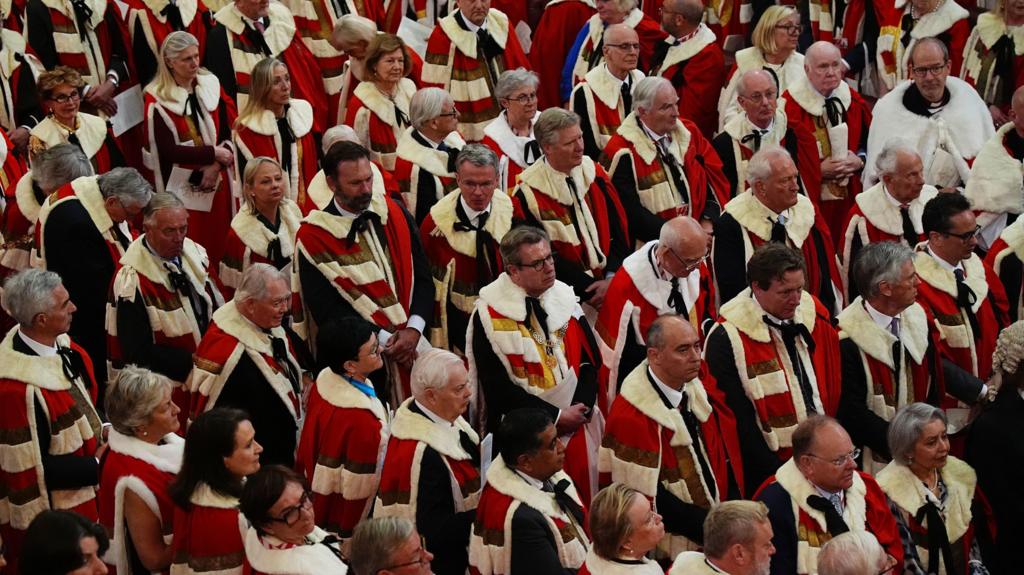
The era of hereditary peers in the House of Lords is drawing to a close, with legislation set to eliminate their inherited right to a seat, marking a significant shift in the upper chamber.
The 92 remaining hereditary peerages are slated for removal by the end of the current parliamentary session, anticipated in May.
However, a compromise has been reached that allows a select number of peers to transition, described by one departing member as boarding a “hereditary lifeboat.”
Under the agreement, the Conservative party has been granted the opportunity to convert 15 of their hereditary members into life peers, enabling them to continue their legislative roles indefinitely.
This concession was reportedly offered by the Labour party, which has a limited number of hereditary peers, in exchange for Conservative agreement to retire some of their existing life peers.
A number of crossbench hereditary peers, who are unaffiliated with any political party, are also expected to be granted life peerages.
While the prime minister holds the ultimate authority in appointments to the Lords, a process will determine which hereditary members are nominated for consideration as life peers.
The Conservative leadership within the Lords will provide recommendations to party leader Kemi Badenoch, who will ultimately make the final decision.
Charles Courtenay, the Earl of Devon, has stated he will not seek to remain in the Lords.
“I don’t think we should be using the hereditary privilege we have in the Lords to haggle or negotiate for life peerages,” the Earl said.
“I don’t think it’s appropriate.”
Lord Courtenay entered the upper chamber in 2018, inheriting a title dating back to 1142.
Despite advocating against the removal of hereditary peers, he has accepted the decision and is not “unduly distressed by it”.
“I’m quite conscious that if people think the hereditary principle is wrong and that’s the decision of the country, then we shouldn’t be using that to retain seats in the Lords for ourselves,” the Earl said.
He is prepared to accept the change, noting parallels with his ancestors who faced execution for treason.
While they will no longer be able to sit and vote in the Lords, outgoing hereditary peers will retain their titles.
“The one thing you look at from the family history is we’ve been through a lot,” Lord Courtenay said.
“There’s nothing to be gained by fighting progress. We just have to crack on and move along.”
Lord Bethell, a Conservative health minister during the Covid-19 pandemic, has also announced his intention to depart the upper house.
“I will not seek a place in the ‘Hereditary Lifeboat’, and instead am looking forward, with enthusiasm and energy, to leaving the life of a parliamentarian in a couple of weeks to pursue new adventures,” Lord Bethell wrote in a LinkedIn post.
The Conservative party is expected to have several candidates to fill the available positions.
Sources suggest Conservative hereditary members serving in shadow ministerial roles within the Lords are likely nominees for life peerages.
Hereditary peers on the Tory frontbench include Viscount Camrose, Viscount Younger of Leckie, the Earl of Minto, Lord Keen of Elie, Earl Howe, the Earl of Courtown and the Earl of Effingham.
Lord Strathclyde, a former Tory leader of the Lords, has also been mentioned as a potential nominee.
Lord Salisbury, another hereditary peer who retired in 2017, expressed understanding for those “upset about leaving, particularly when they’ve given many years of service”.
He told the BBC’s Today in Parliament programme that he was pleased that “a number of hereditary peers will be given life peerages under a deal that has now been agreed with the present leader of the house”.
He added that he hoped “people on the Tory benches like Lord Howe and Lord Strathclyde” would be able to continue to contribute to the House.
The BBC approached five Conservative hereditary peers, none of whom were prepared to comment on the record.
One cited the “acutely sensitive” nature of the matter, while another described it as “a live issue”.
Within the Lords, some believe certain hereditary peers have been effective legislators, exceeding the performance of some politically appointed members.
In a statement regarding the abolition of hereditary peers, the Lord Speaker acknowledged their service.
“Whatever views people may have of this constitutional change, it is sad to say goodbye to friends, who in many cases have contributed significantly to debate and scrutiny and to our institutional memory,” Lord Forsyth of Drumlean said.
“Recognising their contribution is not about party politics but acknowledging the value of service and commitment, and I am proud to do so and to thank them.”
However, many MPs and others outside of Parliament view allowing aristocrats to hold seats by birth as incompatible with modern democracy.
Labour’s 2024 election manifesto pledged legislation to remove the right of all remaining hereditary peers to “sit and vote in the House of Lords”.
“There is no place in a modern democracy for people shaping our laws purely due to who their parents were,” said Dr Jess Garland, director of policy and research for the Electoral Reform Society.
She expressed disappointment at the prospect of hereditary peers returning to the Lords “by the back door”.
“This comes after an aggressive campaign from unelected politicians in the Lords to delay and frustrate the bill, despite it being in the government’s manifesto,” she said.
“This will look farcical to the public, who will wonder why unelected peers have been able to force an elected government into watering down its clear manifesto pledge to remove the hereditary peers from Parliament.”
Over centuries, the unelected hereditary members of the House of Lords have demonstrated a remarkable ability to survive existential threats.
They recovered from the 17th-century revolution, when the Lords was abolished as “useless and dangerous to the people of England”.
They also outlasted former Prime Minister Sir Tony Blair, who labelled their presence an “anachronism” and removed over 600 of them.
In 1999, Blair’s compromise deal preserved 92 hereditary peerages.
Now, if the remaining hereditary peers navigate the situation carefully, they may outlast another Labour prime minister and postpone their seemingly inevitable demise.
The bill abolishes the 92 seats reserved for peers who inherit their titles through their families.
It comes after a Lords standards probe into his contacts with ministers and advisers during the pandemic.
It comes as the government tries to pass a bill to end hereditary peerages ahead of a spring deadline.
MPs and peers are presented with two renovation options and told to make a decision by the mid-2030s.
He joined Tony Blair’s government in 2004, holding prominent roles in politics until his death.