

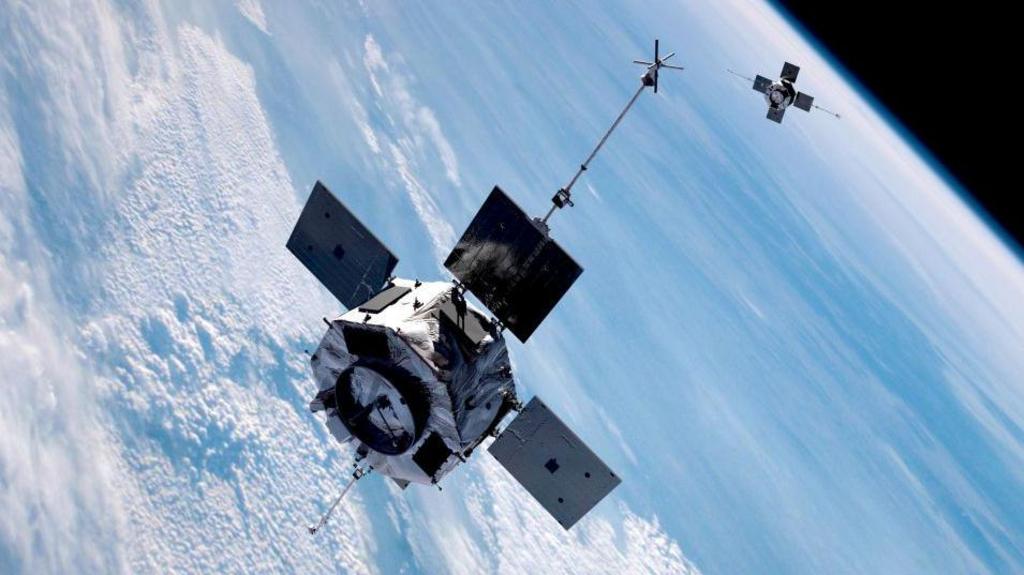
A Van Allen Probe spacecraft, weighing over 1,300 pounds (600kg), is anticipated to re-enter Earth’s atmosphere nearly 14 years after its initial launch, according to NASA.
The U.S. Space Force, as reported by NASA, projects the re-entry to occur around 19:45 EST (00:45 GMT) on Tuesday, though a 24-hour margin of “uncertainty” exists in this prediction.
Launched in 2012, Van Allen Probe A is expected to largely incinerate as it transits the atmosphere, although some components may endure.
The space agency has assessed the risk of harm from falling debris at one in 4,200, characterizing it as a “low” probability.
The spacecraft, along with its counterpart Van Allen Probe B, were deployed on a mission to acquire comprehensive data regarding Earth’s dual radiation belts.
The precise location of the satellite’s projected atmospheric re-entry is currently unconfirmed. The BBC has reached out to NASA for further clarification.
Both NASA and the U.S. Space Force have committed to monitoring the re-entry event and providing updated projections as necessary.
Originally slated for a two-year duration, the mission extended to almost seven years, concluding when the spacecraft exhausted their fuel reserves, rendering them unable to maintain solar orientation.
From 2012 to 2019, the probes traversed the Van Allen belts—rings of charged particles trapped by Earth’s magnetic field—to investigate particle dynamics, according to NASA.
These belts serve as a shield, protecting Earth from cosmic radiation, solar storms, and solar wind, all of which pose threats to human health and technological infrastructure.
The mission yielded significant discoveries, notably the detection of a transient third radiation belt that can arise during periods of heightened solar activity, NASA reported.
Re-entry of Van Allen Probe B into Earth’s atmosphere is not anticipated prior to 2030.
The Southampton Space Institute will leverage its expertise and facilities to enhance education and foster job creation.
Tim Peake holds the distinction of being the first British astronaut to set foot on the International Space Station.
NASA is adding an additional mission to its Artemis program ahead of planned astronaut lunar landings.
The first crewed Moon mission in half a century could potentially launch in February, paving the way for future lunar exploration.
The mission to the Moon’s far side and back has been postponed following the detection of issues with its launch rocket, according to a NASA official.