

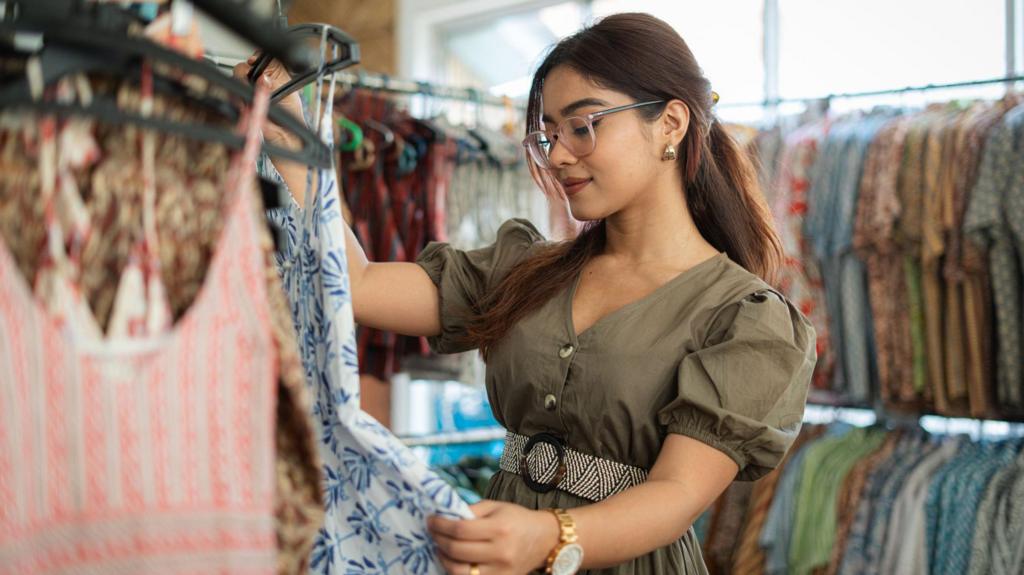
In Sangli, western India, Alka peruses a collection of vibrant Indian ethnic-wear kurtas at a Reliance Trends outlet, a modern three-story retail space.
The geriatric care worker, in her late 50s, is seeking a kurta in a specific shade of baby pink, adorned with a subtle gold paisley pattern.
“I admired the design on a colleague and immediately wanted to purchase one for my daughter,” Alka shared with the BBC.
The store boasts an array of contemporary apparel across its multiple levels, from graphic tees and distressed denim to professional attire and in-house labels featuring Indian and fusion designs.
Cosmetics, sneakers, handbags, and fashion jewelry are also prominently displayed.
Shopping in the store’s air-conditioned environment, complete with fitting rooms, attentive staff, and promotional discounts, provides a novel and pleasant experience for Alka.
Like many Indians, her shopping has traditionally been confined to unbranded goods in open-air markets.
However, value brands like Trends, operated by Isha Ambani, of the Reliance Industries retail group, and Tata’s Zudio, now offer merchandise at comparable prices to those found in bazaars, but with an enhanced shopping environment.
Most items in these stores are priced between $4 and $15. “Moreover, the designs are modern and there’s a growing desire among people to wear branded clothes,” Pankaj Kumar, a retail analyst at Kotak Securities, explained to the BBC.
The surge in aspirational consumers, particularly in smaller cities, fuels substantial growth in India’s organized fast-fashion sector, led by brands like Max, Vishaal Mega Mart, Trends, and Zudio.
While specific quarterly results for Trends are not public, Zudio’s expansion has significantly outpaced global high-street retailers like Zara and H&M, and even the Tata Group’s Westside brand, over the last several years.
In 2018, Zudio operated just seven stores nationwide, generating $12 million in revenue. Westside was a larger brand, with 125 stores and approximately $220 million in revenue.
Currently, the situation has dramatically shifted.
Zudio has grown to 765 stores, projected to surpass $1 billion in revenue by mid-2025, establishing it as the only Indian clothing brand to achieve this milestone.
Westside has doubled its store count, tripling its revenue, but its growth rate lags behind Zudio’s.
Kotak Securities characterizes Zudio’s success as a “classic bottom-of-the-pyramid strategy,” emphasizing that pricing is a critical factor, as “even affordable fashion is a luxury in India’s tier-2 and tier-3 towns.”
However, questions remain: what factors are driving this spending amid a weak job market, stagnant wages, and uneven private consumption, which accounts for 60% of GDP?
“It is clearly a shift in consumer spending,” says Kushal Bhatnagar of Redseer Strategy Consultants.
“Consumers are not necessarily buying more; rather, they are redirecting their purchases from local stores to branded outlets.”
This transition is the result of an aggressive expansion strategy by budget brands seeking to penetrate deeper into India’s markets.
Zudio and Max have spearheaded the “trendification” of affordable fashion, attracting Gen-Z and young millennial consumers by drawing inspiration from the latest fashion trends in Paris and Milan.
An early partnership between Trent, Zudio’s parent company, and Zara facilitated the application of the Spanish fast-fashion giant’s growth strategy, Bhatnagar noted.
Similar to Zara, Zudio maintains a remarkably swift inventory turnover of just 15 days, compared to the 45-60 days of its competitors.
“In the fashion industry, inventory speed is paramount,” Kotak Securities’ Kumar stated. Faster introduction of new styles translates into more frequent store visits.
However, this growth has impacted local retailers on the high street.
They face competition from both budget brands and e-commerce platforms like Meesho, which aggregates sellers and offers affordable goods across India, experiencing year-on-year growth of 35-40%.
“As a country’s GDP per capita increases, branded goods and online shopping naturally gain prominence in retail,” Bhatnagar explains.
The challenge, he says, is to achieve a “consumption uplift,” fostering growth in the overall market size along with the shift in consumer spending. India’s apparel market is currently estimated at $70-$100 billion.
“We underinvest in apparel. Our per capita spending is considerably lower than that of China, the US, or even Indonesia. A healthy market should typically grow by 12-15%, but we’ve seen sub-10% growth in recent years.”
Despite the modest growth in market size, the expansion of fast fashion raises concerns about its environmental impact.
According to a recent report, the textile industry ranks as the third-largest contributor to dry municipal solid waste in India, following plastics, and paper and cardboard. Only a quarter of this waste is recycled.
“While some brands are integrating sustainability into their supply chains, genuine large-scale change remains elusive,” Deloitte noted, estimating that less than 1% of used clothing is globally recycled into new garments and recycled fibers.
For the moment, style and affordability seem to outweigh sustainability concerns, particularly as many Indians in smaller towns embrace the fast-fashion trend.
Follow BBC News India on Instagram, YouTube, X and Facebook.
South Africa recover from a slow start to beat hosts India by 76 runs in their opening game of the Super 8s at the T20 World Cup.
South Africa underline their credentials as serious challengers for the T20 World Cup with victory against co-hosts and defending champions India.
South Africa’s Keshav Maharaj picks up three wickets in an over as team-mate Tristan Stubbs takes all three catches in their T20 World Cup victory over India in Ahmedabad.
BBC Sport lists the best performing batters and bowlers from the Men’s T20 World Cup in India and Sri Lanka.
Fixtures, results and scorecards for the 2026 ICC Men’s T20 World Cup in India and Sri Lanka.