

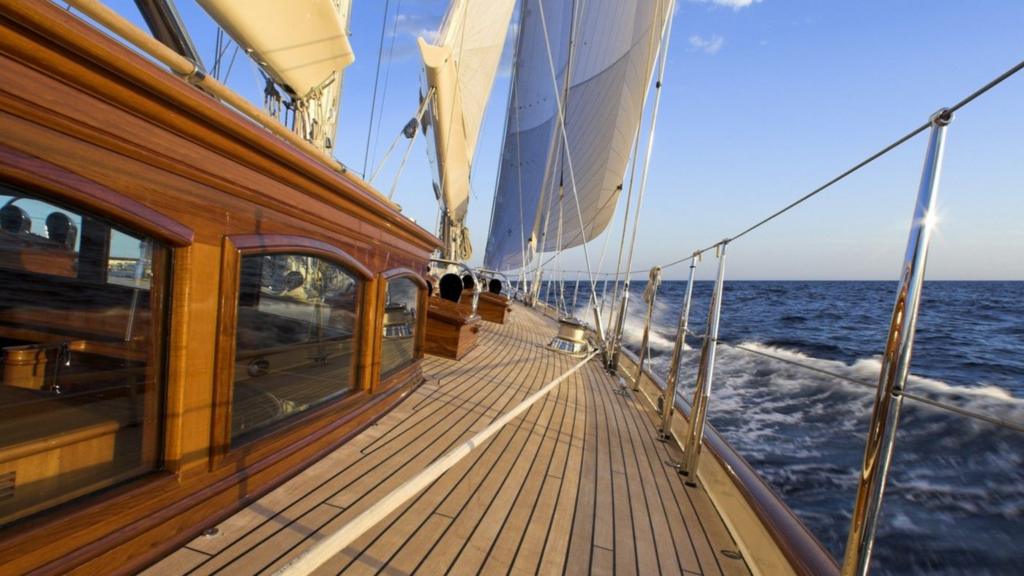
Jeff Bezos’s $500 million superyacht, Koru, delivered in 2023, features teak wood in its interior design and decking.
This dense tropical hardwood is highly valued for its resistance to rot and salt, as well as its aesthetic appeal and symbolic representation of status and prestige.
The highest quality teak originates from old-growth trees, primarily harvested from natural forests in Myanmar.
However, the timber trade is controlled by the country’s military-linked sector, with limited consideration for sustainability, rendering its import illegal in the UK, EU, and US.
Trade sanctions were imposed on the sector in 2021 following the coup, although imports were already significantly restricted under existing laws.
Oceanco, the Netherlands-based shipyard that constructed the Koru, was fined in late 2024 by Dutch authorities for utilizing Myanmar teak in the yacht’s interior.
An investigation is underway in Germany to determine whether the Koru’s deck is also constructed from illegal Myanmar teak, or from legally sourced plantations, with the initial importer of the deck’s wood reportedly based in Germany.
Similarly, UK-based luxury yacht manufacturer Sunseeker received a fine in late 2024 for the use of Myanmar teak. Both Sunseeker and Oceanco have characterized these instances as unintentional, with Sunseeker citing a failure in due diligence.
The ongoing presence of Myanmar teak in supply chains, often disguised as plantation teak from other tropical nations, is a recognized challenge.
Alternatives to teak are increasingly gaining traction within the yacht industry.
These alternatives encompass thermally-modified woods, fully synthetic materials, and engineered teak laminates. While these options have been available for some time, recent innovations are enhancing their appeal, according to companies and some users.
In addition to legal prosecutions, the depletion of pre-sanction stockpiles of old-growth timber is a significant factor driving the adoption of alternatives.
Plantation teak from younger trees is generally considered inferior by high-end shipyards, as it rarely offers the long, wide, dark-brown boards associated with quality.
Other natural woods that could serve as teak substitutes often struggle to meet the industry’s stringent standards or face supply constraints. Cork is occasionally used, but its aesthetic appeal is not universally accepted.
“Alternatives to natural teak are very welcome,” says Walter Kollert, a Portugal-based forestry consultant and member of the steering committee of TEAKNET, a non-profit international teak information network.
“We are in danger of losing old-growth teak forests which are part of a valuable ecosystem,” he says.
While the furniture and housing industries also utilize old-growth teak, they have generally found it easier to substitute plantation teak compared to the yachting industry, he adds.
Last October, Sunreef Yachts, a major luxury yacht manufacturer based in Poland and Dubai, announced its transition away from teak decking entirely.
“Teak is no longer an option anywhere in our range …[and] I believe we are the only ones to do this,” says Nicolas Lapp, the company’s co-founder and chief technical officer.
The decision, he says, was driven both by the difficulty of sourcing high quality plantation teak and the company’s push for greater sustainability.
When you buy plantation teaks, you have a lot of wood that’s just not usable, says Lapp.
After testing alternatives to teak, the company now offers two thermally-modified woods – in which a different natural wood is enhanced through heat to resemble teak – though it is not divulging publicly yet which those products are.
Meanwhile, some small boat models use a recyclable synthetic deck.
The thermally modified woods not only match teak’s visual appeal but are easier to clean, and offer better thermal performance – staying cooler in the sun and insulating the cabins below, reducing the need for air conditioning, notes Lapp.
One newer, thermally-modified wood product on the market is Tesumo, launched by a company of the same name in late 2021.
The operation is small, but business is booming, says Arne Petersen, its managing director, adding it is working to increase output.
There have been some examples in the past of thermally-modified wood which haven’t been successful which can cloud perceptions of newer materials, but Tesumo is a viable alternative, Petersen argues.
The product, made in Germany, emerged from a research project involving the University of Göttingen and Lürssen shipyard – one of the world’s most prestigious yacht builders – after it struggled to find a good natural alternative to old-growth teak.
It starts with a fast-growing undisclosed African hardwood which is heat-treated and then further processed, including with resin impregnation.
High-profile installations so far include one of the helipads on the Lürssen-built superyacht Dragonfly, reportedly owned by Google co-founder Sergey Bryn, and the complete deck of Boardwalk, another Lürssen-built superyacht linked to US businessman Tilman Fertitta, owner of the Houston Rockets basketball team.
Synthetic alternatives, including plastics, are also evolving. Among the earliest was Flexiteek, a UK-made PVC teak substitute introduced in 2000 and which is widely regarded as the market leader in its category.
In late 2024, the company launched its third-generation product.
It is easier to clean than real teak, retains its color as teak greys over time, and has improved thermal performance compared to earlier versions says Steve Moore, the company’s marketing manager.
A different approach still is making better use of real teak.
Laminated teak is an engineered solution in which plantation-grown teak, that would normally be rejected for high-end decking, is thinly sliced and glued together to form a strong, stable material.
“You are kind of tricking the eye…[and in the process] using far more of the log,” says Richard Strauss, CEO of Florida-based Teak Decking Systems.
The company fits decks using either plantation teak mostly sourced from India, or a small handful of alternatives it has had good success with. The laminated wood product it uses, Green Teak, comes from Thailand.
Meanwhile old habits die hard. Strauss notes that plantation teak is still the most popular among his customers.
Lapp of Sunreef says what’s really needed is a wider culture shift away from teak altogether.
Customers typically start with wanting teak until they learn the problem and that alternatives can offer benefits.
“Then we show them… and they realise they can’t tell the difference,” says Lapp.
However, small UK family yacht building business Jeremy Rogers is sticking with teak for now – sourced from older government-managed plantations in Java that it is confident are authentic and harvested sustainably.
The firm’s past experiments with alternatives mostly fell short, says Jessie Rogers.
“The problem for the alternatives is there is nothing quite like real teak,” she says.
Precious metal prices hit record highs in January as investors parked their money in “safe havens”.
In France, traditional restaurants are disappearing – the French blame high costs and the “Americanisation” of eating habits.
Sir Keir Starmer’s visit to China brought agreements on visas, services, healthcare, green tech and finance.
The company’s revenue was boosted by iPhone sales, but sales of its wearable tech and Mac computers dipped.
Since returning to the White House last year, the US president has used tariffs as a key policy tool.