

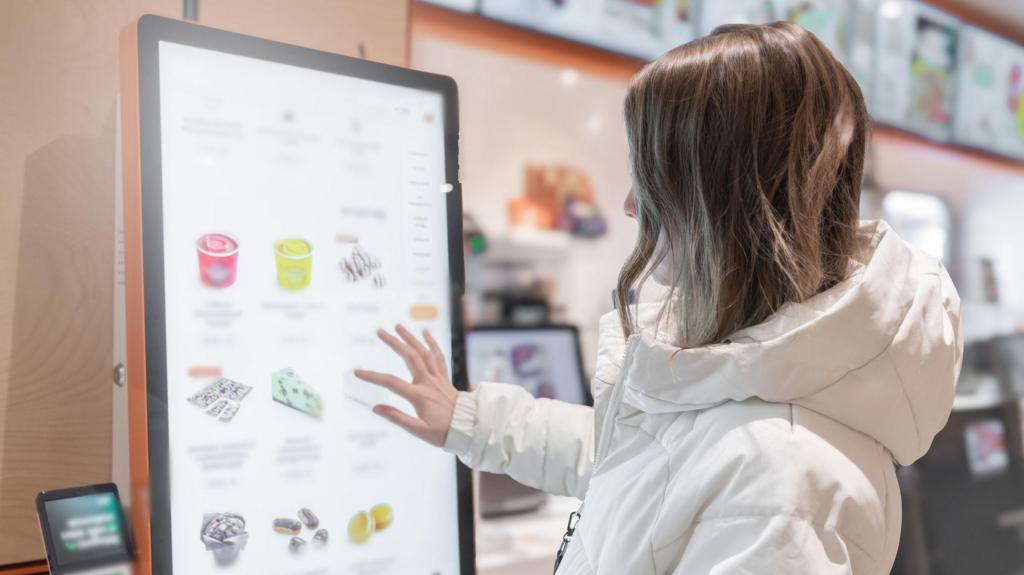
In an industrial park just outside Birkenhead, on Merseyside, a British company is quietly revolutionizing the retail landscape.
This is Evoke Creative, a firm specializing in self-service terminals, those ubiquitous touchscreens now found everywhere from McDonald’s to public libraries.
The surge in popularity of these interactive kiosks, particularly among restaurant chains, is largely attributed to their proven ability to significantly boost sales.
This sales increase is no accident, but a result of applied behavioral science – the study of human behavior and the factors that influence decision-making.
Dean Ward, founder and chief product officer of Evoke Creative, whose client roster includes Travelodge, McDonalds, and JD Sports, explains the mechanics behind the sales boost.
“Firstly, these terminals remove the psychological barrier of feeling judged when speaking to a person. We believe this is a key factor,” Ward states.
“The prompts, ‘Would you like extra fries? Would you like to go large?’ can feel judgmental to some, leading them to decline. Terminals eliminate this concern.”
“Additionally, the high-quality product imagery allows customers to clearly see the product, its ingredients, and related items. This visual merchandising is highly effective.”
“Finally, the consistent upsell prompts throughout the customer journey, delivered without judgment and with ample time for consideration, make customers far more likely to say ‘yes’ to add-ons.”
Data corroborates Ward’s observations. According to Vita Mojo, another technology provider whose clients include Leon and Honest Burgers, 61% of customers spend more at a terminal than at a traditional till.
Reports suggest that the average increase in per-order spending can reach as high as 40%.
Even before the formalization of behavioral science, companies were leveraging its core principles to influence consumer choices.
In the 1940s, RJ Reynolds, a US tobacco company, famously touted that “more doctors smoke Camels than any other cigarette.”
This tactic echoes in modern toothpaste commercials featuring dentists recommending specific brands.
Ben Jones, of the business consultancy The Behavioural Architects, explains that both examples exploit “authority bias.”
“Authority bias is our inclination to align our opinions and behaviors with figures we perceive as authoritative or expert,” Jones clarifies. “In situations of uncertainty, we tend to follow the lead of those we deem credible or knowledgeable.”
“Businesses can leverage this through endorsements: dentists recommending toothpaste, athletes endorsing sportswear, or nutritionists promoting food products.”
While RJ Reynolds may have been an early adopter, today, behavioral science is employed by entities ranging from major corporations to the United Nations (UN).
In the UK, the introduction of auto-enrolment in workplace pensions in 2012 stands out as a particularly successful application. This initiative has resulted in over 10 million additional people saving for retirement.
The significant increase in pension participation is attributed to “default bias,” a principle also at play when individuals retain their phone’s default ringtone or computer wallpaper.
“Default bias is our general tendency to favor the pre-selected or default option,” Jones explains. “We make thousands of decisions daily, and defaults help us manage this overload of choices.”
“Defaults enable swift action. The automatic enrolment in pension schemes is a prime example, overcoming our inertia towards retirement planning and promoting positive long-term outcomes.”
Behavioral science can even influence seemingly trivial choices, such as wine selection. While it may sound like folklore, research supports the claim.
In an experiment led by Adrian North at Leicester University, alternating French accordion music and German oompah tunes in a supermarket significantly impacted wine sales.
On days featuring French music, French wine sales dominated; similarly, German wine sales surged when German music was played. Interestingly, customers remained unaware of the music’s influence, yet the sales figures clearly demonstrated the effect.
The World Food Programme (WFP), a branch of the United Nations (UN), provides food aid and guidance globally.
In Tunisia, the WFP partnered with Ogilvy to create a TV drama called Salla Salla, which aired last year.
They applied behavioral science principles to the script, aiming to subtly convey messages about healthy eating and reducing food waste.
“We innovatively used creativity to change behaviors,” says Takwa Khelifi from the WFP.
“Knowing the facts alone doesn’t change people. We all know better, but we don’t always do better.”
The show ranked fourth in viewership on Tunisian TV and resulted in a 22% decrease in bread consumption.
From brands to governments and the UN, behavioral science is shaping choices in subtle ways, often without our conscious awareness.
His comments seemed to hint at further layoffs at the owner of Facebook, Instagram and WhatsApp.
Some 1,180 jobs are at risk as the chain’s administrators assess options.
The co-owner of The Hundred House says his business will be excluded as it is classed as a hotel.
The technology giant confirmed the redundancies hours after it told staff in an email sent in error.
The parcel delivery giant says it is cutting back on low-profit deliveries for the online retailer.