

“`html
A leading proponent of the assisted dying bill has told BBC News that its prospects of becoming law this year are now “very, very difficult.”
Lord Falconer stated that the legislation has “absolutely no hope” of passing without a “fundamental change” in the House of Lords’ approach.
The former justice secretary is raising the possibility of using the Parliament Act, a rarely invoked mechanism to override objections from the House of Lords, if the bill is not passed before the King’s Speech in May.
Such a move could trigger a constitutional clash over this highly sensitive issue.
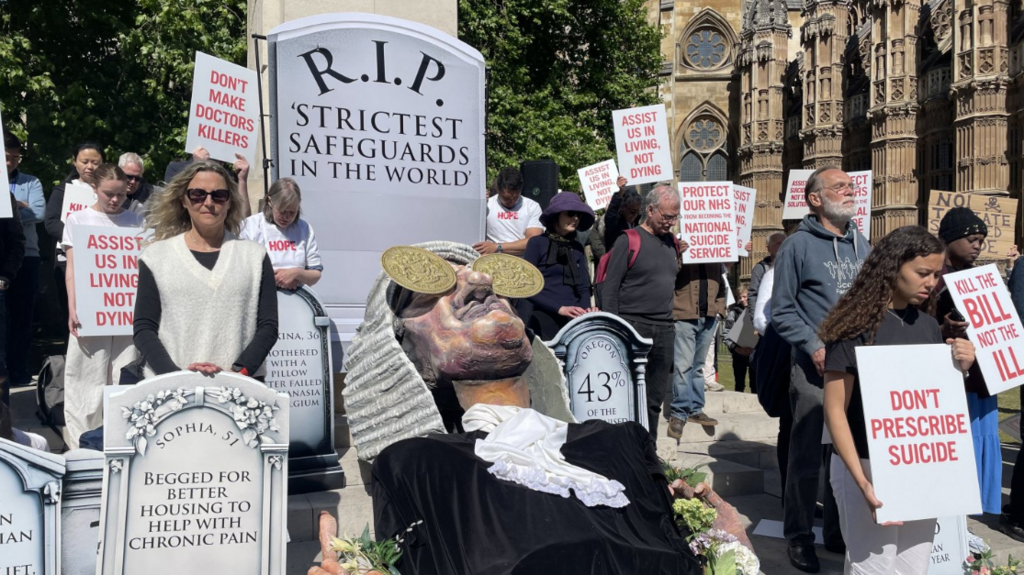
Opponents of the assisted dying legislation argue that it contains inherent risks, particularly for vulnerable individuals, and requires extensive amendments before it can be enacted.
A government source indicated that many ministers now believe the bill will not pass through the Lords and expressed hope that a compromise could be reached.
“It seems pretty clear to us now that the House of Lords is not going to pass this bill,” the government source stated.
The source suggested that a Royal Commission could be established to examine practical questions raised by Labour MP Kim Leadbeater’s proposal.
The source also noted that using the Parliament Act for a private member’s bill would be deeply controversial.
“The prime minister will need to step in before it gets to that stage,” the government source said.
A source close to Labour MPs and peers opposed to the Bill characterized the threat of using the Parliament Act as “the act of a bully who knows they are losing the argument.”
They argued that because the proposed legislation would have to be identical, it would mean forcing a flawed bill into law without the ability to change it.
Lord Falconer insisted that the Parliament Act was an “established part of our constitution” and that peers should not block the bill given that elected MPs had approved it.
Typically, bills introduced by backbench MPs, known as Private Members’ Bills, fail unless they are passed by both the Commons and the Lords in one parliamentary session.
A session ends when Parliament is prorogued, and a new one begins with a King’s Speech – which is expected in May.
The Parliament Act allows for a bill that has been passed by the Commons but rejected by the Lords to return in a new parliamentary session.
If an identical bill passes the Commons a second time, the Lords cannot block it again, and the legislation will become law at the end of that second session even without the Lords’ approval.
The powers have only been used seven times since 1911.
There are also several hurdles supporters would need to overcome.
Someone willing to bring the exact same bill would need to be drawn high up in the ballot of MPs able to bring a Private Members Bill.
Asked if it was now impossible for the bill to pass, Lord Falconer told BBC News: “It’s very very difficult, it’s not impossible if the Lords were to change the way that they were dealing with it.”
“I’ve seen no sign so far that there’s going to be a change,” he added. “But if it goes on like this it has absolutely no hope whatsoever of getting out of the Lords.”
Pressed on the controversy of using the Parliament Act to prevent the Lords from blocking the bill a second time, Lord Falconer said: “The issue about assisted dying is very controversial, but ultimately somebody in our constitution has got to decide whether the country should make the change.
“The people who should decide it should be the elected representatives in the Commons. If they make up their mind but are blocked in giving effect to that decision by a small number of peers then the constitutional answer is the Parliament Act.”
Lord Falconer has written to all peers on Wednesday evening setting out a number of amendments he will table, aimed at addressing concerns such as around those with eating disorders becoming eligible for an assisted death, and toughening restrictions on advertising for the service.
“It is our responsibility as a House to find a way forward,” he told peers, urging them to back the changes.
However several peers believe the change is dangerous and could mean vulnerable people are pressured into ending their lives prematurely.
A source close to Labour MPs and Peers opposed to the Bill told BBC News: “Threats to use the ‘nuclear option’ of the Parliament Act to recklessly force through this bill, which poses such risks to the vulnerable, is the act of a bully who knows they are losing the argument on the substance…
“People need to be very clear, using the Parliament act to force this through would mean that none of the known issues with the Bill would be fixed.
“Every MP who voted to force it though would bear responsibility for the inevitable suffering and deaths of vulnerable people.”
Sign up for our Politics Essential newsletter to read top political analysis, gain insight from across the UK and stay up to speed with the big moments. It’ll be delivered straight to your inbox every weekday.
It comes as the government looks into its own potential ban, with a consultation closing in the summer.
A court heard Lenny Scott was ambushed and shot dead for simply doing his job as a prison officer.
Peers had a choice between Lord Forsyth and ex-ballet dancer Baroness Bull in a vote earlier this month.
Supporters are increasingly concerned the bill could run out of time to become law.
It’s more than a year since MPs first backed the proposed legislation but it still needs to be approved by peers.
“`