

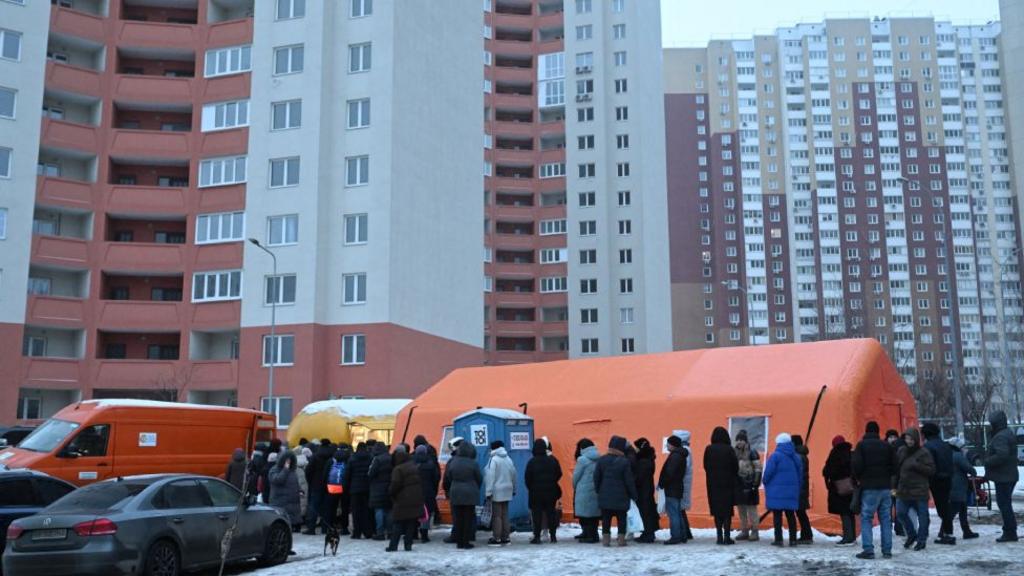
Ukraine is currently enduring what many consider to be its most challenging winter in recent memory.
With temperatures in January plummeting to below -15C, Russian forces have been targeting critical energy infrastructure, leaving an estimated one million Ukrainians without access to heating.
The capital city, Kyiv, has been a primary focus of these attacks. Following the latest Russian bombardment overnight on January 24th, nearly 6,000 apartment buildings were left without heating, according to Mayor Vitaly Klitschko.
This marks the third Russian assault on Kyiv’s heating infrastructure in just over two weeks, following strikes on January 9th and 20th that also left hundreds of thousands of residents facing freezing conditions in their homes.
“Living in Kyiv is a bit of a gamble these days,” remarked Rita, a resident of the Ukrainian capital, in an interview with the BBC.
“If you have heating and gas, there is no electricity and water. If you have electricity and water, there is no heating.
“Coming home is like playing a guessing game every day – will I be able to shower or have hot tea, or neither? And of course missiles and drones come on top of all that.”
She further stated that she is forced to sleep wearing a hat and multiple layers of clothing to stay warm.
Compounding the crisis for Ukraine, and arguably facilitating Russia’s strategy, is the widespread reliance on communal central heating systems in apartment buildings, where water is heated at a central plant and then distributed to individual radiators.
Heating plants in Ukraine are extensive, and attacks by Russian forces have far-reaching consequences, affecting thousands of residents. Ukraine reports that all such power plants have now been targeted.
While power outages can be partially mitigated with generators or battery packs, addressing the lack of heating presents a more complex challenge, especially when electricity is also unavailable to power alternative heating solutions.
Kyivteploenergo, the sole provider of heating and hot water in Kyiv, informed the BBC that “the absolute majority” of homes in the capital rely on its services, but declined to provide an exact number for security considerations.
In Zaporizhzhia, a city near the front lines with a population of 750,000, nearly three-quarters of residents depend on central heating, according to Maksym Rohalsky, head of the local association of apartment building residents.
Prior to Russia’s full-scale invasion in 2022, approximately 11 million Ukrainian households relied on central heating, compared to seven million with autonomous heating systems, as stated by Ukrainian energy expert Yuriy Korolchuk.
Cities throughout the Soviet Union, including those in Ukraine, were the focus of extensive construction programs in the 1950s, aimed at mass-producing affordable housing.
The urban landscapes of former USSR countries are dominated by ubiquitous nine-story residential buildings constructed from prefabricated concrete panels, known as “panelki,” or smaller five-story apartment blocks called “khrushchevki,” named after Soviet leader Nikita Khrushchev, who oversaw their construction in the 1950s and 1960s.
These buildings receive heating from large TETs plants, an acronym for “heat and electricity centrals” in Ukrainian, which generate both electricity and heat.
Detached, single-family homes, referred to as “private houses” in Ukraine, are typically found in rural areas and are uncommon in cities.
“Ukraine inherited the Soviet heating system and it hasn’t changed anything, it stays predominantly centralised,” Korolchuk told the BBC.
“These heating plants were not designed to be attacked with missiles or drones, that’s why these vulnerabilities came to the fore during the war.”
According to him, this represents a shift in Russian tactics.
“During the previous winters, there were no such strikes against the heating system. They happened only occasionally, and they didn’t directly target heating plants,” he added.
Referring to ongoing discussions aimed at ending the conflict, he suggests that “the factor of negotiations is now possibly playing a role, it’s a form of pressure.”
While large, centralized installations offer economies of scale, they present a significant vulnerability. Attacks on these facilities can have devastating consequences for hundreds of thousands of people.
The Ukrainian government is keenly aware of this vulnerability and is planning to mitigate it by mandating individual heating points in apartment buildings.
However, reversing decades of Soviet urban planning will be a complex and time-consuming process.
Sofia Demkiv says she is “truly proud” of her achievement after what she has been through.
A leak exposes for the first time the extent of Russia’s misuse of Interpol to request the arrest of critics.
French officials seized the tanker, named the Grinch, in the Mediterranean Sea on Thursday.
It’s the first time representatives from Kyiv, Moscow and Washington have come together since the full-scale invasion of Ukraine in 2022.
Lincolnshire Wildlife Park says Aleks should begin his journey from Ukraine in the next few weeks.