

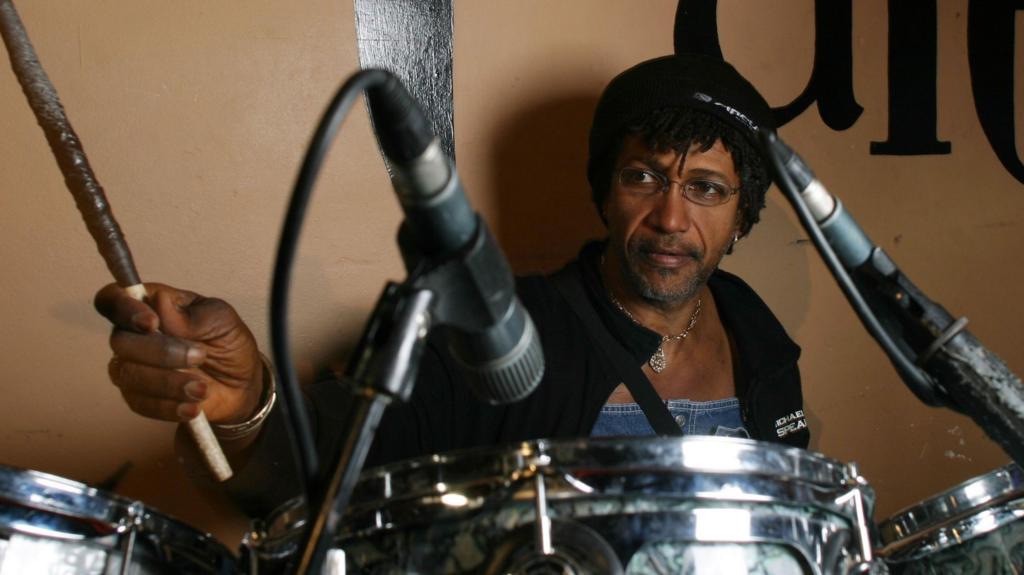
Sly Dunbar, the revered reggae drummer who collaborated with a diverse array of artists from Bob Marley to The Rolling Stones, has died at the age of 73.
Dunbar, considered one of the genre’s most influential drummers, contributed to iconic tracks such as Bob Marley’s “Punky Reggae Party” and Dave and Ansell Collins’ classic, “Double Barrel.”
He achieved even greater renown as one half of the production duo Sly & Robbie, crafting groundbreaking hits for a wide spectrum of artists, including Peter Tosh, Black Uhuru, and extending beyond reggae to collaborate with figures like Bob Dylan, Grace Jones, and Ian Dury.
The news of Dunbar’s passing was initially reported by his wife, Thelma, who informed The Gleaner, a Jamaican newspaper, that she discovered him unresponsive Monday morning. The musician’s agent and publicist subsequently confirmed the information to the BBC.
Born Lowell Fillmore Dunbar in Kingston, Jamaica, his musical journey began with rudimentary percussion on tin cans, inspired by watching Lloyd Knibbs and the Skatalites on television.
“I saw [Knibbs] playing and I thought, ‘I want to be a drummer’ because he’s the hardest worker in the band,” Dunbar stated in a 1997 interview.
“He’s my idol! In some ways, I’m self-taught but I got a lot of help from other drummers by watching them play.”
During his teenage years, Dunbar met bassist Robbie Shakespeare, leading to the formation of the Revolutionaries’ rhythm section, which became a fixture at the renowned Channel One recording studio.
Their distinctive sound diverged from Bob Marley’s melody-centric approach, placing greater emphasis on the beat, notably through the pioneering “rockers” rhythm, which infused the music with heightened syncopation and energy.
Throughout the 1970s, they collaborated with prominent reggae artists such as Gregory Isaacs, Dennis Brown, and Barrington Levy, while also touring the US with Peter Tosh.
According to anecdotal accounts, the duo reportedly sustained themselves on a diet of bread and water during this period, in pursuit of saving enough capital to launch their own production enterprise.
Taxi Records was subsequently established in 1980, nurturing a new wave of Jamaican talent, including Shaggy, Shabba Ranks, Skip Marley, Beenie Man, and Red Dragon.
Concurrently, they provided the powerful rhythms on Grace Jones’s acclaimed 1981 album, “Nightclubbing,” opening doors to collaborations with prominent figures in rock and pop, ranging from Dylan and Joe Cocker to singers like Marianne Faithfull, Madonna, and Sinead O’Connor.
Domestically, they garnered recognition for modernizing reggae’s sonic landscape through the integration of electronic instruments and textures.
Subsequently, they cultivated a vibrant and melodic interpretation of dancehall with the duo Chaka Demus & Pliers, achieving chart success with tracks like “Tease Me” and “Murder She Wrote” in the early 1990s.
At one juncture, Shakespeare (who passed away in 2001) estimated that he and Dunbar had participated in over 200,000 recordings, encompassing both their own compositions and their contributions as backing musicians or producers for other artists.
“When you buy a reggae record, there’s a 90% chance the drummer is Sly Dunbar,” producer Brian Eno remarked at the New Music New York festival in 1979.
“You get the impression that Sly Dunbar is chained to a studio seat somewhere in Jamaica, but in fact what happens is that his drum tracks are so interesting, they get used again and again.”
Dunbar’s wife stated that she found him unresponsive in bed at approximately 07:00 on Monday, January 26.
“I went to wake him up and he wasn’t responding, I called the doctor and that was the news,” she recounted.
While an exact cause of death has not been disclosed, it has been reported that Dunbar had been experiencing health issues for some time.
“Yesterday was such a good day for him,” Thelma shared with Jamaica’s Gleaner newspaper.
“He had friends come over to visit him and we all had such a good time. He ate well yesterday… sometimes he’s not into food. I knew he was sick… but I didn’t know that he was this sick.”
Among those expressing their condolences was British DJ David Rodigan, who lauded Dunbar as a “true icon” and “one of the greatest drummers of all time.”