

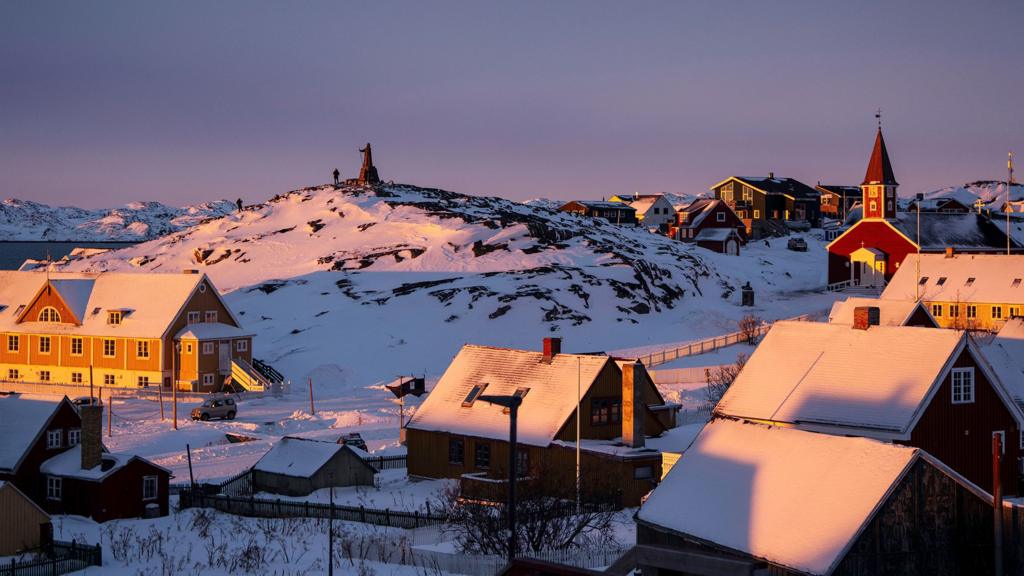
Former U.S. President Donald Trump has announced the existence of a “framework of a future deal with respect to Greenland.”
This statement, issued Wednesday, comes as a surprise following weeks of escalating tensions, including a suggestion of military action to acquire the semi-autonomous territory belonging to Denmark, a NATO ally.
The central questions now are: What could this deal entail, and will it be acceptable to Denmark and Greenland, both of which have firmly stated they will not cede sovereignty over the world’s largest island in the Arctic?
President Trump made the announcement after discussions at the World Economic Forum in Davos, Switzerland.
“Based upon a very productive meeting that I have had with the Secretary General of NATO, Mark Rutte, we have formed the framework of a future deal with respect to Greenland,” he stated on his Truth Social media platform.
While details were not provided, he indicated that talks would continue to finalize the agreement.
Rutte clarified that the crucial matter of Danish sovereignty over Greenland was not discussed during his meeting with Trump.
Danish Prime Minister Mette Frederiksen has stated that while negotiation is possible on various aspects, “we cannot negotiate on our sovereignty.”
Greenland’s prime minister echoed this sentiment, emphasizing that sovereignty is “a red line.” Notably, Jens-Frederik Nielsen stated he was unaware of the specifics of the deal under discussion.
Citing unnamed officials, The New York Times reported one potential concept involved Denmark relinquishing sovereignty over limited areas of Greenland for the establishment of U.S. military bases.
This arrangement would mirror the status of two bases in Cyprus, which have remained under UK sovereignty since Cyprus’s independence in 1960.
However, it remains unclear how this model could be implemented if both Denmark and Greenland maintain their refusal to cede sovereignty.
In advocating for acquiring Greenland, Trump has cited the purported threat posed by Chinese and Russian vessels operating near the island, despite Denmark’s assertion that no such threat exists “today.”
In response, NATO allies have attempted to reassure the U.S. of their commitment to bolstering Arctic security, with Mark Rutte stating that the framework deal will necessitate this contribution.
“I have no doubt we can do this quite fast. Certainly I would hope for 2026, I hope even early in 2026,” he said on Thursday.
UK Foreign Secretary Yvette Cooper said the UK had called for setting up an Arctic Sentry “very similar to the approach that Nato has taken to the Baltic Sentry” – a mission to increase the surveillance of ships in the Baltic Sea.
Under a 1951 agreement with Denmark, the U.S. has the authority to deploy an unlimited number of troops to Greenland. Currently, over 100 U.S. military personnel are permanently stationed at the Pituffik base in the territory’s northwest.
According to U.S. officials, discussions aimed at reaching a deal may focus on renegotiating this existing agreement.
Underlying these negotiations is Trump’s desire to “own” Greenland.
If his vision were to be realized, negotiators would not only need to overcome the objections related to sovereignty but also address the constitutional prohibition against the sale of land in Greenland.
One potential model is the U.S. naval base at Guantánamo Bay in Cuba, which has been under complete U.S. control since 1903 through a perpetual lease agreement.
It remains unclear whether these considerations contributed to Trump’s shift in stance at Davos, leading him to abandon the threat of military action to annex Greenland, much to the relief of NATO allies.
NATO was founded in 1949 on the principle that an attack on one ally is an attack on all. Denmark has made it clear that a military attack by an ally on another would spell the end of the trans-Atlantic alliance, where the US is the major partner.
The fact that Trump’s announcement of a “framework” came after he met Mark Rutte has prompted some concern in Greenland that negotiations on their future were being conducted in their absence.
On Thursday, Greenland’s Foreign Minister Vivian Motzfeldt said his government had not asked him to negotiate on their behalf but to convey “the red lines directly to President Trump”.
Rutte has not confirmed this has been the case.
He has been criticised for the praise he has constantly showered on President Trump.
Trump maintains that Greenland is vital to his plan for building a Golden Dome defense system, intended to protect the U.S. from missile attacks by Russia and China, suggesting that European allies could participate in this effort.
The island possesses significant, largely untapped reserves of rare earth minerals, many of which are essential for technologies such as mobile phones and electric vehicles.
Trump has not stated that the U.S. seeks Greenland’s resources but argues that U.S. control over the island “puts everybody in a really good position, especially as it pertains to security and to minerals.”
You can also send us your questions by following this link
The gun-lobby group, typically aligned with Trump, criticises a suggestion that those who carry guns risk being lawfully shot.
BBC Verify has analysed footage of the shooting from multiple angles, piecing together a detailed picture of what happened.
As the widely anticipated storm hits around half the US states, scientists and officials are warning of “life threatening” conditions.
Federal and state authorities have offered conflicting versions of what happened in the moments leading to the shooting.
A powerful winter storm swept across the country, with heavy snow, ice and dangerously low temperatures affecting millions.