

“`html
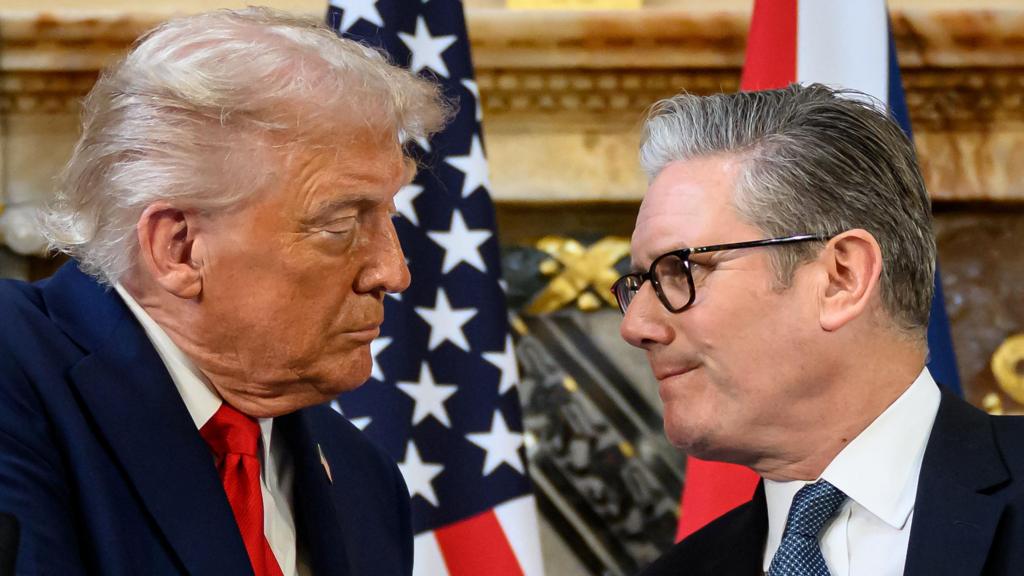
Sir Keir Starmer conveyed to Donald Trump during a phone call on Sunday that the imposition of tariffs on allies opposing a potential U.S. takeover of Greenland would be “wrong,” according to Downing Street.
This marks the first dialogue between the two leaders since the U.S. President declared intentions to levy a 10% tariff on goods imported from eight European nations, including the UK, pending an agreement on the U.S. acquisition of the island.
The White House has intensified its appeals for U.S. control over the autonomous Danish territory, citing national security concerns, a move that has alarmed both European allies and the island’s inhabitants.
Sir Keir has consistently asserted that the future of Greenland must be determined by its own people and the citizens of Denmark.
Following the conversation, a Downing Street spokeswoman stated that the Prime Minister informed Trump that “security in the high north is a priority for all NATO allies in order to protect Euro-Atlantic interests.”
“He also stated that applying tariffs on allies for pursuing the collective security of NATO allies is wrong.”
She added that Sir Keir had consulted with his Danish counterpart, Mette Fredriksen, European Commission President Ursula von der Leyen, and NATO Secretary General Mark Rutte prior to his call with Trump.
Denmark has emphasized that Greenland is not for sale and that an attack on its territory would signify the end of the NATO military alliance, while Greenland has expressed its preference to remain Danish rather than become American.
The eight countries targeted by Trump’s tariff plan issued a joint statement on Sunday, asserting that the threatened levies “undermine transatlantic relations and risk a dangerous downward spiral.”
The statement—from Denmark, Finland, France, Germany, the Netherlands, Norway, Sweden, and the UK—affirmed that these nations “stand in full solidarity with the Kingdom of Denmark and the people of Greenland” while underscoring their commitment to Arctic security.
Trump has repeatedly argued that Denmark lacks the capacity to protect Greenland from potential threats posed by nations like Russia and China.
While he has not dismissed the possibility of acquiring the territory by force, his administration has indicated that its primary approach is to purchase it.
Trump’s plan, announced on Saturday, entails the implementation of a 10% tariff on goods from the eight countries starting February 1, which could escalate to 25% from June 1, until an agreement is reached.
Sir Keir’s intervention in this matter represents a rare public rebuke of a U.S. President with whom he has, until now, maintained a strong relationship.
Earlier, Culture Secretary Lisa Nandy told the BBC’s Sunday with Laura Kuenssberg that Trump’s tariff threat was “deeply unhelpful and counterproductive,” and that an “adult debate” with the White House was needed.
She suggested that Trump often “expresses a very strong view” before encouraging “dialogue,” adding: “He welcomes difference of opinion… and what often happens is a negotiation.”
Nandy also stated that the UK would not compromise its position on Greenland’s future, which she characterized as “non-negotiable.”
The UK has previously managed to avoid or minimize U.S. tariffs, and Sir Keir has acted as a key intermediary between Washington and Europe in efforts to end the war in Ukraine; however, his government has firmly sided with Denmark regarding the ownership of Greenland.
Trump has long expressed his desire to gain control of the Arctic island, and his administration appears to have been emboldened by the successful capture of Venezuela’s President Nicolas Maduro at the beginning of January.
U.S. House Speaker Mike Johnson told the BBC before the tariffs were announced that he accepted Greenland was “not our land” but that it had “strategic importance to us.”
“I don’t foresee military intervention,” he said, adding diplomatic channels were “the way to go.”
Trump’s announcement has drawn criticism across the UK’s political spectrum.
Shadow Foreign Secretary Dame Priti Patel described the U.S. President’s tariff threat as “completely wrong” and “counterproductive,” harming families and businesses in both the UK and the US.
Conservative MP Sir Jeremy Hunt told Laura Kuenssberg that he did not believe Trump would “actually follow through” on annexing Greenland.
“To invade the sovereign territory of a NATO ally would mean the end of NATO—and that would actually make America weaker.”
Reform UK’s Deputy Leader Richard Tice stated that while “the objective of protecting Greenland for all NATO allies is correct, the way [Trump] is going about it is completely wrong.”
Liberal Democrat leader Sir Ed Davey earlier said Trump was “punishing the UK and NATO allies just for doing the right thing,” while the Green Party’s parliamentary leader Ellie Chowns called the decision “unhinged.”
Greenland’s location between North America and the Arctic makes it well-placed for early warning systems and for monitoring vessels in the region.
The US already has more than 100 military personnel stationed at its missile-monitoring station on Greenland and, under existing agreements with Denmark, it has the power to station as many troops as it wants there.
But in recent years, there has been increased interest in Greenland’s natural resources – including rare earth minerals, uranium and iron – that are becoming easier to access as climate change thaws its ice sheet.
Several European nations have rallied to support Denmark.
The UK sent a military officer to Greenland earlier this week as part of a so-called reconnaissance mission that also included personnel from the other European nations now facing the possibility of new tariffs.
Trump said on Saturday that they were “playing a very dangerous game” and had put the “Safety, Security, and Survival of our Planet” at risk.
The eight nations said in their joint statement on Sunday: “As members of NATO, we are committed to strengthening Arctic security as a shared transatlantic interest.”
The planned, Danish-led exercise “responds to this necessity” and “poses no threat”, it added.
“We will continue to stand united and co-ordinated in our response. We are committed to upholding our sovereignty.”
Tariffs are taxes on foreign products paid to the government imposing them by the companies importing them, not the exporting countries themselves.
However, the levies can harm those economies as those companies may decide to import fewer products due to the extra cost.
The government has launched a consultation on how the BBC should be funded in the future.
The prime minister has apologised for signing off the appointment of a Labour donor to the watchdog role.
Ian Byrne sends a letter to Lisa Nandy over the decision to interview the former Sun editor..
Report finds that new football regulator chair David Kogan had made two separate donations of £1,450 to the culture secretary.
The broadcaster’s chair is set to issue a response to a parliamentary committee over claims a Panorama documentary misled viewers.
“`