

“`html
Greenland may share little beyond snow and cold with the Swiss Alps, but its future is a key issue looming over the gathering of global leaders and businesses at this week’s World Economic Forum (WEF).
The timing of Donald Trump’s controversial proposition regarding Greenland appears strategically aligned with this high-profile meeting.
Trump’s affinity for Davos is somewhat paradoxical, given the sentiments of his core support base.
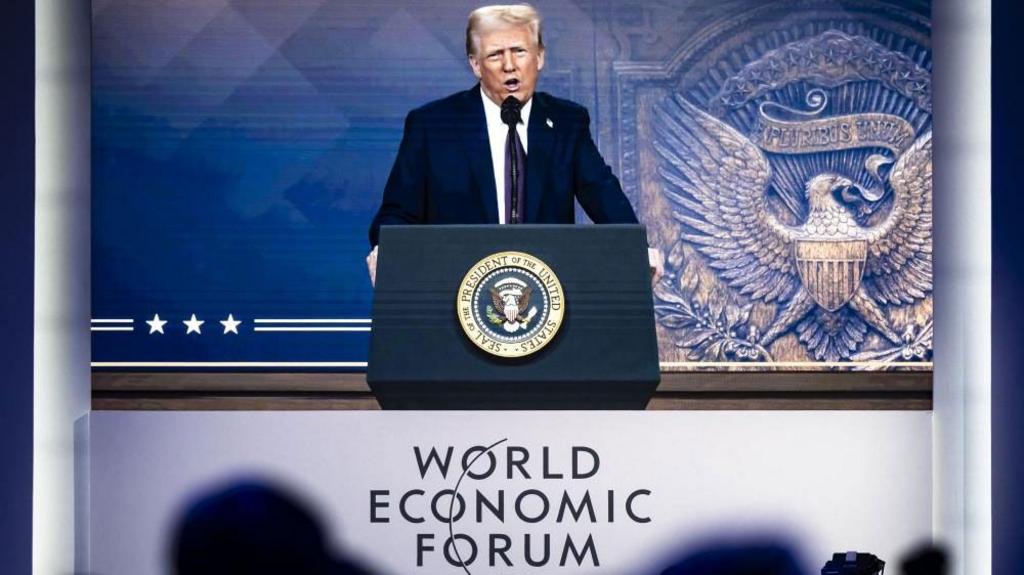
Last year, he addressed the WEF remotely from the White House, presenting himself to an audience of largely perplexed European executives just two days after his inauguration.
An air of unease filled the room as he alluded to his territorial ambitions for Canada and Greenland, extending an “offer you can’t refuse” to those importing into the U.S.: establish factories domestically or face tariffs that could generate trillions. “Your prerogative,” he stated.
He delivered this message with a smile, apologized for his absence, and pledged to attend this year’s forum.
On Wednesday, he is expected to champion the “Team USA” message amidst global uncertainty, particularly in Europe. Trump’s presence and policies are set to drive the largest Davos gathering to date, potentially triggering what a WEF session might term “The Great Global Disruption.”
Trump is, undeniably, the chief disruptor at present. He will likely face scrutiny from world leaders and corporate executives regarding his attempts to economically influence Europe concerning Greenland. This year’s Forum promises to be both a global focal point and a source of considerable unease.
“A spirit of dialogue” is the official theme. While the event undoubtedly fosters unique opportunities for conversation, the U.S. administration’s approach often seems at odds with the call for global cooperation that defines Davos.
After all, Davos doesn’t align seamlessly with the “Make America Great Again” (MAGA) ethos.
The conference in the Swiss Alps frequently faces criticism, exemplified by Florida Governor Ron DeSantis’ claim that his state is where the “Davos agenda is dead on arrival,” promising to resist its “woke banks” and “lab grown meat.”
This year, suggestions have surfaced that the White House has encouraged the Forum to downplay its customary emphasis on green initiatives, global development, and “woke” agendas in favor of more pragmatic business concerns.
Concurrently, America’s leading corporations have been mobilized to create a “USA House” in a church, providing a venue for delegates to celebrate the World Cup and the 250th anniversary of U.S. independence.
Given the global disputes over borders and sovereignty, from Greenland to Caracas to the Donbas, and the presence of numerous world leaders, the possibility of a summit reminiscent of Yalta – the 1945 meeting where leaders from the U.S., UK, and Russia convened to strategize the defeat of Germany – cannot be entirely dismissed.
The majority of G7 leaders are expected to attend, as is Ukrainian President Zelensky, along with 65 other heads of state and government, 850 of the world’s top executives, and numerous tech innovators.
Trump himself will arrive in the Swiss Alps accompanied by five cabinet members, a sizable entourage of administration officials, and leading figures from the U.S. business community, including Nvidia’s Jensen Huang and Microsoft’s Satya Nadella.
However, this is not inherently friendly territory for the U.S. president. His veiled remarks about acquiring or even invading Greenland are unlikely to resonate positively with a European audience.
Instead, Canadian Prime Minister Mark Carney may embody the vision of North America that Europe finds more appealing. Carney has navigated nearly a year of U.S. trade turbulence with a growing economy, diversifying trade partnerships, and was recently seen advocating for a new world order to protect multilateralism alongside Xi Jinping in China.
Chinese representatives, at the finance minister level, will also be present, presenting their nation – the world’s second-largest economy and now the leading car exporter – as a stabilizing force. Each year, they appear to subtly emphasize their steady economic, technological, and geopolitical advancement.
Let’s not forget the lessons of last year’s Davos, where U.S. triumphalism on Tuesday was quickly overshadowed by news of a groundbreaking Chinese AI chatbot called DeepSeek by the end of the week.
It was at Davos a decade ago that I first learned about quantum computing.
Then, last year, a session on car batteries left me convinced that U.S. and European car manufacturers were unlikely to catch up with Chinese technology within this decade.
While Davos attracts its share of critics, it remains an event worth observing, as glimpses of the future can often be found within its most prominent spaces.
After sending Trump to the White House in a historic shift, some Latinos feel he’s not improving the economy.
Trump’s volatile trade policy has thrown the world economy into chaos, and put some US prices up.
It comes as fresh details emerged in the death of a Minneapolis woman shot last week by an ICE agent in the city.
John Swinney says additional duties should not be used as a “bargaining chip” in discussions between trade partners.
The US president says several European allies opposed to his plans to buy Greenland will face 10% tariffs from February.
“`