

“`html
Warning: This article contains graphic descriptions of death and injury
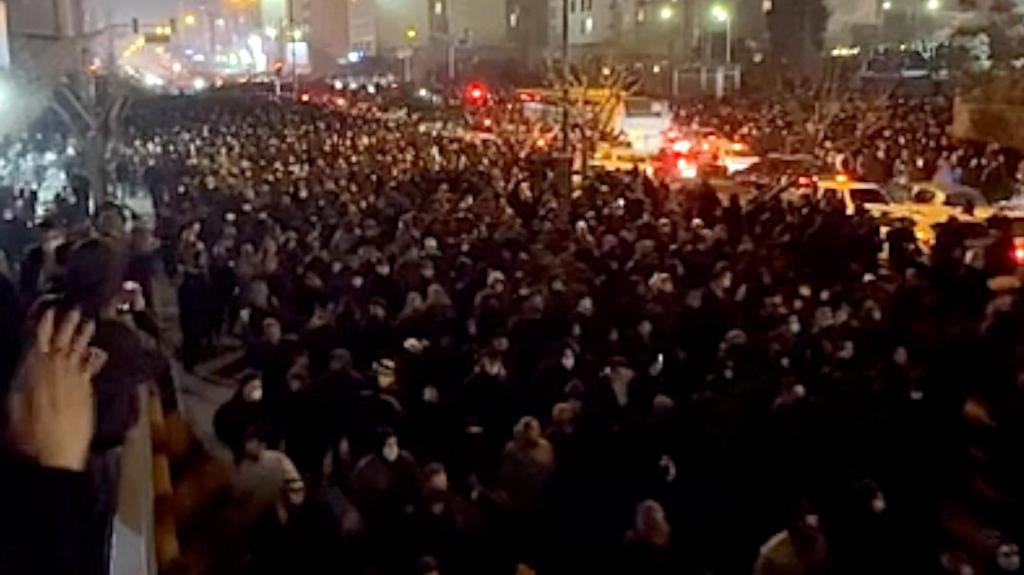
On January 8th, while returning home from a protest in Tehran, Reza embraced his wife Maryam to shield her. “Suddenly, I felt my arm go light – there was only her jacket in my hands,” he recounted to a family member, who subsequently spoke with BBC Persian. Maryam had been fatally shot, with the origin of the bullet unknown.
Reza carried Maryam’s body for an arduous hour and a half. Overcome with exhaustion, he sought respite in an alley. Shortly thereafter, a nearby residence opened its doors. The occupants sheltered them in their garage, providing a white sheet to shroud Maryam’s body.
In the days leading up to Maryam’s participation in the protests, she had spoken with her children, aged seven and 14, about the unfolding events in their nation. “Sometimes parents go to the protests and don’t come back,” she had said. “My blood, and yours, is no more precious than anyone else’s.”
Reza and Maryam’s names have been altered to ensure their safety.
Maryam is among the thousands of protesters who tragically never made it home, as authorities responded to the escalating demonstrations across Iran with a brutal crackdown.
The Iranian Human Rights Activists News Agency (HRANA), based in the United States, reports confirming the deaths of at least 2,400 protesters, including 12 children, in the past three weeks.
Ascertaining the precise death toll remains exceedingly difficult, and it is anticipated to rise in the coming days. This is due to a near-total internet blackout imposed by Iranian authorities since Thursday night.
Human rights organizations lack direct access to the country, and the BBC, along with other international news outlets, is unable to report from the ground.
While Iranian authorities have not released an official death toll, local media outlets report that 100 security personnel have been killed. Protesters, portrayed as “rioters and terrorists,” are accused of setting fire to numerous mosques and banks across various cities.
The demonstrations originated in Tehran, the capital, on December 29th, sparked by a sharp decline in the value of the Iranian currency against the US dollar. As the protests spread to dozens of other towns and cities, they evolved into expressions of opposition against Iran’s clerical leadership.
Security forces swiftly initiated a violent crackdown, with reports indicating that at least 34 protesters had been killed by January 7th, the 11th day of the unrest. However, the most intense period of repression appears to have occurred last Thursday and Friday, as thousands took to the streets nationwide, demanding an end to the rule of Supreme Leader Ayatollah Ali Khamenei.
BBC Persian has received numerous accounts from within Iran. Defying potential repercussions, witnesses conveyed their desire to ensure the global community is aware of the violence inflicted upon protesters.
“Our neighbourhood smells of blood – they killed so many,” one individual shared with BBC Persian. Another recalled security forces “mostly shooting at heads and faces”.
The protests have extended across all 31 provinces. Emerging information strongly suggests that the scale of killings in smaller cities and towns is equally severe as in major urban centers.
In Tonekabon, a town of 50,000 residents in the north, 18-year-old university student Sorena Golgun was killed on Friday. According to a family member, he was “shot in the heart” while fleeing an ambush by security forces.
Like Sorena, many of the other protesters who lost their lives were young individuals with aspirations. Robina Aminian, a 23-year-old fashion design student with aspirations of studying in Milan, was fatally shot in Tehran on Thursday.
Her mother endured a six-hour journey from their home in the western city of Kermanshah to retrieve Robina’s body from Tehran. During the return trip, she cradled her beloved daughter in her arms. Upon arrival, however, security forces compelled her to bury the body in a remote cemetery outside the city, with no other family or friends present.
Not all those killed were protesters. Navid Salehi, a 24-year-old nurse in Kermanshah, was shot multiple times as he left work on Thursday.
The bodies of numerous protesters were transported to the Kahrizak Forensic Medical Centre in Tehran.
The scenes witnessed there were so harrowing that Sahanand, who wished to remain anonymous, decided to travel nearly 1,000km to a border region to disseminate video footage using the mobile data networks of neighboring countries. On Saturday, he reportedly saw over 2,000 bodies lying on the ground.
The BBC has no independent means of verifying this claim. However, in two recently surfaced videos from Kahrizak, BBC Verify and BBC Persian have counted at least 186 bodies in one video and at least 178 in the other. It is possible that the videos show some of the same bodies, preventing a definitive count, but the true number is likely to be significantly higher.
One young woman, speaking to BBC Persian anonymously, described last week’s events as resembling “a war”. While protesters remained “more united than ever before,” she felt overwhelmed and fled the country this week, joining many others gripped by fears of a new wave of executions and prosecutions by the authorities.
“I’m really afraid of what might happen to those who are still in Iran,” she added.
Additional reporting by Farzad Seifikaran and Hasan Solhjou
“`