

“`html
As of Wednesday, Burmese democracy icon Aung San Suu Kyi will have spent two decades in detention in Myanmar, with five years elapsing since the military coup of February 2021 ousted her government.
Details regarding her health and living conditions remain scarce, though she is believed to be held in a military prison in Nay Pyi Taw, the capital. “For all I know she could be dead,” her son Kim Aris stated last month, a claim countered by a military junta spokesman who insisted she is in good health.
She has been denied access to her legal counsel for at least two years and is not known to have met with anyone outside of prison staff. Following the coup, she received cumulative jail sentences totaling 27 years, widely viewed as the result of fabricated charges.
Despite her absence from the public sphere, her influence in Myanmar remains significant.
Calls for her release are persistent, accompanied by appeals to the ruling generals to cease their destructive campaign against the armed opposition and negotiate a resolution to the ongoing five-year civil war.
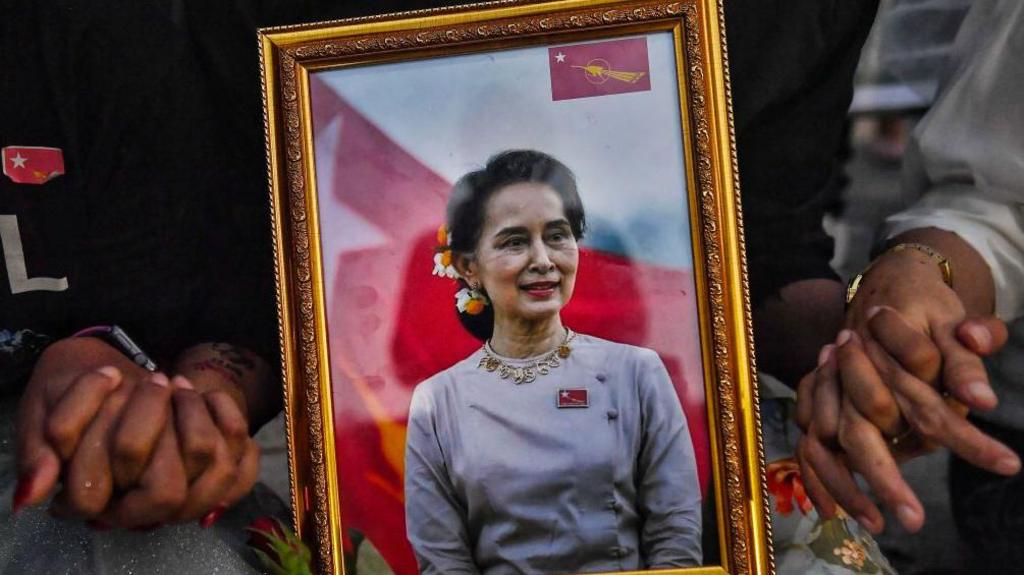
While the military has attempted to erase her once-ubiquitous image, glimpses of faded posters depicting “The Lady,” or “Amay Su” (Mother Su), as she is affectionately known, can still be found. The question remains: could she still play a role in mediating the conflict between the military and the people of Myanmar?
History offers a potential parallel. In 2010, after nearly five decades of military rule characterized by brutal suppression of opposition and economic mismanagement, the regime, as it is doing now, orchestrated a general election. This election excluded Aung San Suu Kyi’s popular National League for Democracy (NLD), ensuring victory for its proxy party, the USDP.
Similar to the current election, which is being conducted in phases, the 2010 election was widely condemned as a sham. However, at the end of that year, Aung San Suu Kyi was released, and within 18 months, she was elected to Parliament. By 2015, her party secured victory in the first free election since 1960, making her the de facto leader of the country.
The transition appeared to be a near-miraculous shift towards democracy, suggesting the possibility of genuine reformers within the ranks of the seemingly unyielding generals.
Could a similar scenario unfold after the junta completes its three-stage election at the end of this month?
Much has changed since then.
Years of engagement between the generals and UN envoys explored avenues to end their pariah status and reintegrate with the international community. It was a more optimistic period, with the generals observing the economic prosperity of their Southeast Asian neighbors through trade with the West, and seeking an end to debilitating economic sanctions.
They also aimed to improve relations with the U.S. as a counterbalance to their reliance on China, coinciding with the Obama administration’s “pivot” to Asia.
While the top generals remained hard-line and suspicious, a group of less senior officers showed interest in exploring a political compromise.
The precise factors that motivated the military leadership to open up the country remain unclear. However, they evidently believed that their 2008 constitution, which guaranteed the armed forces one-quarter of the seats in a future parliament, combined with their well-funded party, would be sufficient to limit Aung San Suu Kyi’s influence after her release.
They significantly underestimated her popularity and the extent to which decades of misrule had alienated the population.
In the 2015 election, the USDP secured just over 6% of the seats in both houses of parliament. In the subsequent election in 2020, they anticipated a stronger performance, following five years of an NLD administration that began with unrealistically high expectations and inevitably disappointed many. However, the USDP fared even worse, winning only 5% of seats in the two houses.
Even those dissatisfied with Aung San Suu Kyi’s performance in government still preferred her party over the military’s. This raised the possibility that she might eventually garner enough support to amend the constitution and end the military’s privileged position.
It also dashed Commander-in-Chief Min Aung Hlaing’s hopes of becoming president after his retirement. He launched his coup on February 1, 2021, the day Aung San Suu Kyi was scheduled to inaugurate her new government.
This time, there are no reformers within the ranks, and no prospect of the type of compromise that restored democracy in 2010. The shocking violence used to suppress protests against the coup has prompted many young Burmese to take up arms against the junta. Tens of thousands have been killed, and tens of thousands of homes have been destroyed. Attitudes on both sides have become more entrenched.
The 15 years Aung San Suu Kyi spent under house arrest in her Yangon home after 1989 were markedly different from her current detention. Her dignified, non-violent resistance earned her admirers across Myanmar and globally. During the periods of freedom granted by the military, she delivered stirring speeches from her front gate and gave interviews to journalists.
Today, she is unseen and unheard. Her long-held belief in non-violent struggle has been rejected by those who have joined the armed resistance, who argue that they must fight to end the military’s role in Myanmar’s political life. Criticism of Aung San Suu Kyi’s governance is now more prevalent than before.
Her decision to defend Myanmar against charges of genocide at the International Court of Justice regarding the military’s atrocities against Muslim Rohingyas in 2017 significantly tarnished her international image. While it resonated less within Myanmar, many younger opposition activists are now willing to condemn her handling of the Rohingya crisis.
At the age of 80, with uncertain health, the extent of her influence, even if released and willing to play a central role, remains unclear.
Yet, her long struggle against military rule has made her synonymous with the hopes for a freer, more democratic future.
There is simply no other figure of her stature in Myanmar, and for that reason alone, many would argue that she remains essential to charting a path out of the country’s current impasse.
It comes one day after a crane accident in another part of the country killed 32 people.
Singh, the leader of the Workers’ Party, was stripped of his title after being convicted of lying to MPs.
A severe cold snap tightens its grip, leaving millions shivering across northern India.
Singh, who was convicted for lying to MPs, has always maintained his innocence.
The ship, which has no engine and moves under square sails, retraced the ancient route in 17 days.
“`