

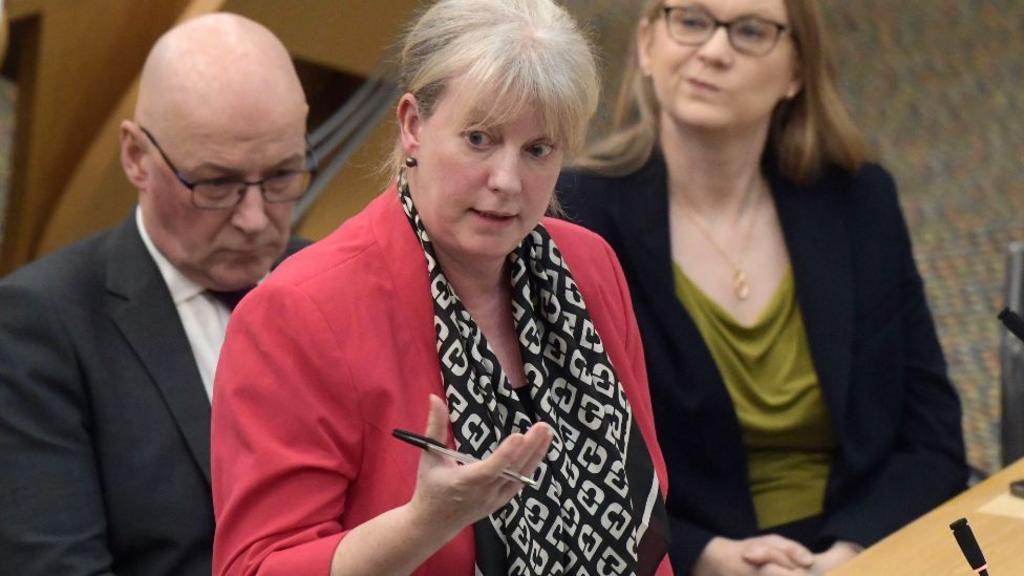
The Scottish government has unveiled its fiscal blueprint, outlining planned revisions to income tax thresholds as part of the Budget for 2026-27.
Finance Secretary Shona Robison stated that the proposed changes would result in 55% of Scottish taxpayers paying less income tax compared to residents in the rest of the UK for the upcoming fiscal year.
In addition to income tax adjustments, Robison announced plans to increase taxes on properties valued at over £1 million and to raise the Scottish Child Payment.
While opposition Members of the Scottish Parliament (MSPs) acknowledged certain positive aspects of the Budget, concerns were raised that it lacked comprehensive reforms.
The £68 billion Budget, which delineates financial strategies for the coming year and beyond, is being presented just months before the Holyrood elections.
While Robison asserted that the proposed tax and spending measures would alleviate financial strain on families, economists have noted the presence of significant spending cuts.
Currently, Scottish taxpayers earning below approximately £30,000 benefit from slightly lower income tax rates compared to the rest of the UK, while those earning above this threshold face progressively higher rates.
The UK government sets the threshold at which individuals begin paying income tax.
Above that threshold, the Scottish government operates three lower tax bands: starter, basic, and intermediate.
Robison stated her intention to raise the thresholds for the basic and intermediate rates, thereby subjecting a larger portion of earnings to the lower 19% starter rate.
The basic rate (20%) threshold, currently at £15,398, will increase by 7.4% to £16,537.
The intermediate rate (21%), which currently begins at £27,492, will rise to £29,527.
However, the higher rate (42%) threshold will remain at £43,663, and the advanced (45%) and top (48%) rates will also remain unchanged.
Consequently, Scottish taxpayers earning less than £33,500 will experience a marginal reduction in income tax compared to their counterparts in the UK, up to a maximum of £40 per year.
Conversely, those earning more than £33,500 will face increasingly higher tax burdens. For instance, an individual earning £50,000 will pay approximately £1,500 more in taxes compared to someone earning the same amount south of the border.
The government aims to ensure that most Scottish taxpayers pay less income tax than they would elsewhere in the UK.
However, Robison’s projection that 55% of Scots will be better off is predicated on salary forecasts for the upcoming financial year. This introduces the possibility that the government’s objectives may not align with actual outcomes, a concern highlighted in prior fiscal years, as previously noted.
Robison also informed parliament of the introduction of two new council tax bands, effective April 2028, for properties with a current valuation exceeding £1 million.
She stated that this measure would promote “greater fairness while also increasing revenues for local councils.”
Public Finance Minister Ivan McKee told BBC Radio Scotland Drivetime that the measure would generate about £14m in revenue.
While the Scottish government establishes the overall framework for council tax, local authorities are responsible for setting, administering, and allocating the rates.
Robison’s announcement follows the UK government’s recent unveiling of plans for a “mansion tax” on properties in England valued at over £2 million.
Robison also announced:
During her speech, Robison said: “To deliver even more for those with the least, we will ask those with the most, the very wealthiest in our land, to contribute that little bit more.”
She told MSPs: “This is a budget for a stronger NHS, a budget for a more prosperous Scotland, a budget that once again gives the people of Scotland the best cost-of-living deal anywhere in the UK.”
The Scottish Fiscal Commission estimates that the income tax changes will generate £72 million in 2027-28 and approximately £200 million from 2028-29.
Joao Sousa, deputy director of the Fraser of Allander Institute, said the government was actually cutting day-to-day spending by £480m compared to financial plans announced in June.
He said this was largely due to much weaker underlying tax forecasts from the Scottish Fiscal Commission.
The government has also cut its capital budget – used for long-term infrastructure projects – by £850m, according to Sousa.
Scottish Conservative finance spokesman Craig Hoy welcomed the freezes to lower tax thresholds but said it did “nothing” for middle earners.
He also urged the government to go further in rates relief for businesses.
Hoy said the Budget “prioritises welfare over work with £650m extra being spent in the social justice portfolio”.
He added: “This SNP government remains high on tax and low on delivery.”
Labour finance spokesman Michael Marra said the government’s proposals would not deliver “real change”.
“They want to pretend on their own abysmal record, in reality they have decimated Scotland’s finances and brought our services to their knees.”
The Scottish Greens, who had called for a “mansion tax”, also welcomed an increase to wraparound care for children and support for workers affected by the closure of the Exxon Mobil plant at Mossmorran.
However, co-leader Gillian Mackay said she was “disappointed” that rules on free childcare eligibility had not been changed.
Liberal Democrat finance spokesman Jamie Greene welcomed business rates relief but called on more to be done to help struggling companies.
The Scottish government will table its plans in a budget bill later this week.
MSPs will begin debating the proposals early next month. A final vote on whether to pass the bill into law is scheduled for 25 February.
The government would need the votes of five other MSPs to get to a true majority of 65 – or they could try to reduce the numbers on the other side by convincing MSPs to abstain.
Last year, the Budget was passed with the support of Green and Liberal Democrat MSPs, who negotiated concessions with the government.
Labour have said they will not make the Budget fall – though they could still vote against it if the SNP have already agreed a deal with the Greens or LibDems.
Sarwar said he was focused instead on ensuring a new administration was in place following May’s Holyrood election.
If that is the case, the new government could make some changes to spending plans in an emergency budget.
However, it would be unable to change some major announcements, such as those on income tax, until the next financial year.
The Berwick Bank wind farm in the outer Firth of Forth will contain up to 307 turbines generating enough electricity to power up to six million homes.
Former Scottish Premiership and international player Iain Jenkins was operated on by Eljamel in 1999.
The police, fire service and prison service had all asked for extra funding to strengthen their numbers and resources.
The university makes an admissions call to aspiring students for its new branch campus in Mumbai.
A review of the front page stories from the daily newspapers in Scotland.