

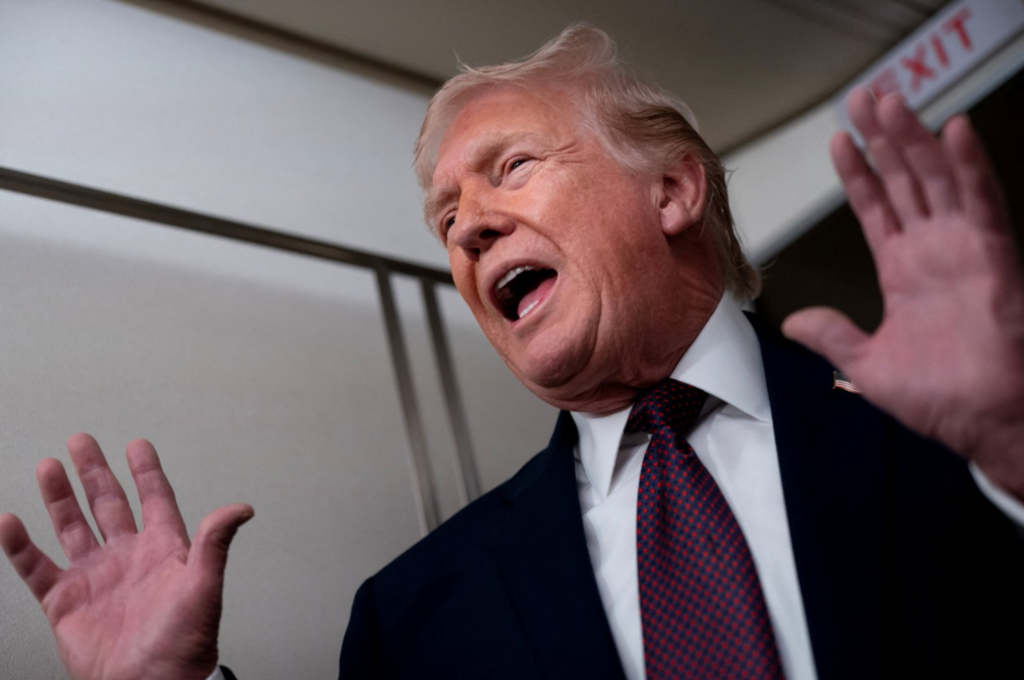
Shares of banks and credit card companies have declined following a call from U.S. President Donald Trump to limit credit card interest rates.
President Trump stated on Truth Social Friday that interest rates on credit cards should be capped at 10% for a one-year period starting January 20th.
The president did not elaborate on how such a limit would be implemented or whether it would be legally enforceable.
In early trading, shares in major U.S. credit card issuers American Express, Visa, and Mastercard experienced declines. Barclays, a U.K. bank with a substantial U.S. card business, saw its shares fall by 1.9% at the close of trading in London.
U.S. banking associations have responded that capping rates would restrict access to credit and prove “devastating” for many families and small businesses.
The average interest rate on credit cards in the U.S. currently stands at approximately 20%.
In his social media post, President Trump advocated for a 10% limit, reviving a proposal from his 2024 presidential campaign.
“Effective January 20, 2026, I, as President of the United States, am calling for a one year cap on Credit Card Interest Rates of 10%,” he wrote. “Please be informed that we will no longer let the American Public be ‘ripped off’ by Credit Card Companies.”
On Sunday, speaking to reporters aboard Air Force One, President Trump asserted that credit card companies would be “in violation of the law” if they failed to comply with his demands.
American Express shares initially dropped by 4%, while Visa and Mastercard experienced declines of over 2%. Other major U.S. lenders, including JPMorgan Chase and Bank of America, also saw their shares open more than 1% lower.
According to Matt Britzman, senior equity analyst at Hargreaves Lansdown, forcing companies to reduce their lending rates would “upend the basic economics of the industry.”
“Most banks would respond by cutting credit limits, closing riskier accounts, and scaling back rewards programmes, because they simply couldn’t cover losses at that price point.”
Data from the Federal Reserve’s most recent survey of consumer finances indicates that nearly half of U.S. households carried credit card debt in 2022.
The survey revealed that those with a balance owed an average of over $6,000 (£4,454), translating to roughly $100 in monthly charges with interest rates around 20%.
The concept of capping credit card rates has garnered support from a diverse coalition of lawmakers, ranging from progressives like Bernie Sanders to populists aligned with President Trump’s MAGA agenda.
However, the path to enacting the proposal remains unclear.
Similar initiatives have previously stalled in Congress. Furthermore, the administration has sought to diminish the role of agencies that have historically regulated such matters.
“Begging credit card companies to play nice is a joke,” Democrat Senator Elizabeth Warren stated on X.
“I said a year ago if Trump was serious I’d work to pass a bill to cap rates. Since then, he’s done nothing but try to shut down the CFPB [Consumer Financial Protection Bureau]”.
Analysts suggest that executive action by the White House would likely face legal challenges from the industry, which has previously succeeded in contesting regulations in court.
In a joint statement, five U.S. banking organizations affirmed their shared goal with the president “of helping Americans access more affordable credit.”
However, they cautioned that the proposed cap would “reduce credit availability and be devastating for millions of American families and small businesses who rely on and value their credit cards, the very consumers this proposal intends to help.”
“If enacted, this cap would only drive consumers toward less regulated, more costly alternatives.”
Early in 2023, Senators Sanders and Hawley introduced bipartisan legislation aimed at capping credit card interest rates at 10% for five years, but it has not yet been enacted.
In April 2025, the Trump administration initiated efforts to repeal a regulation limiting credit card late fees to $8. The rule had been implemented by President Joe Biden’s administration as part of a broader effort to combat “junk fees.”
A US-based rights group says it has confirmed the killing of 1,850 protesters during a crackdown by authorities, as the US president urges Iranians to keep demonstrating.
The BBC’s Europe editor Katya Adler hears from Greenlanders, whose island is embroiled in a geopolitical storm.
It is the strongest statement by a leader of the Danish territory since US President Donald Trump renewed plans to annex it.
As Iran’s deadly crackdown on anti-government protests continues, the US president is considering how best to respond.
The new body is part of the White House’s 20-point plan to end the war between Israel and Hamas.