

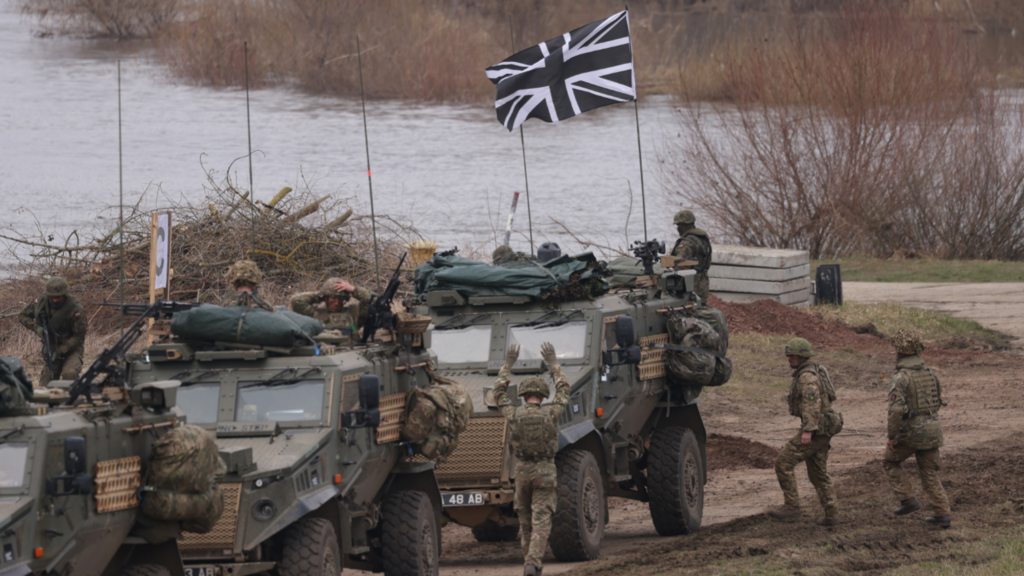
Sir Keir Starmer has committed to holding a parliamentary vote on the deployment of British troops to oversee any agreement aimed at ending the conflict in Ukraine.
The Prime Minister stated that this move would align with “recent practice” regarding parliamentary approval for military action.
This announcement follows the UK and France’s reaffirmed commitment to potentially deploy troops to deter further Russian aggression against Ukraine, contingent upon a peace accord.
Sir Keir has not specified the potential number of British troops involved, stating to MPs that deployments would be “in accordance with our military plans.”
During Prime Minister’s Questions, Sir Keir informed MPs that, in the event of a peace agreement, British personnel would conduct “deterrence operations” and safeguard new military “hubs” planned by allies within Ukraine.
While the Prime Minister did not explicitly state whether a vote would precede troop deployment, his press secretary later informed reporters that Parliament would have a say before any “long-term deployment” of UK forces.
However, the press secretary declined to comment on whether a Commons vote would be binding on the government should MPs reject the proposed deployment.
Legally, Parliament does not possess a formal role in approving military action, which is formally authorized by the Prime Minister on behalf of the monarch.
Over recent decades, a convention has emerged wherein MPs are afforded the opportunity to debate deployments, although this principle has not been consistently applied.
In 2013, MPs voted against potential UK military intervention in Syria to deter the use of chemical weapons, marking the first time since the late 18th century that a British leader lost a vote on military action.
Parliament was also consulted on action against the Islamic State group (IS) in Iraq in 2014, and in Syria the following year.
However, Theresa May authorized action in Syria in 2018 without parliamentary consultation, and more recently, Rishi Sunak and Sir Keir authorized RAF airstrikes against Houthi targets in Yemen without a vote.
On Tuesday, the UK and France signed a “declaration of intent” regarding the deployment of troops in Ukraine by air, land, and sea, following a summit in Paris.
The statement further indicated that Ukraine would authorize the UK, France, and other allies to employ “necessary means, including the use of force,” within its territory.
Allies also proposed that the US would take the lead in monitoring any potential truce.
However, full security guarantees have not been finalized, and the US, which has been at the forefront of efforts to end the war, reportedly did not sign such a pledge during the talks.
Tan Dhesi, Chairman of the Commons Defence Committee, welcomed the announcement but cautioned that “it intensifies the very real challenges our armed forces are already facing.”
“It also runs the risk of overstretching our armed forces and so calls into question the UK’s ability to sustain pre-existing commitments to our allies,” the Labour MP added.
During a Commons debate, both the Conservatives and Liberal Democrats also welcomed the announcement but emphasized the need for increased defence spending.
However, Reform UK leader Nigel Farage stated that “under the current terms, with the current strength of the British Army,” he would vote against the deployment of British soldiers to Ukraine.
“We neither have the manpower nor the equipment to go into an operation that clearly has no ending timeline,” he told Times Radio.
Farage indicated that he might consider supporting the move if more countries were involved, but added: “As it is, it will be us and the French completely exposed for an unlimited period of time.”
This follows nine months of planning discussions by a group of countries, known as the Coalition of the Willing, regarding security guarantees to be offered to Ukraine in the event of a deal, alongside separate negotiations to end the war itself.
Sir Keir stated that a deal to end the war “will not happen” without such guarantees in place, “backed by the United States.”
Moscow has repeatedly warned that any foreign troops in Ukraine would be considered a “legitimate target.”
Russian President Vladimir Putin initiated a full-scale invasion of Ukraine in February 2022, and Moscow currently controls approximately 20% of Ukrainian territory.
The Prime Minister’s comments followed the recent incident of shipping containers washing ashore in Sussex.
Some Labour MPs express optimism that further relief measures may be introduced to support the hospitality industry.
More than a year has passed since MPs initially endorsed the proposed legislation, but it still requires approval from the House of Lords.
The announcement was made by UK PM Sir Keir Starmer following a meeting of Ukraine’s allies in Paris.
The PM emphasizes the need for Labour to highlight its “renewal” of the country in contrast to Reform’s “grievance and division.”