

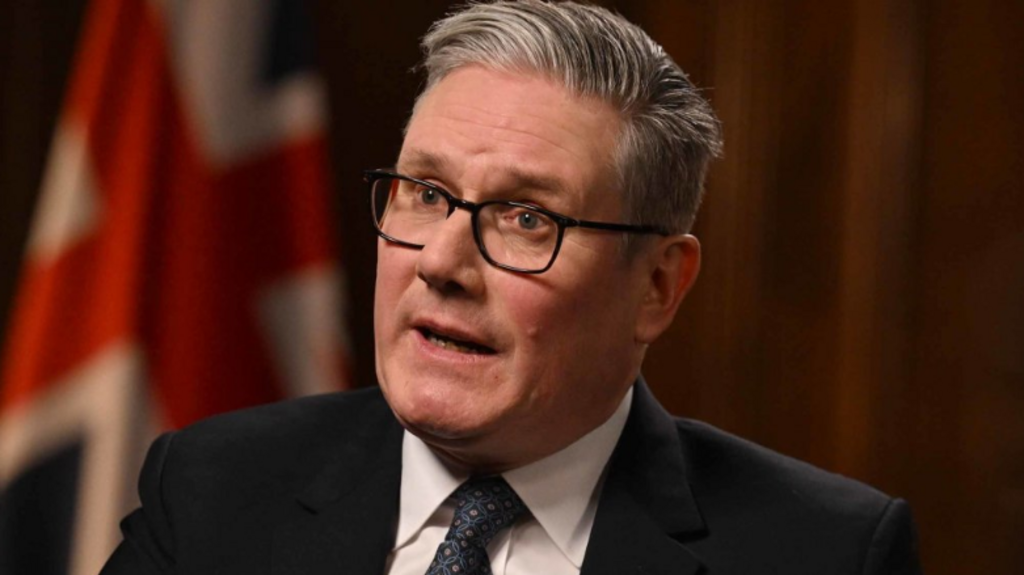
Sir Keir Starmer has indicated that the UK should pursue closer alignment with EU markets “if it’s in our national interest.”
Speaking to the BBC’s Laura Kuenssberg, the prime minister suggested that “looking to the single market rather than the customs union for our further alignment” would be preferable, citing the need to protect trade deals with India and the US.
However, he reaffirmed his commitment to manifesto pledges not to rejoin the EU single market or customs union, nor to reinstate freedom of movement.
These remarks represent the clearest signal to date that Sir Keir intends to foster a closer relationship with Europe across a wider range of policy areas.
The Conservative party has accused the Prime Minister of using Brexit as a scapegoat for the UK’s current economic challenges.
The UK is already harmonizing some regulations with Brussels, particularly in the areas of food and agriculture, to maintain access to the European single market.
Speaking to Laura Kuenssberg, Sir Keir stated: “I think we should get closer, and if it’s in our national interest to have even closer alignment with the single market, then we should consider that, we should go that far.”
“I think it’s in our national interest to go further.”
He added: “I actually think that now we’ve done deals with the US, which are in our national interest, now we’ve done deals with India which are in our national interest, we are better looking to the single market rather than the customs union for our further alignment. And it wouldn’t be in our interest now to give up.”
The prime minister emphasized that building closer economic ties was a “sovereign decision,” leading to the best relationship with the EU “for 10 years.”
“What I’m saying is, there are other areas where we should consider whether it’s in our interest to do the same and align with the single market,” he said.
“Now, that needs to be considered on an issue-by-issue, sector-by-sector basis, but we’ve already done it with food and agriculture and that will be implemented this year.”
Sir Keir’s remarks follow increasing pressure from within the Labour movement to pursue a customs union, with 13 backbenchers supporting proposals that would pave the way for such an arrangement in a Commons vote in December.
When reminded of his promise that “Brexit is safe in my hands,” the prime minister insisted that this was not an attempt to reverse it, as nobody wanted to be “picking over the bones of Brexit” but rather “looking forward” at what was in the national interest.
Separately, concerns have been raised that ongoing negotiations regarding a youth mobility scheme for British and EU students could ultimately require the UK to adopt the free movement of EU citizens.
Sir Keir clarified: “That is not the return to freedom of movement, we’re not going back to freedom of movement.”
“But I personally think that young people having that opportunity is a very good thing.”
“And when we announced just recently that we’re going back to the Erasmus scheme so that young people can study, exchange, research can be done in a much better way than it is now – that was widely welcomed.”
Conservative shadow foreign secretary Priti Patel asserted that Labour’s “Brexit betrayal” was becoming increasingly apparent and that Sir Keir would be “surrendering our freedom to cut regulation and strike our own trade deals” by pursuing closer alignment with the single market.
Speaking to BBC News, she also stated: “He’s unpicking and unravelling Brexit and this is another excuse for him, rather than fixing the fundamental problems that he has created and his government and his chancellor have created in the UK economy.”
Liberal Democrat MP Layla Moran, appearing on Sunday with Laura Kuenssberg, welcomed Sir Keir’s “warm language” regarding EU alignment, stating that her party had “long argued this is the direction we should be moving in.”
She stated that the government needed to be “shifting the big dials” on the economy but noted that the Lib Dems would prioritize the customs union over the single market, as they believed the UK could not re-enter the latter without allowing free movement.
At the end of last year, Paul Nowak, the UK’s most senior trade unionist, told the BBC that “the closest possible economic and political relationship with the European Union” was “essential” to bolster economic growth.
Deputy prime minister David Lammy also mentioned on the News Agents podcast last month that rejoining the EU’s customs union was “not currently our policy,” but he highlighted that Turkey had experienced growth as a result of its collaboration with the bloc.
Turkey’s agreement excludes agricultural goods and services but eliminates point-of-origin checks, which have proven challenging for the post-Brexit UK, and has been suggested as a potential alternative for the UK.
Sign up for our Politics Essential newsletter to read top political analysis, gain insight from across the UK and stay up to speed with the big moments. It’ll be delivered straight to your inbox every weekday.
Trade unionist Paul Nowak says he wants to see the “closest possible” economic relationship with the EU.
The site at Sevington is used to carry out checks on goods going in and out of the UK.
One hundred MPs voted for and 100 against the Liberal Democrats’ bill, which would require the UK to begin talks with the EU for a new customs union.
It comes after the deputy prime minister said countries in a customs union with the EU see benefits.
This week, the PM was trying to set the scene for what is to come on the UK-EU relationship, sources say.