

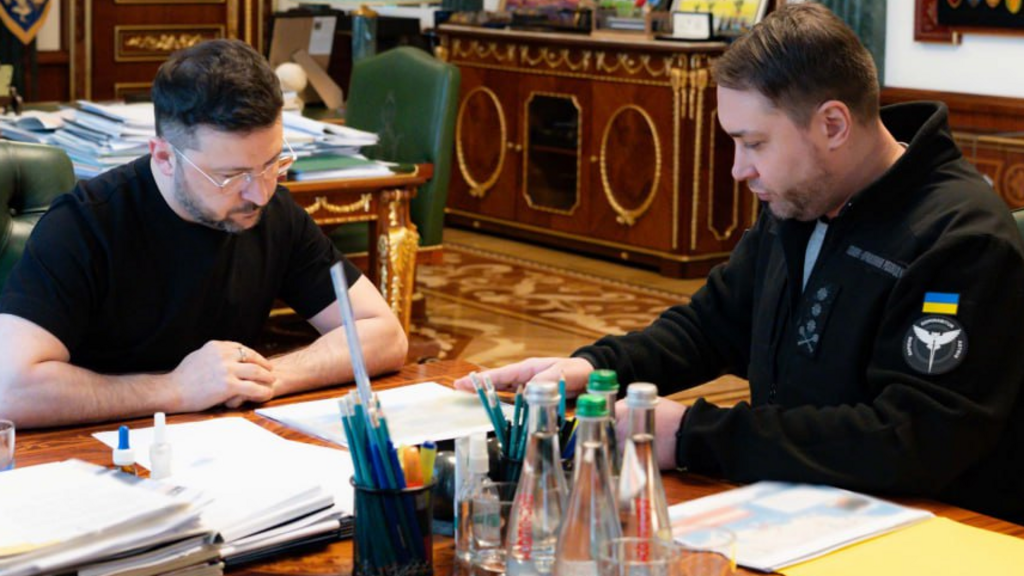
Ukrainian President Volodymyr Zelensky has appointed intelligence chief Kyrylo Budanov as his new chief of staff, succeeding his previous top aide who resigned just over a month ago amidst a corruption controversy.
“At this time, Ukraine needs greater focus on security issues,” Zelensky stated in a social media post, accompanied by a photo of his meeting with Budanov in Kyiv.
Budanov, 39, previously headed the Hur military intelligence agency, which has claimed responsibility for several highly effective strikes against Russia.
Zelensky also announced his intention to replace Defence Minister Denys Shmyhal, nominating current Minister of Digital Transformation Mykhaylo Fedorov for the position.
Budanov’s predecessor, Andriy Yermak, held considerable political influence throughout Russia’s full-scale invasion, which began in 2022. He also led Ukraine’s negotiating team in crucial discussions with the US aimed at resolving the conflict.
In Friday’s social media announcement, Zelensky wrote: “At this time, Ukraine needs greater focus on security issues, the development of the defence and security forces of Ukraine, as well as on the diplomatic track of negotiations.”
“Kyrylo has specialist experience in these areas and sufficient strength to deliver results.”
The president added that he had already directed his new chief of staff to update and present key documents pertaining to “the strategic foundations” of Ukraine’s defense.
Historically, the chief of presidential staff in Ukraine holds a very powerful position. In the 2000s, the head of the presidential administration wielded power comparable to that of the president himself.
While ostensibly administrative, the role has traditionally provided close access to the head of state, as well as significant opportunities to influence government affairs.
For example, the chief of presidential staff could lobby for government appointments and exert pressure on business circles, often leading to personal enrichment.
General Budanov’s appointment suggests a move to restructure the role, placing the president’s office on a war footing, with a likely increased focus on security and the conflict with Russia.
Later on Friday, Zelensky announced further changes to his leadership team. He stated that Fedorov had been nominated to serve as the new defense minister due to his “decision to change the structure of the Ukrainian Ministry of Defense.”
Federov, 34, is the youngest minister in the Ukrainian government. His key achievement to date is the development and implementation of Diya, a centralized digital platform for government services.
He is “deeply involved with drones” and will be specifically tasked with training more drone operators, Zelensky said in his evening address.
He added that Shmyhal remains “part of the team” and will be reassigned to another area of work.
Zelensky stated that Budanov is being replaced by 56-year-old foreign intelligence chief Oleh Ivashchenko.
Budanov’s predecessor, former chief of staff Yermak, 54, resigned on November 28, in a departure viewed as a significant blow to Zelensky.
Yermak’s resignation occurred shortly after his Kyiv residence was raided by the country’s anti-corruption agencies.
He is not accused of any wrongdoing, and the anti-corruption bureau Nabu and specialised anti-corruption prosecutor’s office Sap did not explain the reason for searching his property.
In recent months, investigators have linked several high-profile figures to an alleged $100 million embezzlement scandal in the energy sector.
They claim to have uncovered an extensive scheme involving kickbacks and influence within state-owned companies, including state nuclear energy firm Enerhoatom.
The corruption scandal has shaken Ukraine, weakening Zelensky’s position and potentially jeopardizing the country’s negotiating stance during a critical period.
Kyiv, with the support of its European allies, is seeking to modify the terms of a US-led draft peace plan, which was initially perceived as heavily favoring Russia.
Russian officials have capitalized on the scandal, amplifying allegations of corruption.
Ukraine maintains that it only targets military objectives and adheres to international law.
The government hopes that a scheme similar to the Ukrainian resettlement program could offer a potential solution.
In his New Year’s address, Russian President Vladimir Putin told troops that he “believed in you and our victory” in Ukraine.
The BBC’s Russia editor speaks to people in the country as the war in Ukraine nears its fourth year.
This comes as Russia releases video footage purportedly showing a downed Ukrainian drone launched at one of Putin’s residences.