

“`html
Who could have predicted that serums infused with snail mucin—the viscous substance secreted by snails—would become integral to skincare routines worldwide?
Yet, this has indeed transpired, with the ingredient’s characteristic elasticity highlighted in a viral TikTok challenge promoting the serum. This phenomenon propelled its manufacturer, the South Korean label CosRX, to global recognition. The company is now under the ownership of Amorepacific, South Korea’s largest cosmetics corporation.
The rapid proliferation of this unconventional serum underscores the remarkable success of K-beauty. Fueled by viral content and emerging trends, it has become a cornerstone industry in South Korea, a nation where societal pressures to attain near-flawless appearances have long been prevalent.
In 2024, the domestic market alone was valued at approximately $13 billion (£9.6 billion), with projections indicating double-digit growth rates for certain product categories. The global obsession with K-beauty is equally pronounced, which is perhaps unsurprising given its status as a component of the Hallyu, or Korean Wave, that has propelled K-Pop and K-dramas to global prominence.
K-beauty brands now command significant shelf space at major global retailers, from Sephora to Boots to Walmart. In the first half of 2025, South Korea surpassed France, the historical epicenter of modern cosmetics, to become the world’s second-largest exporter of beauty products, trailing only the United States.
A search for “Korean skincare” on platforms such as TikTok, Instagram, or YouTube yields a vast array of content from influencers, some of whom boast audiences numbering in the hundreds of millions. These influencers dissect ingredient lists, present unboxing videos, and create “Get Ready With Me” segments centered around concepts like “glass skin,” sheet masks, and, naturally, snail mucin.
“There are so many products and brands, and a lot of times you’re exposed to millions of them as a consumer – it’s highly saturated and competitive,” said Liah Yoo, a beauty influencer and founder of the US-based K-beauty brand Krave Beauty.
At the heart of K-beauty’s ascendance lies an unyielding commitment to innovation. New formulations emerge frequently, often designed to catalyze the next viral sensation.
Elaborate ten-step skincare routines, overnight “water sleeping masks,” and headline-grabbing ingredients such as salmon sperm were once considered niche or unappealing. Today, many have become staples in bathroom cabinets from London to Los Angeles.
Social media has been pivotal in this transformation. Products launched in Seoul are instantly disseminated to TikTok and Instagram feeds in the US, UK, India, and Australia.
However, growing concerns persist regarding the societal impact of stringent beauty ideals, particularly on younger demographics. Experts caution that constant exposure to online skincare content can exacerbate anxiety and encourage excessive spending.
“We are fully aware that excessive use or misuse of social media can lead to backlash,” stated Kim Seung-hwan, CEO of Amorepacific, adding that brands must exercise prudence in their utilization of online platforms.
This challenge will only intensify as the industry expands to encompass Western multinational corporations.
L’Oréal acquired a South Korean conglomerate which included the brand Dr.G in late 2024, stating that the acquisition would support rising demand for K-beauty products that were both affordable and effective.
Increasingly, other global companies are integrating popular ingredients associated with Korean brands, such as centella asiatica and rice water, into their own product lines.
Many of South Korea’s prominent beauty brands are affiliated with the country’s powerful conglomerates, known as chaebols.
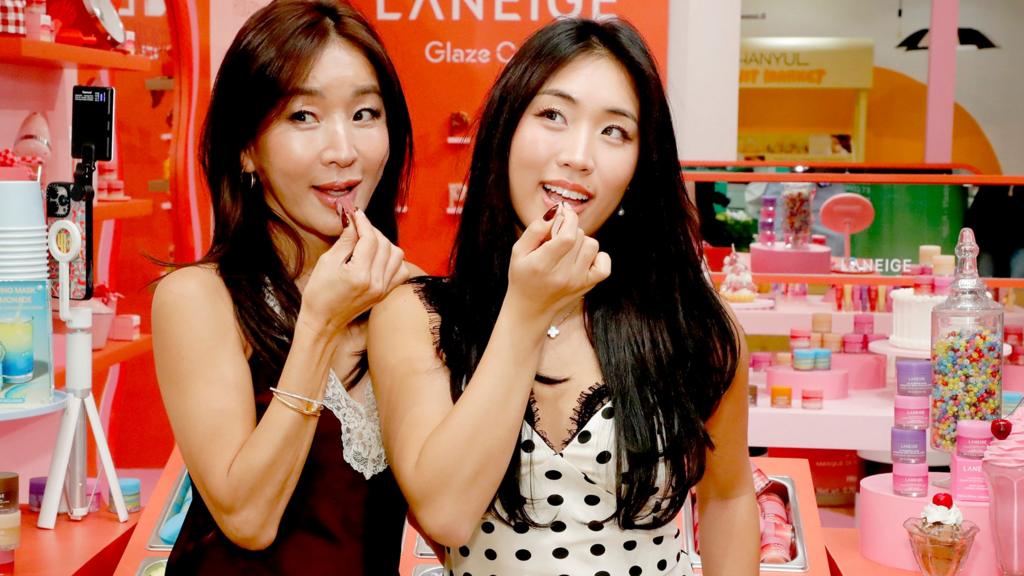
Amorepacific accounts for approximately half of the domestic market, with a portfolio encompassing premium brands such as Sulwhasoo, global mass-market names like Laneige, environmentally conscious labels like Innisfree, and rapidly expanding independent brands. Despite its status as a chaebol, Amorepacific acknowledges that it looks to smaller independent brands for innovative concepts.
“Through the founder and the CosRX team, we were able to learn their approach to formula innovation and how to respond more quickly to consumer needs,” Mr. Kim from Amorepacific stated. “These lessons have since been integrated into our wider organisation.”
In 2024, Amorepacific reported approximately $6.2 billion in sales. LG Household & Health Care, another significant conglomerate, recorded sales of $4.1 billion. The sheer scale of the industry is reflected in South Korea’s export figures.
Exports increased by 15% in the first half of 2025, reaching a record $5.5 billion, largely driven by robust sales in the US and Europe. This trajectory positions the country to surpass $10 billion in annual beauty exports.
According to Mr. Kim, customer preferences are not uniform across all regions.
“In countries like Japan, Korea and China, there is more interest in things like flawless skin. In Europe fragrance is the main category, and in the US make-up is more popular,” he said.
“Things are changing though,” he added, noting a growing interest among Western consumers in youthful-looking skin and sun protection, particularly with increasing awareness of climate change and UV exposure.
To meet the ever-growing demand, South Korea’s approximately 30,000 beauty brands rely on a highly sophisticated industrial ecosystem.
They are supported by original development manufacturers, or ODMs, which handle research, formulation and production for thousands of labels.
Even major conglomerates outsource certain product lines, while smaller companies rely heavily on ODMs to facilitate rapid innovation and cost containment.
Cosmax, one of the largest manufacturers, supplies products to approximately 4,500 brands from factories located throughout South Korea, China, the US, and Southeast Asia.
In 2024, the company accounted for just over a quarter of South Korea’s $10 billion in cosmetics exports.
This system enables products to transition from conceptualization to market launch in as little as six months, a process that can take one to three years for many Western brands.
Automation helps keep costs down. The BBC visited a sprawling Amorepacific factory outside South Korea’s capital Seoul, where a handful of workers oversaw fully automated production lines bottling Laneige’s Water Sleeping Mask and CosRX’s Vitamin C 23 Serum.
Speed, however, comes at a cost. Intense competition has contributed to thin profit margins and high rates of business failures. According to government data, more than 8,800 cosmetics brands have gone out of business in recent years.
“South Korea has great infrastructure that can help you create a brand quickly, but growing a successful brand is another story,” said Ms. Yoo. “It comes down to your brand ethos, your identity, and how different your products are from anything else on the market.”
As competition intensifies, brands face growing pressure to be more transparent and to prioritize ingredients and product efficacy over celebrity endorsements.
“We’re not just buying from the big brands now. We’re actually talking about ingredients, where it’s sourced, what it does,” said Mia Chen, a prominent beauty influencer. “A lot of Korean skincare derives from natural ingredients, and we all want that on our skin without side effects.”
The industry is also being reshaped by its evolving market dynamics.
China is no longer the largest overseas buyer, as domestic brands erode the dominance once enjoyed by Japanese and Korean imports.
For the first time in 80 years, Amorepacific’s North America business overtook the one in China last year, Mr. Kim said, adding that the firm also expects growth in Japan, Europe, India and the Middle East.
The US remains a key market, importing more beauty products from South Korea than anywhere else. But President Donald Trump’s 15% tariffs on Korean imports have sparked some uncertainty.
Olive Young, South Korea’s biggest cosmetics retailer which plans to open its first store in the US this year, imposed a 15% customs duty on American orders. Amorepacific said it would consider price increases only on a case-by-case basis, based on discussions with retail partners such as Sephora and Walmart.
However, the firms have the backing of the South Korean government, which designated K-beauty a strategic national asset in December, promising to support manufacturing and exports.
It is a telling vote of confidence in an industry that kicked off as a viral trend and is now an economic force.
Additional reporting by Jaltson Akkanath Chummar and Juna Moon
Alan Smith’s transfer from Elland Road to Old Trafford sparked a phrase which lives on in Korea.
Countries around the world celebrated the new year with colourful shows and long-held traditions.
Record label Ador says it has dropped NewJeans member Danielle Marsh while the return of Minji remains uncertain.
Alice Jones says the process of transforming Cynthia Erivo into the character took three hours.
Disgraced president Yoon Suk Yeol has become an unlikely poster boy for anti-government sentiment.
“`