

Archaeological researchers have made intriguing new discoveries at a medieval cemetery in Wales, potentially unlocking the mysteries surrounding the women interred there.
Excavations have revealed the presence of what appears to be a small building, alongside a collection of domestic and decorative artifacts, including notably refined colored glass beads.
To date, the site has yielded 58 skeletons dating back to the 6th or 7th Century. Unusually, almost all of the remains are those of women.
These recent findings bolster the growing body of evidence suggesting the burial ground served as part of an early female religious community.
For the past four years, archaeologists have meticulously excavated the site located on the grounds of Fonmon Castle, positioned near the Cardiff Airport runway.
The skeletons are buried in shallow graves hewn into the limestone bedrock. Examination of the bones and teeth indicates a challenging existence, yet the artifacts discovered within the graves suggest a degree of wealth and luxury.
The research team has been dedicated to unraveling the identities of these women.
The latest dig has provided a significant clue: the outline of a structure, possibly a small building.
“The site is producing fragments of building stone, suggesting a structural element. We are considering the possibility of a small shrine or chapel,” explains Dr. Andy Seaman of Cardiff University, who leads the excavation.
“I believe we have uncovered a site that may represent an early religious community.”
The potential building is centrally located within the cemetery, with graves clustered around it, suggesting a desire for burial proximity to this feature.
Indeed, according to Cardiff University archaeologist Tudur Davies, the desire for proximity is such that some graves contain multiple individuals.
“It’s a highly desired location for interment,” he notes.
“In some instances, two, three, or even four individuals have been buried in the same spot repeatedly. There appears to be less of a taboo against placing bodies in the same location, with remains simply moved aside.”
Artifacts unearthed at the site are shedding further light on the people buried there.
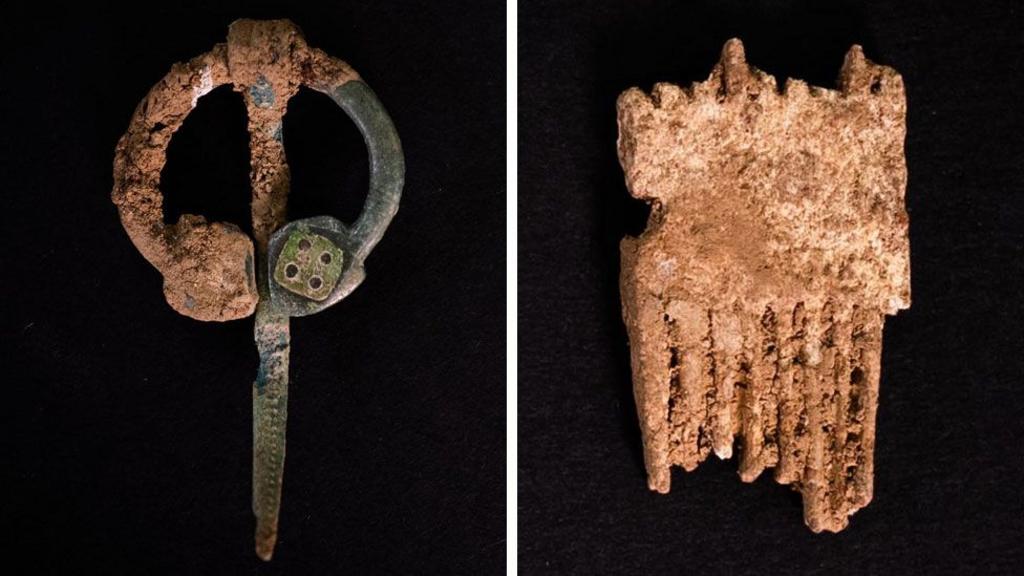
The artifacts have been transported to Cardiff University’s laboratory, where conservator Nicola Emmerson is meticulously removing centuries of accumulated dirt from an ornate copper brooch.
“Further analysis is required, but it is likely made of bronze,” she states. “We also suspect it was once gilded with a coating of gold.”
She explains that the ends were adorned with green enamel.
“This would have been a highly decorative brooch, making it a particularly special find for the site.”
In addition to the brooch, the team has unearthed a bone pin featuring a detailed pattern and a comb intricately carved from antler.
Also discovered were exquisite, multicoloured glass beads, each measuring approximately 3mm across, representing miniature works of art. These may have been stitched onto clothing or incorporated into jewelry.
Domestic items found at the site are equally revealing.
“We have a quern stone for grinding flour for bread, along with pottery and glass for eating and drinking,” Dr. Seaman notes.
“Clearly, this was not solely a place for the deceased. A living community also resided here.”
He suggests the community was enclosed and situated adjacent to the cemetery, set apart from the broader society.
The pieces of this medieval puzzle are gradually falling into place, yet questions remain.
The remains of a few men have been found – who were they? And what of the children? Were they related to the women?
While most individuals at the cemetery were buried with care, two women were unceremoniously cast into a ditch, one with her hands and feet bound. What transgression led to such treatment?
The team is currently investigating the possibility that this site represents an early example of Christianity.
“This is a period where history is not yet fully written,” Dr. Seaman explains.
“Our understanding of early church sites, their function, appearance, and organization, remains limited.”
“While we possess detailed knowledge of later periods, this formative era of history is less well-understood, making this a truly exciting opportunity.”
The archaeologists plan to continue their excavations later this year.
The visual spectacle, known as The Beam, marked the 80th birthday of Harwell Campus.
Dame Sarah Mullally will be the first woman to hold the position when she is installed in January.
A factory in space has been switched on and has reached temperatures of about 1,000C.
A controversy kicked off after two religious podcasters moved into an Appalachian hill town deep in the Bible Belt.
Bishop of Oxford, Dr Steven Croft, will retire from his role in the summer after nearly a decade.