

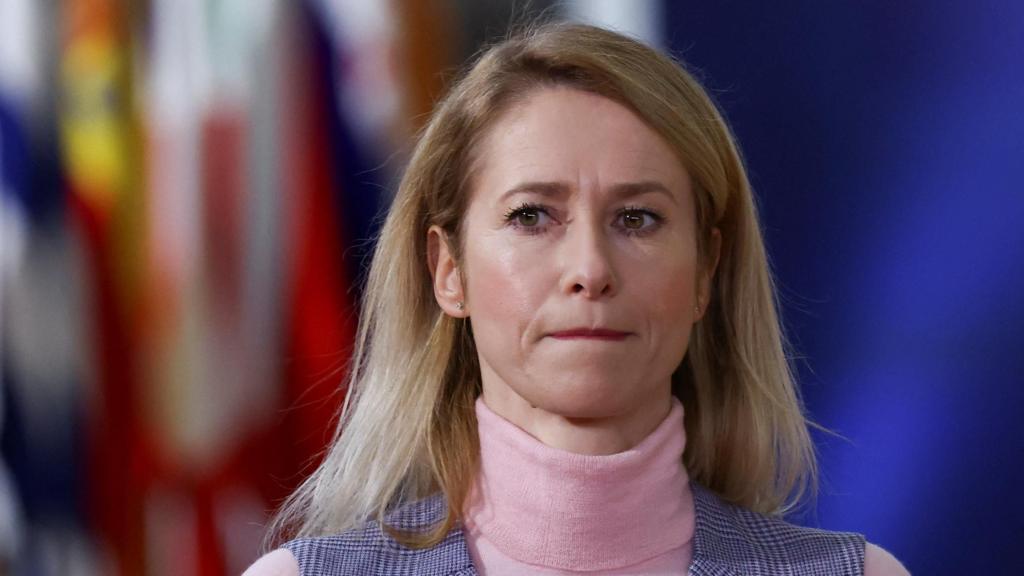
The European Union’s top diplomat has characterized Moscow’s assertions that Ukraine targeted Russian government sites as a “deliberate distraction” intended to undermine the ongoing peace process.
Kaja Kallas’ social media remarks appear to reference the Kremlin’s claim of a Ukrainian drone strike targeting one of President Vladimir Putin’s residences.
“Unfounded claims from the aggressor, who has indiscriminately targeted Ukraine’s infrastructure and civilians, should not be accepted,” Kallas stated on social media.
Earlier this week, Moscow accused Ukraine of targeting President Putin’s private home near Lake Valdai in northwestern Russia.
The Kremlin stated that Russia would reassess its position in the current peace negotiations as a result of the alleged attack.
Since Foreign Minister Sergei Lavrov initially made the claims, Russian state media and politicians have discussed the purported attack with increasingly inflammatory rhetoric.
“The attack is a strike on the heart of Russia,” stated Andrei Kartapolov, head of the Russian parliament’s defense committee. “After what [Ukraine] has done, there can be no forgiveness.”
While the Kremlin initially indicated it saw no need to share proof of the alleged attack, on Wednesday, the Russian army released what it presented as evidence of the attempted strike.
This included a map purportedly showing the drones were launched from the Sumy and Chernihiv regions of Ukraine, as well as a video of a downed drone in a snowy woodland. A serviceman standing near the wreckage identified it as a Ukrainian Chaklun drone.
The BBC has been unable to independently verify the footage, and the location of the shoot cannot be determined.
While the profile of the wrecked UAV (unmanned aerial vehicle) shares similarities with Ukrainian-produced Chakluns, the components are inexpensive and readily available online, making it impossible to definitively trace them to the Ukrainian military.
Russia’s defense ministry also released a video featuring a purported local resident who described hearing a rocket-like sound at the time of the alleged attack.
However, a Russian investigative media outlet reported speaking to over a dozen residents in the area around President Putin’s residence, none of whom had heard anything indicating that drones had approached or been shot down by air defenses.
“If something like that had happened, the whole city would have been talking about it,” one resident told the outlet.
A spokesperson for Ukraine’s foreign ministry dismissed Russia’s presented evidence as “laughable.” “They are not serious even about fabricating the story,” Heorhii Tykhyi told Reuters.
Ukrainian President Volodymyr Zelensky has also vehemently denied the allegations, linking them to the ongoing U.S.-led effort to achieve a ceasefire in Ukraine.
President Putin has not publicly addressed the alleged drone strike, but during his New Year’s Eve address to Russian troops in Ukraine, he stated, “We believe in you and our victory.”
On Wednesday, U.S. President Donald Trump’s advisors held discussions with President Zelensky and national security advisors from the UK, France, and Germany regarding ending the war in Ukraine.
U.S. special envoy Steve Witkoff stated they discussed “strengthening security guarantees and developing effective deconfliction mechanisms to help end the war and ensure it does not restart.”
In President Zelensky’s New Year’s Eve address, he stated, “the peace agreement is 90% ready, 10% remains.”
“Those are the 10% that will determine the fate of peace, the fate of Ukraine and Europe,” he said.
Meanwhile, French President Emmanuel Macron stated that European states and allies scheduled to meet in Paris on January 6 “will make concrete commitments to protect Ukraine and ensure a just and lasting peace on our European continent.”
In recent weeks, the American and Ukrainian delegations have been working closely, and President Zelensky has expressed cautious optimism that his country’s demands were being taken into account.
In his view, he stated on Tuesday, the claims about the drone attack on President Putin’s Valdai residence were about “the fact that over the past month there were quite successful talks and a positive meeting between our teams, culminating in our meeting with President Trump.”
President Zelensky stated that Russia wanted to disrupt the “positive momentum” between the U.S. and Ukraine.
When the claims emerged, President Zelensky also warned that the alleged drone strike would be used as an excuse to carry out strikes on Kyiv and Ukrainian government buildings. Overnight on Wednesday, air alerts briefly sounded in the capital as a drone approached, but no impacts or damage were reported.
Instead, several locations across the country were struck by drones, and Odesa on the Black Sea suffered a large-scale attack that hit an apartment block and injured six people, including three children. More than 170,000 were also left without power as temperatures struggled to rise above 0°C.
Odesa has been under sustained attack for several weeks. The intensity of the strikes appears to have increased since President Putin’s threat in early December to cut off Ukraine’s access to the sea in retaliation for drone attacks on tankers of Russia’s “shadow fleet” in the Black Sea.
With only hours remaining until the end of another year of war, many in Kyiv had only one wish for 2026.
“We hope that all of this will end. We want this to be over and to live as we did before,” said 26-year-old Mariya.
Standing outside the golden-domed St. Sophia monastery in Kyiv, she added: “We have a very beautiful country with enormous potential. Our strength is in our people, and that is why we keep going.”
As she spoke, teenage carollers nearby sang Christmas songs, collecting donations for the armed forces. “We all want victory to come in 2026. It’s our united wish,” said one.
President Zelensky has expressed a desire for peace negotiations to resume and accelerate early in January with the involvement of both American and European officials. However, any agreement will ultimately require Russian buy-in, which does not appear likely and which the alleged drone incident over President Putin’s residence may have further diminished.
So, could next year truly bring peace? “We truly hope so, but we can’t say for certain. We are doing everything we can,” Mariya said.
Next to her, a woman named Ksenia shrugged and turned her eye to the sky: “Really, only God knows.”
The BBC has documented a sharp increase in soldiers’ obituaries as part of its work in counting Russian war losses.
The U.S. and Ukrainian presidents both described talks in Florida as “great” and “terrific,” but the issue of territory remains “unresolved.”
This year has witnessed multiple major conflicts with geopolitical implications of unparalleled importance.
Despite both leaders expressing optimism in Florida, there is no indication of progress, according to the BBC’s Vitaliy Shevchenko.
Iryna Izotova stated that she fled shortly after the war began and has since settled in Coventry.