

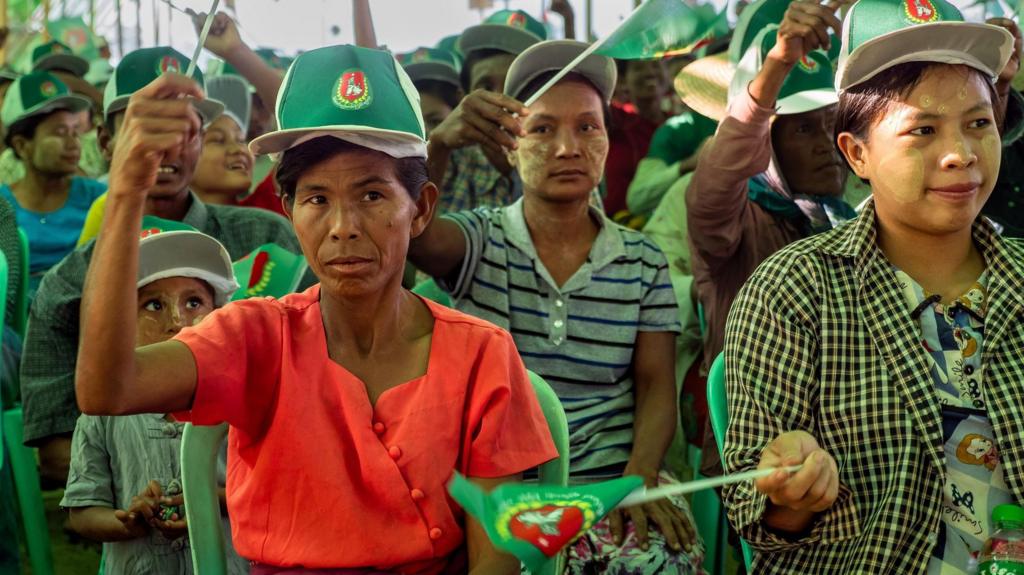
On a rugged patch of land near the Irrawaddy River, Tayza Kyaw, a retired Lieutenant-General and aspiring parliamentarian, addressed a crowd, promising a brighter future.
As the candidate for the military-backed Union Solidarity and Development Party (USDP), he campaigned in Aungmyaythazan, a constituency within Mandalay.
Despite clutching branded hats and flags, the audience of 300-400 individuals appeared weary under the afternoon sun, with some visibly dozing.
Children played amongst the rows of seats, many belonging to families affected by the recent earthquake. These families, seemingly hoping for aid, dispersed immediately after the rally.
This Sunday, Myanmar citizens will have their first opportunity to vote since the military coup nearly five years ago, an event that triggered a devastating civil war.
However, the election, repeatedly delayed by the ruling junta, has been widely denounced as a sham. The National League for Democracy, the nation’s most popular party, has been disbanded, and its leader, Aung San Suu Kyi, remains imprisoned in an undisclosed location.
Voting, scheduled in three phases over a month, will be impossible in conflict-ridden regions. Even in areas where voting proceeds, it’s overshadowed by fear and intimidation.
During a rally in Mandalay, party officials prevented the BBC from interviewing attendees about their views on the election, citing concerns that they might express dissenting opinions or lack media training.
The palpable nervousness was further underscored by the presence of numerous plain-clothes military intelligence officers. In a nation where even liking critical Facebook pages or using the term “revolution” is criminalized, party activists feared the consequences of unfiltered questioning by a foreign journalist.
This apprehension permeated Mandalay’s streets. At a fish market, customers declined to comment on the election. “We have no choice but to vote,” one remarked, while the vendor urged the BBC to leave, fearing repercussions.
Only one woman dared to speak candidly, under the condition of anonymity and a private setting.
“This election is a farce,” she stated. “People are scared and have lost their humanity and freedom. Many have died, been tortured, or fled. How can things improve under military rule?”
She would abstain from voting, despite the inherent risks.
In July, military authorities enacted a law criminalizing any actions deemed to disrupt the electoral process, including speech, organizing, and protesting.
Earlier this month, Dr. Tayzar San, a key figure in the 2021 coup protests, was charged under this law for advocating an election boycott. The junta has offered a reward for his capture.
In September, three Yangon residents received lengthy prison sentences for posting stickers depicting a bullet and ballot box.
A large poster near Mandalay’s royal palace commands, “Co-operate and crush all those harming the union,” casting a shadow over citizens.
In such an environment, a free vote remains an illusion.
However, junta leader Min Aung Hlaing appears optimistic, believing the election will grant him legitimacy despite widespread conflict and limited participation.
He even attended a Christmas mass in Yangon, condemning “hatred and resentment” as causes of oppression and violence.
This statement comes from an individual accused of genocide against the Rohingya and whose coup sparked a civil war responsible for 90,000 deaths, according to ACLED.
Min Aung Hlaing’s election strategy enjoys China’s diplomatic support, which provides technical and financial assistance for the multi-party process. The rest of Asia is likely to accept it with reluctance.
His army, bolstered by Chinese and Russian arms, has regained territory from opposition groups, with plans to include reconquered areas in the election’s final phase.
With Aung San Suu Kyi and the NLD sidelined, the USDP is poised for victory, a stark contrast to its six percent parliamentary seat share in the 2020 election.
Some analysts suggest that Min Aung Hlaing faces internal dissent, with questions surrounding his leadership. While likely retaining the presidency, his power might be diluted through the re-establishment of parliament, albeit without key parties from the 2020 election.
China views the election as a potential exit strategy from the impasse caused by the coup.
Even near Mandalay, the deep wounds of Myanmar’s ongoing civil war are evident.
Across the Irrawaddy River lies Mingun, a once-popular tourist destination. Access requires traveling along a riverside road, which has been a contested area for four years, with People’s Defence Forces controlling villages and launching attacks against military convoys.
Reaching Mingun required navigating multiple checkpoints. The local police commander negotiated passage at a tea shop.
The young commander, visibly strained, carried a revolver and was guarded by two even younger men with assault rifles.
He explained that the weapons were necessary for movement within the village.
His phone displayed images of his opponents: young men with makeshift weapons, possibly smuggled or obtained from fallen soldiers. The Unicorn Guerrilla Force, he noted, was his most formidable adversary, engaging in relentless conflict. “If we see each other we always shoot. That’s the way it is.”
He added that elections would not occur in most northern villages. “Everyone here has taken sides in this conflict. It is so complicated and difficult. But no-one is ready to compromise.”
After an hour, the journey to Mingun was deemed too dangerous. The PDFs might not recognize the team as journalists, he explained.
Compromise remains elusive from the military, which seeks to legitimize its regime through a quasi-democratic facade.
General Tayza Kyaw attributed the civilian casualties and attacks on schools and hospitals entirely to those opposing the military takeover.
“They chose armed resistance,” he stated. “Those who are with the enemy cannot be viewed as the people, according to the law. So, they are just terrorists.”
Residents of Mandalay describe the election as lacking the vibrancy of the 2020 vote. Rallies have been scarce, and only a few parties are challenging the USDP nationwide, lacking its resources and support. Low voter turnout is anticipated.
Despite these factors, many Burmese citizens will vote out of fear or exhaustion from the ongoing conflict.
“We will vote,” one woman said, “but not with our hearts.”
Additional reporting by Lulu Luo
Almost one million people were displaced when hostilities resumed earlier this month after the first truce broke.
The meteor could be seen blazing through the night sky over Japan’s Mount Fuji
Born on 16 December last year in Indian-administered Kashmir, the sheep has been named Tarmeem.
Nine years after her husband disappeared, Susanna Liew had a stunning legal win in one of Malaysia’s biggest mysteries.
Najib was convicted for his role in the billion-dollar scandal involving the country’s sovereign wealth fund 1MDB.