

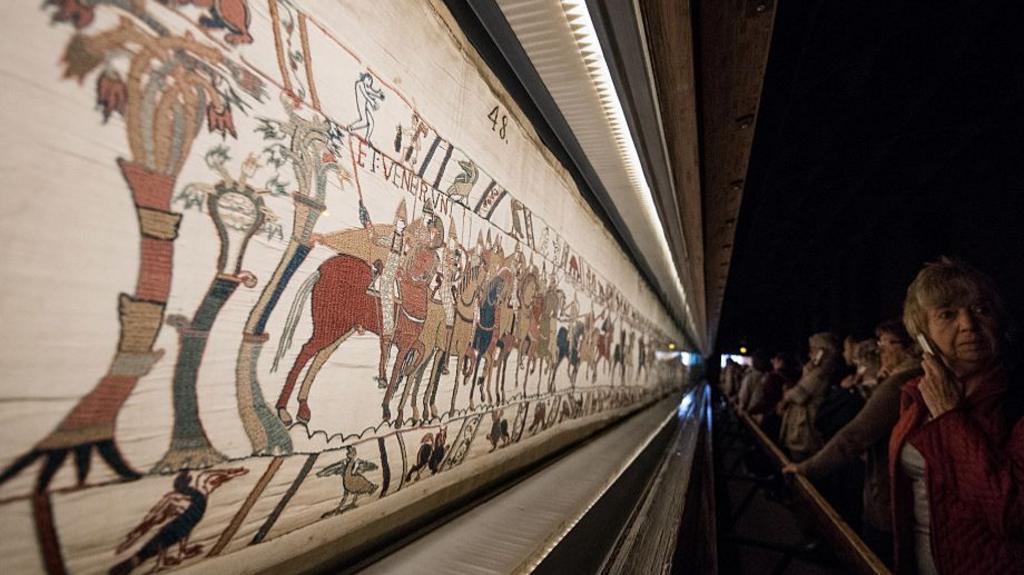
The UK Treasury is poised to provide an estimated £800 million in insurance coverage for the Bayeux Tapestry during its loan to the British Museum next year, safeguarding against potential damage.
This historic 70-meter embroidery, depicting the pivotal Battle of Hastings in 1066, will journey from France to London as part of a cultural agreement between the two nations.
The artefact’s transportation, storage, and exhibition period will be protected under the Government Indemnity Scheme (GIS), a program designed to cover losses or damages to invaluable items.
According to a Treasury spokesperson, this long-standing scheme is essential, as “public museums and galleries would face a substantial commercial insurance premium, which would be significantly less cost effective” without it.
Despite the agreement, some French art experts have voiced concerns regarding the transportation of the nearly 1,000-year-old tapestry, citing its delicate condition. However, French officials have refuted these claims.
Reportedly, the Treasury has received and provisionally approved an initial valuation for insuring the Bayeux Tapestry. Formal confirmation of the loan is contingent upon the final valuation assessment.
The Financial Times, citing unnamed sources, estimates the final valuation to be approximately £800 million. The Treasury did not contest this figure when contacted by the BBC.
The Bayeux Tapestry is scheduled to be on display in the Sainsbury Exhibitions Gallery of the British Museum from September 2024 until July 2027, coinciding with the renovation of its permanent home, the Bayeux Museum.
The extensive masterpiece, comprised of 58 scenes, 626 characters, and 202 horses, chronicles a contested period in Anglo-French relations, specifically William the Conqueror’s seizure of the English throne from Harold Godwinson, marking the beginning of Norman rule in England.
The Government Indemnity Scheme facilitates public display of art and cultural objects in the UK that “might not have been otherwise because the cost of insurance would have been too high.”
Established in 1980, the scheme has enabled numerous high-value loans, including Vincent van Gogh’s 1888 painting, “The Bedroom,” to the National Gallery.
It is estimated that the scheme saves museums and galleries around £81 million annually compared to the expenses of obtaining commercial insurance.
In return for the Bayeux Tapestry, the British Museum will loan a selection of items to France, including 7th-century Anglo-Saxon artefacts from the Sutton Hoo burial site in Suffolk and the 12th-century Lewis chess pieces.
The Bristol raid happened in September but information has only just been released.
The Chew Valley hoard is thought to be be the highest value find in English history.
The Wenlok Jug, which is on display in Luton, is estimated to be worth between £750,000 and £1m.
The National Treasures exhibition features Viking and Bronze Age jewellery found on the Isle of Man.
The British Museum hopes to secure the pendant, found by a metal detectorist in Warwickshire.