

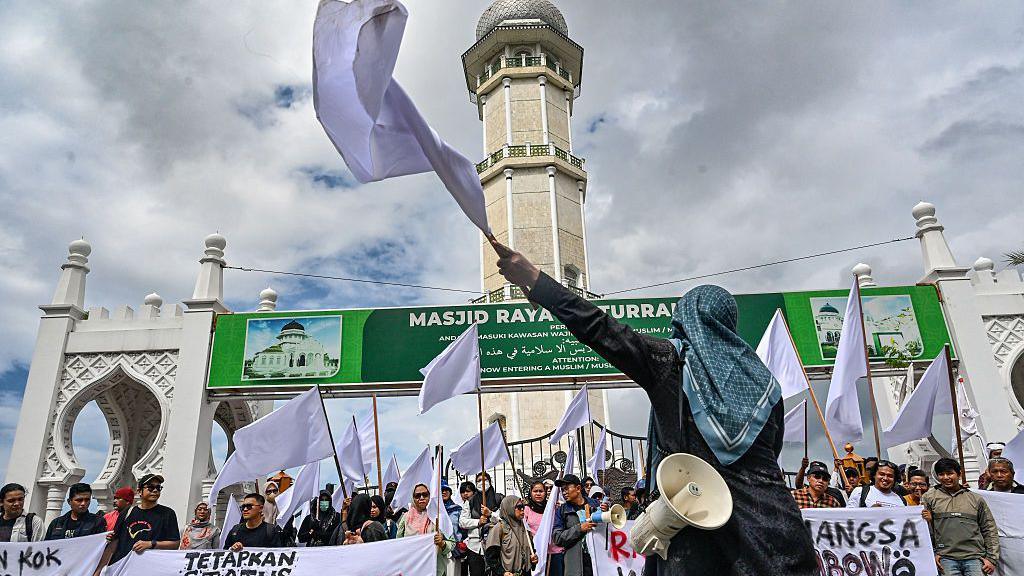
Residents in Indonesia’s westernmost province have raised white flags for weeks, signaling distress over the state’s perceived slow response to a series of devastating floods.
The floods, triggered by a rare cyclone in November, have claimed over 1,000 lives and displaced hundreds of thousands across Sumatra. Aceh, the hardest-hit province accounting for nearly half the fatalities, continues to struggle with access to clean water, food, electricity, and medical supplies.
Reflecting the growing frustration with the crisis management, the governor of North Aceh publicly expressed his anguish earlier this month.
“Does the central government not know [what we’re experiencing]? I don’t understand,” a tearful Ismail A Jalil stated before cameras.
Despite the situation, President Prabowo Subianto has declined foreign aid, asserting that the situation is “under control.”
“Indonesia is capable of overcoming this disaster,” he affirmed to his cabinet last week. He has also resisted calls to declare a national disaster, a move that would unlock emergency funding and expedite relief efforts.
The Prabowo administration has faced increasing criticism for being reactive, disorganized, and disconnected – characteristics some analysts attribute to his presidency, which he secured in February 2024 on populist promises.
Earlier this year, his signature billion-dollar free school meals program was embroiled in controversy due to mass food poisoning incidents. In August and September, thousands of Indonesians demonstrated against unemployment and the rising cost of living, marking some of the largest protests in the country in recent decades.
The government’s handling of the November floods has added another challenge for the president, even as his approval ratings remain steady at approximately 78%.
Last Thursday, dozens of protesters gathered in Banda Aceh, the capital of Aceh, waving white flags and urging the central government to accept international assistance.
Among the crowd, a young girl held a sign that read: “I am just three years old, I want to grow up in a safe and sustainable world.”
While typically a symbol of surrender, the white flags displayed across the province – on damaged roofs, along eroded riverbanks, and outside mosques – represent a plea for international solidarity, according to protesters.
“The flags do not mean we are giving in. They are a distress signal to grab the attention of friends outside, to let them know the conditions in Aceh today are very bad,” Husnul Khawatinnissa, a rally participant, told the BBC.
Entire villages have been decimated, and widespread damage to roads and infrastructure has isolated numerous communities. Survivors report widespread illness and starvation.
“How much longer must we wash ourselves in mud and floodwaters?” exclaimed Nurmi Ali, another demonstrator.
Provincial authorities have sought support from the United Nations, with the Aceh governor stating that he welcomes help “from anyone, anywhere.”
The Prabowo administration maintains that relief efforts are underway on a “national scale,” noting the disbursement of approximately 60 trillion rupiah ($3.6 billion) for reconstruction efforts.
For some in Aceh, the situation evokes painful memories of the 2004 Boxing Day tsunami, one of the worst natural disasters in history.
A magnitude 9.1 undersea earthquake generated a tsunami with waves up to 30 meters (100 feet) high that struck the Indian Ocean coastline, resulting in an estimated 230,000 deaths in over a dozen countries.
Aceh, already devastated by decades of civil war, was among the most severely impacted. Residents say they had only recently begun to rebuild their lives when the November floods struck.
Relief arrived more promptly after the 2004 tsunami, despite its greater devastation, they say.
Numerous countries, multilateral organizations such as the World Bank, and private entities contributed billions of dollars to the recovery effort. The Indonesian government subsequently established a dedicated agency to manage funds and aid projects.
“Everyone took action, and the community recovered quickly after the tsunami. What we’re suffering now is worse,” said Rindu Majalina, who was a high school student at the time.
The mother of three has struggled to feed her children since the recent floods destroyed their home. Residents “fight like zombies” for every available supply delivered to her village “because we are starving,” she added.
Several countries have offered assistance. The UAE, for example, sent 30 tonnes of rice and 300 relief packages to Medan, another flood-affected city, but the aid was returned by authorities, citing “guidance” from the central government.
The president’s refusal to accept international aid is a demonstration of his authority, according to Vidhyandika Djati Perkasa, a senior politics researcher at Indonesia’s Centre for Strategic and International Studies.
“Opening the door to foreign assistance means inviting foreign scrutiny, which they do not want… [Prabowo] doesn’t want to be seen as a failure and is trying to maintain his image,” Mr. Perkasa said, noting that this strategy could have political repercussions.
Prabowo has prioritized the “symbolic performance of sovereignty” over effective crisis management, according to Vedi Hadiz, an Asian studies professor at the University of Melbourne.
Critics argue that the government lacks a comprehensive understanding of the situation on the ground. Some also accuse Prabowo of insensitivity towards flood victims by promoting the expansion of palm oil plantations – an industry whose deforestation practices, environmental groups say, have exacerbated the flooding.
Rindu Majalina initially considered herself fortunate to have survived the floods, “but it turns out the post-disaster situation is even worse.”
“It has been very painful and miserable,” she said. “Everything has come to a complete standstill, from markets to schools to offices. My children don’t know if they’ll ever be able to go back to school.”
With reporting by Akramul Muslim, Rino Abonita and Nanda Fahriza Batubara in Aceh
Up to nine inches (23cm) of snow could fall across the New York region during one of the busiest travel weekends of the year.
Najib was convicted for his role in the billion-dollar scandal involving the country’s sovereign wealth fund 1MDB.
Cambodia accuses Thailand of “indiscriminate attacks”, as negotiators meet for a third day to try to end weeks of renewed fighting.
A recent study has found that India will generate over 11 million tonnes of solar waste by 2047 if it does not scale up recycling.
Tarique Rahman, who has lived in London since 2008, arrives weeks before pivotal elections are held.