

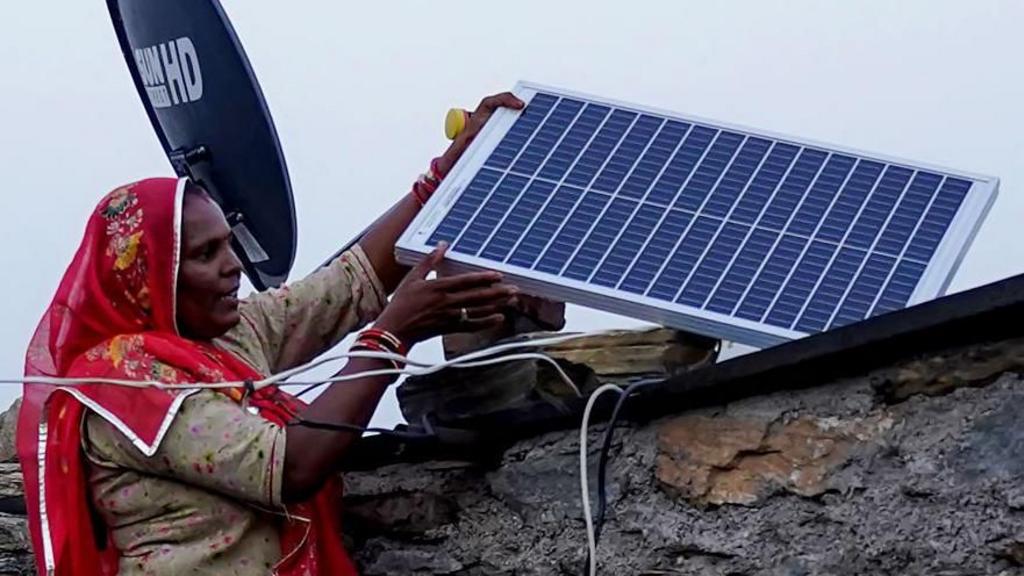
India’s rapid expansion of solar energy has been lauded as a significant achievement. However, the absence of a comprehensive waste management strategy raises questions about the true sustainability of this transition.
Over the past decade, India has ascended to become the world’s third-largest solar energy producer, with renewable sources now central to its climate action plan. Solar panels are now a common sight, adorning vast solar parks and residential rooftops across the country.
Beyond large-scale solar farms, millions of rooftop systems are contributing power to the national electricity grid. Government figures indicate that nearly 2.4 million households have adopted solar energy under a subsidized scheme.
The growth of solar energy has reduced India’s dependence on coal. While thermal and other non-renewable sources still account for over half of the installed capacity, solar now contributes more than 20%. However, this accomplishment presents a challenge: despite its clean energy production, solar panels can pose environmental hazards if not properly managed at the end of their life cycle.
Solar panels are largely recyclable, composed of materials like glass, aluminum, silver, and polymers. However, trace amounts of toxic metals such as lead and cadmium can contaminate soil and water if mishandled.
Typically, solar panels have a lifespan of approximately 25 years, after which they require removal and disposal. Currently, India lacks a dedicated budget for solar panel recycling, and only a few small-scale facilities exist to process end-of-life panels.
Official data on solar waste in India is currently unavailable. However, one study estimated approximately 100,000 tonnes of solar waste by 2023, projected to rise to 600,000 tonnes by 2030. While the current volume is relatively small, experts warn that the bulk of waste is yet to come, and without substantial investment in recycling infrastructure, India could face a growing waste management crisis.
A recent study by the Council on Energy, Environment and Water (CEEW) projects that India could generate over 11 million tonnes of solar waste by 2047. Effectively managing this volume would require nearly 300 dedicated recycling facilities and an investment of $478 million (£362 million) over the next two decades.
“Most of India’s large solar parks were constructed in the mid-2010s, so the real wave of waste is expected in the next 10 to 15 years,” notes Rohit Pahwa of the energy company Targray.
India’s solar waste projections align with global trends. The United States may generate between 170,000 and 1 million tonnes, and China nearly 1 million tonnes by 2030, following rapid solar expansion in the 2010s.
However, policy frameworks vary considerably across countries.
In the U.S., solar panel recycling is primarily market-driven, operating under a patchwork of state regulations. China’s system, like India’s, is still under development and lacks a dedicated regulatory framework.
In 2022, India included solar panels under its e-waste regulations, making manufacturers responsible for the collection, storage, dismantling, and recycling of panels at the end of their service life.
Experts suggest that enforcement is inconsistent, particularly for home and small-scale panels, which constitute 5-10% of installations. Although the proportion is modest, these panels can still generate substantial waste and are more challenging to track, collect, and recycle.
Damaged or discarded panels often end up in landfills or with unauthorized recyclers, where unsafe methods can release toxic materials. The BBC has contacted India’s renewable energy ministry for comment on this issue.
“Solar power offers the illusion of clean energy for two decades, but without a robust plan for recycling panels, it risks leaving behind a graveyard of modules and a limited legacy,” warns environment expert Sai Bhaskar Reddy Nakka.
Despite these challenges, experts suggest the issue also presents significant opportunities.
“As waste volumes increase, so will the demand for companies with the expertise to process it,” says Mr. Pahwa.
According to CEEW, efficient recycling could reclaim 38% of materials for new panels by 2047 and prevent 37 million tonnes of carbon emissions from mining operations.
India already has established markets for glass and aluminum, and valuable metals found in solar cells, such as silicon, silver, and copper, can be recovered for use in new panels or other industries, according to Akansha Tyagi, co-author of the CEEW study.
Currently, most solar waste is processed using basic methods that recover only low-value materials like glass and aluminum, while precious metals are lost, damaged, or extracted in minimal quantities.
Experts suggest that the next decade will be crucial for India’s solar energy goals. The country must act swiftly to establish a regulated, self-sustaining recycling system, increase public awareness, and integrate waste collection into solar business models.
Companies that profit from solar power should also be responsible for the end-of-life management of their panels, says Mr. Nakka.
“Without proper recycling, clean energy today could translate to increased waste tomorrow,” he cautioned.
Follow BBC News India on Instagram, YouTube, X and Facebook.
Najib was convicted for his role in the billion-dollar scandal involving the country’s sovereign wealth fund 1MDB.
Cambodia accuses Thailand of “indiscriminate attacks”, as negotiators meet for a third day to try to end weeks of renewed fighting.
Weeks after floods ravaged the island of Sumatra, many still do not have access to clean water and food.
Tarique Rahman, who has lived in London since 2008, arrives weeks before pivotal elections are held.
Recent deadly protests in Bangladesh are further straining Delhi’s already frayed tied with Dhaka.