

The U.S. economy accelerated during the third quarter, fueled by increased consumer spending and a surge in exports.
The world’s largest economy grew at an annualized rate of 4.3%, surpassing the previous quarter’s 3.8%. This figure exceeded expectations, marking the most robust growth in two years.
The report, delayed due to the U.S. government shutdown, offers insights into an economy impacted by shifts in trade and immigration policies, alongside persistent inflation and government spending reductions.
While these factors have caused fluctuations in sectors like imports and exports, the underlying economy has demonstrated resilience, exceeding many forecasts.
“This is an economy that has defied doom and gloom expectations basically since the beginning of 2022,” stated Aditya Bhave, senior economist at Bank of America.
In an interview with the BBC’s Business Today program, Mr. Bhave described the economy as “very very resilient.”
“I don’t see why that wouldn’t continue going forward,” he added.
The overall growth figure for the third quarter was significantly stronger than anticipated, with analysts projecting an annual pace of approximately 3.2%.
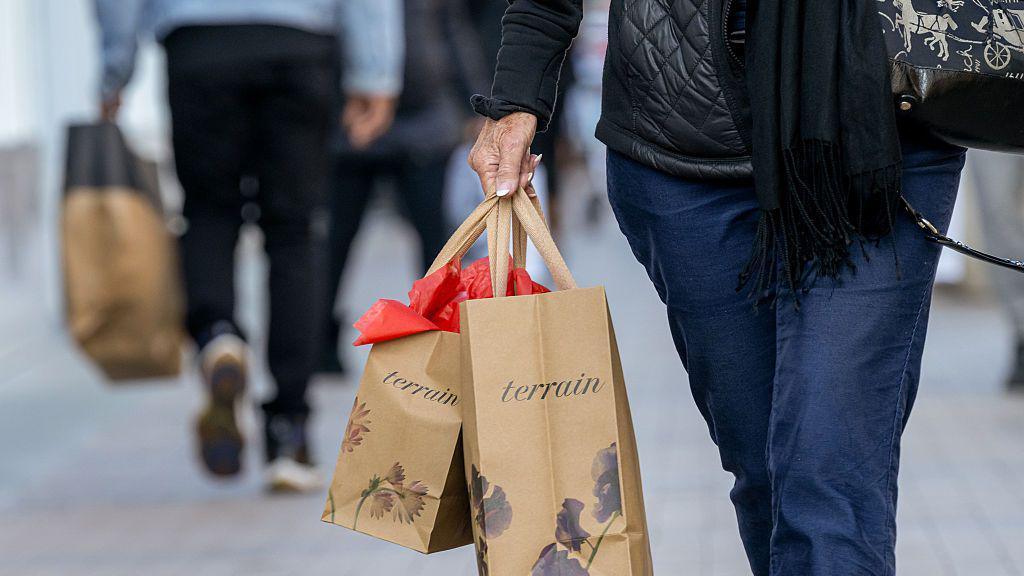
This growth was propelled by consumer spending, which increased at an annualized rate of 3.5%, compared to 2.5% in the preceding quarter, despite a slowing job market, as households allocated more funds to healthcare services.
Imports, which negatively impact growth, continued their decline, reflecting the tariffs imposed on shipments entering the U.S. earlier this year.
Conversely, exports rebounded sharply, surging by 7.4%. Government spending also increased, driven by defense expenditures.
These gains offset a slowdown in business investment, including intellectual property, and a housing market constrained by elevated interest rates, impacting affordability and supply.
Michael Pearce, chief U.S. economist at Oxford Economics, suggested the economy is well-positioned heading into 2026, anticipating a boost from tax cuts and the Federal Reserve’s recent interest rate adjustments.
“Underlying measures are consistent with a solid expansion,” he stated.
In a social media post, President Trump lauded the figures, attributing them to his tariffs. This comes amid declining consumer confidence and polls indicating dissatisfaction with his economic policies.
However, some analysts cautioned that rising prices for some households could hinder the sustainability of the recent quarter’s strong growth.
Over the three months ending in September, the Federal Reserve’s preferred inflation gauge, the personal consumption expenditures price index, rose to 2.8%, compared to 2.1% in the previous quarter, according to the report.
Analysts have warned that these price increases disproportionately affect lower and middle-income households, while higher-income households continue to spend freely.
Oliver Allen, senior U.S. economist at Pantheon Macroeconomics, noted that recent surveys and credit card data suggest households are curtailing spending.
“The weak labor market, stagnant real incomes, and exhaustion of pandemic-era excess savings all seem finally to be catching up with households,” he said.
The strength of the UK economy helps determine how much tax the government collects to pay for services.
The impact of the JLR cyber-attack continued to affect output, while analysts say spending was hit by Budget uncertainty.
The Budget somehow has to provide certainty, boost consumer and business confidence, and fill a large fiscal gap.
The cyber-attack on Jaguar Land Rover hit manufacturing and weighed on growth in the economy, figures show.
Beijing has avoided any sharp downturn but faces economic challenges including US tariffs.