

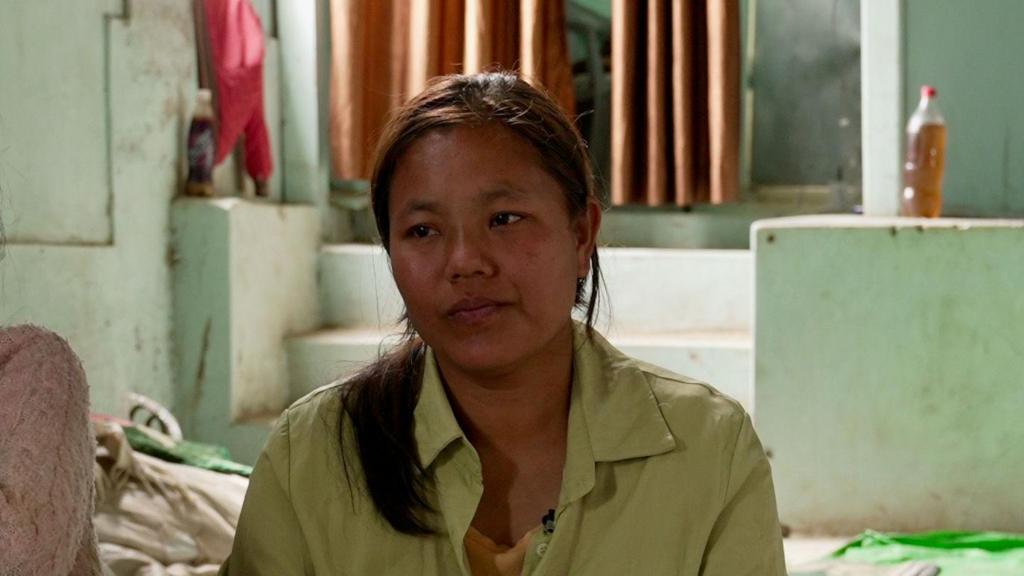
Late one night last month, Iang Za Kim was startled by explosions in a neighboring village, followed by the sound of fighter jets overhead. She rushed out of her home and saw smoke rising in the distance.
“We were terrified,” she recounts. “We thought the junta’s planes would bomb us too. So we grabbed what we could – some food and clothes – and ran into the jungles surrounding our village.”
Iang’s face trembles as she recounts the events of November 26 in K-Haimual, her village in Myanmar’s western Chin State, before she breaks down in tears.
She is among thousands of civilians who have fled their homes in recent weeks following a fierce campaign of air strikes and a ground offensive launched by the Burmese military in rebel-held areas across the country. The military aims to recapture territory ahead of elections scheduled to begin on December 28.
Four other women seated around her on straw mats also begin to weep, the trauma of their journey to safety clearly etched on their faces.
While the air strikes prompted Iang’s immediate flight, she also expressed a desire to avoid being forced to participate in the election.
“If we are caught and refuse to vote, they will put us in jail and torture us. We’ve run away so that we don’t have to vote,” she explained.
Sources within Chin State have described the junta’s latest offensive as the most intense in over three years.
Many of those displaced have sought refuge in other parts of the state. Iang is part of a group that crossed the border into India’s Mizoram state. They are currently sheltered in a dilapidated badminton court in Vaphai village, with their few salvaged possessions packed in plastic sacks.
Indian villagers have provided them with food and basic necessities.
Ral Uk Thang, 80, was forced to flee his home, spending days in makeshift shelters in the jungle before reaching safety.
“We’re afraid of our own government,” he stated. “They are extremely cruel. Their military has come into our and other villages in the past, they’ve arrested people, tortured them, and burned down homes.”
Gaining access to Burmese civilians for interviews remains challenging. Myanmar’s military government restricts access for foreign journalists. The military seized power in a coup in February 2021, shortly after the last election, and has since faced widespread condemnation for its repressive regime, which has indiscriminately targeted civilians in an effort to quell the armed uprising across Myanmar.
During its recent offensive, the junta targeted a hospital in Rakhine State, just south of Chin State, last week. Rebel groups in Rakhine report that at least 30 people were killed and more than 70 injured.
The Chin Human Rights Organisation reports that since mid-September, at least three schools and six churches in Chin State have been targeted by junta airstrikes, resulting in the deaths of 12 people, including six children.
The BBC has independently verified the bombing of a school in Vanha village on October 13. Two students – Johan Phun Lian Cung, 7, and Zing Cer Mawi, 12 – were killed while attending lessons. The bombs tore through their classrooms, injuring more than a dozen other students.
Myanmar’s military government has not responded to the BBC’s requests for comment regarding these allegations.
This is the second time Bawi Nei Lian and his young family – his wife and two young children – have been displaced. In 2021, shortly after the coup, their home in Falam town was destroyed in an air strike. They rebuilt their lives in K-Haimual village, only to find themselves homeless once more.
“I can’t find the words to explain how painful and hard it is and what a difficult decision it was to make to leave,” he said. “But we had to do it to stay alive.”
“I want the world to know that what the military is claiming – that this election is free and fair – is absolutely false. When the main political party is not being allowed to contest the election, how can there be genuine democracy?”
The National League for Democracy party, led by Aung San Suu Kyi, which won by landslides in the two elections prior to the coup, will not be participating as most of its senior leaders, including Suu Kyi, are imprisoned.
“We don’t want the election,” Ral Uk Thang stated. “Because the military does not know how to govern our country. They only work for the benefit of their high-ranking leaders. When Daw Aung San Suu Kyi’s party was in power, we experienced a bit of democracy. But now all we do is cry and shed tears.”
Iang Za Kim believes the election will be rigged. “If we voted for a party not allied with the military, I believe they will steal our votes and claim we voted for them.”
The election will be held in phases, with results expected around the end of January. Rebel groups have denounced it as a sham.
At the base of the Chin National Front in Myanmar, the most prominent rebel group operating in the state, the group’s Vice Chairman Sui Khar stated: “This election is only being held to prolong military dictatorship. It’s not about the people’s choice. And in Chin State, they hardly control much area, so how can they hold an election?”
He indicated areas of intense fighting on a map, noting that nearly 50 rebel fighters had been injured in the past month alone. While there have been fatalities, the group has yet to release official figures.
“There are columns of hundreds of soldiers trying to advance into the northern part of Chin state from four directions,” Sui Khar said. “The soldiers are being supported by air strikes, artillery fire and by drone units.”
Access to the base is exceedingly rare. Nestled within densely forested mountains, it serves as the heart of the resistance against the junta in Chin State.
Sui Khar led a visit to the base’s hospital, revealing a group of injured fighters who had been brought in overnight and underwent hours of surgery. Some have required amputations.
Many were still in school when the coup occurred in 2021. Now barely adults, they have abandoned their aspirations to fight on the front lines against the junta.
Abel, 18, is in too much pain to speak. He was with a group of fighters attempting to reclaim territory seized by the junta a week prior. They won the battle, but Abel lost his right leg and sustained serious injuries to his hands.
In the adjacent bed lies Si Si Maung, 19, who also had a leg amputated.
“As the enemy was retreating we ran forward and I stepped on a landmine. We were injured in the explosion. Then we were attacked from the air. The airstrikes make things very difficult for us,” he said. “I’ve lost a leg, but even if I’ve to give up my life I’m happy to make the sacrifice so that future generations have a better life.”
The severity of the latest offensive is evident in room after room at the hospital.
Yet, it is the support and resolve of tens of thousands of young people like Si Si Maung, who have taken up arms against the junta, that has enabled the rebels to make significant gains against a far more powerful adversary over the past four and a half years.
Some, like 80-year-old Ral Uk Thang, hope that after the election, the junta will retreat, allowing him to return home.
“But I don’t think I will live to see democracy restored in Myanmar,” he said. “I hope my children and grandchildren can witness it some day.”
Additional reporting by Aamir Peerzada, Sanjay Ganguly and Aakriti Thapar