

“`html
Newly published research details a “mysterious mass burial event” that occurred approximately 3,300 years ago in southern Scotland.
Guard Archaeology conducted excavations in 2020 and 2021 during the construction of the access route to the Twentyshilling Wind Farm, located near Sanquhar in Dumfries and Galloway.
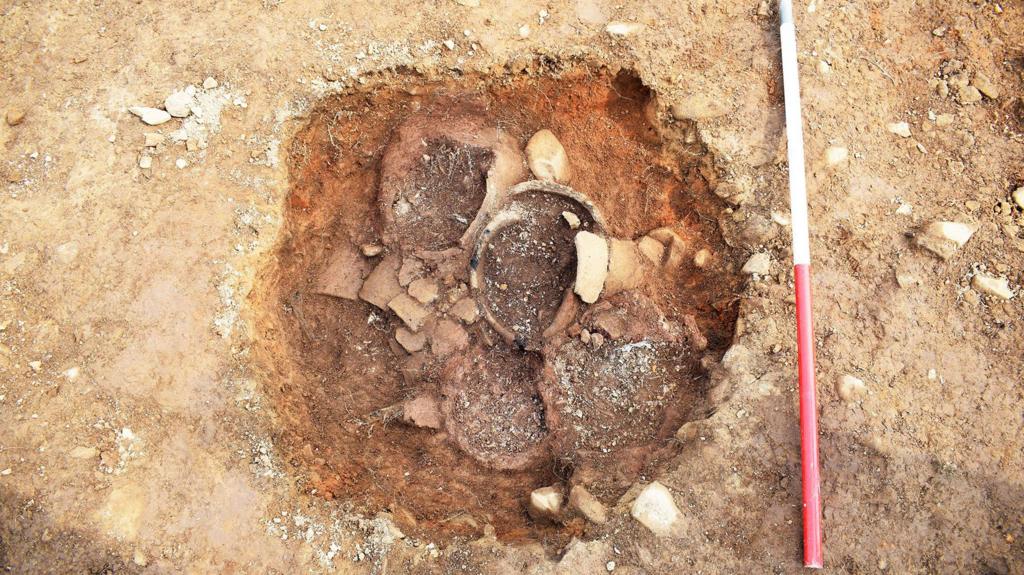
The excavation uncovered a Bronze Age barrow, an ancient burial mound, containing the cremated remains of multiple individuals within five closely-packed urns.
Archaeologist Thomas Muir, who directed the excavation, suggested the mass burial may be attributed to a “horrible event,” such as a famine, leading to a high number of deaths within a short period.
The wind farm is situated about three miles (4.8km) south of Sanquhar in a rugged, upland terrain.
During their work, Guard Archaeology discovered the urns containing the cremated bones of at least eight individuals, all interred during a single mass burial event that took place between 1439 and 1287 BC.
A small group of pits located some distance to the north was also excavated, revealing evidence of late Neolithic activity dating between 2867 and 2504 BC.
“The five urns in the Twentyshilling Barrow contained the remains of at least eight individuals,” stated Mr. Muir.
“The urns were deposited simultaneously, tightly packed within the pit, and share a date range of the 15th to 13th Century BC.”
He explained that this indicates a single mass burial, “possibly of members of the same family or group.”
“What is significant about the Twentyshilling remains is that they were cremated and then buried almost immediately,” he noted.
He clarified that this is unusual, given the “quite a tradition” during the Bronze Age of leaving bodies exposed for a period, as observed at another dig in Broughton in the Scottish Borders.
“That site had been reopened and reused several times, indicating use by a community over an extended period,” he said.
“In contrast, the findings at Twentyshilling suggest a catastrophic event, possibly famine, that resulted in the deaths of numerous individuals within a very short timeframe.”
The Bronze Age in the area may have been “a time of particular stress,” as other burial sites in the region exhibit evidence of famine and abandonment.
The archaeological work at Twentyshilling was a prerequisite for planning permission for the now fully operational wind farm.
Attractions recreating the ocean liner’s fateful voyage are drawing in crowds. But are they valuable historical experiences, or cynically turning tragedy into entertainment?
Scientists say they now know where the ‘Beachy Head Lady’, an ancient skeleton, actually came from.
TV’s suggestive “Launderette” Levi’s advert was first shown 40 years ago, and sales went through the roof. The ad marked a turning point – and its influence continues today.
Almost £1.3m of government money will be spent on major repairs to the Grade I listed Norman castle.
Discoveries on the list include a lost medieval village and a hillfort possibly attacked by the Romans.
“`