

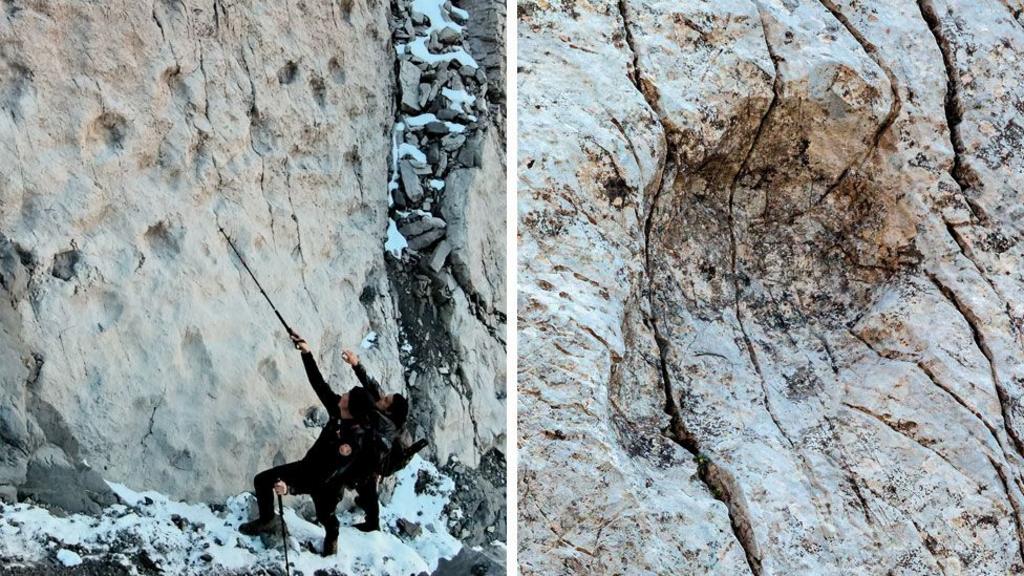
A remarkable discovery in northern Italy’s Stelvio National Park has revealed thousands of dinosaur footprints, estimated to be 210 million years old.
The fossilized tracks, some measuring up to 40cm (15in) in diameter, are arranged in parallel rows, with many displaying distinct imprints of toes and claws.
Experts believe the footprints belong to prosauropods, herbivorous dinosaurs characterized by their long necks, small heads, and sharp claws.
“I never would have imagined I’d come across such a spectacular discovery in the region where I live,” stated Cristiano Dal Sasso, a paleontologist based in Milan.
The site was initially identified last September by a photographer who observed the footprints stretching for hundreds of meters across a vertical mountain face within the national park, located northeast of Milan.
During the Triassic period, approximately 250 to 201 million years ago, the mountain wall was a tidal flat that subsequently became part of the Alpine mountain range.
“This place was full of dinosaurs; it’s an immense scientific treasure,” Dal Sasso emphasized.
He further noted that the herds appeared to have moved in a coordinated manner, adding, “and there are also traces of more complex behaviours, like groups of animals gathering in a circle, perhaps for the purposes of defence.”
While prosauropods, which could reach lengths of up to 10m (33ft), typically walked on two legs, the presence of handprints in front of some footprints suggests they occasionally rested their forelimbs on the ground.
Elio Della Ferrera, the photographer who first discovered the site, expressed hope that the find would “spark reflection in all of us, highlighting how little we know about the places we live in: our home, our planet”.
According to a press release from the Italian culture ministry, due to the area’s remoteness and lack of accessible paths, drones and remote sensing technology will be utilized for further study.
The Stelvio National Park, located in the Fraele valley near Italy’s border with Switzerland, is situated close to the venue for the upcoming Winter Olympics.
“It’s as if history itself wanted to pay homage to the greatest global sporting event, combining past and present in a symbolic passing of the baton between nature and sport,” the Italian Ministry of Culture stated.