

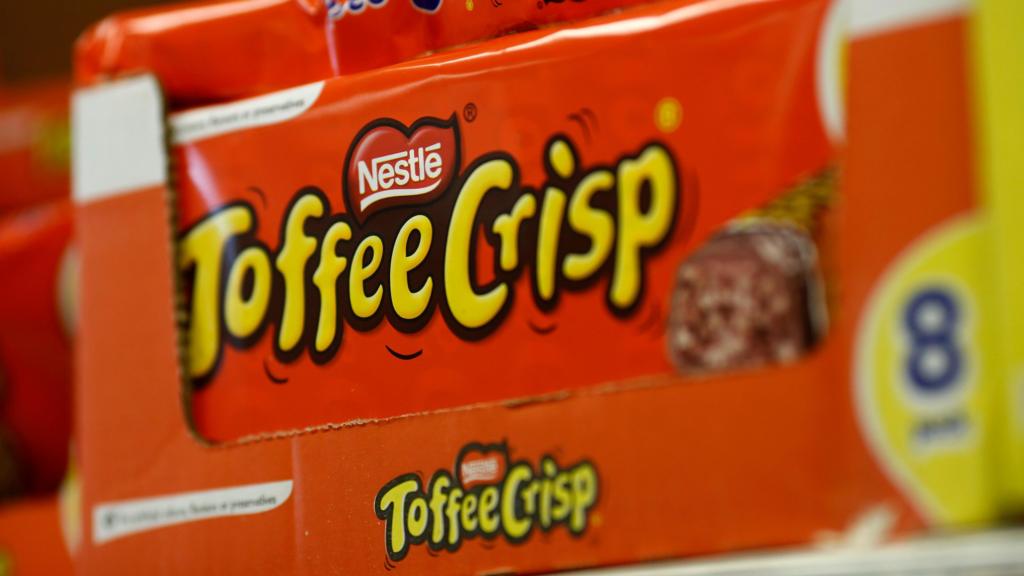
Nestle’s Toffee Crisp and Blue Riband bars will no longer be classified as chocolate products following recipe adjustments.
To meet UK standards for milk chocolate, a product must contain a minimum of 20% cocoa solids and 20% milk solids. The reformulated bars now fall below these thresholds due to an increased proportion of less expensive vegetable fat.
Nestle attributed the recipe changes to rising input costs, stating that the new formulations were “carefully developed and sensory tested.” The company also indicated that there are no current plans to alter the recipes of its other chocolate products.
As ingredient costs, particularly cocoa and butter, have increased, food manufacturers have been modifying recipes to reduce the quantity of these pricier components, in addition to reducing serving sizes.
The products are now described by Nestle as being “encased in a smooth milk chocolate flavour coating,” rather than being covered in milk chocolate.
A Nestle spokesperson explained that the company has experienced “significant increases in the cost of cocoa over the past years, making it much more expensive to manufacture our products. We continue to be more efficient and absorb increasing costs where possible.”
The change to the bars’ ingredients was initially reported by The Grocer.
Nestle is among several manufacturers implementing such reformulations.
In October, McVitie’s Penguin and Club bars were relabeled as “chocolate flavour” after their parent company, Pladis, opted to use cheaper alternatives to cocoa, reducing its overall content.
While cocoa commodity prices have recently seen a slight decrease, the cost of chocolate has been driven up by a surge in costs over the past three years, attributed to poor harvests and droughts.
The practice of altering ingredient proportions in food and beverage manufacturing due to cost pressures is sometimes referred to as “skimpflation.”
This trend has become increasingly prevalent in recent years, as inflation has elevated production costs.
Reports in 2024 indicated that supermarkets have reduced the proportion of more expensive ingredients, such as beef and chicken, in their ready-made meals.
An Egyptian snack, Icelandic pool culture, Cuban music and Albanian lahuta music also get recognition.
McDonald’s said the moment served as “an important learning” as it explored “the effective use of AI”.
The produce will be planted in 2026 with any surplus used for cooking workshops.
Ben Cohen was speaking about his concerns for the independence of Ben & Jerry’s board.
A period underwear company claims its taglines were copied, but Sweaty Betty disputes this.