

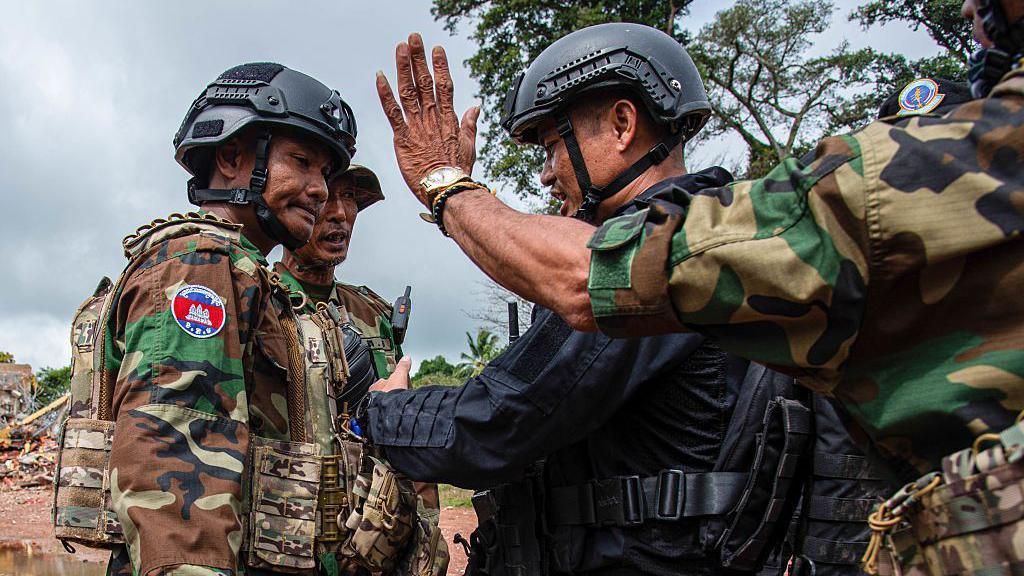
Renewed artillery fire, rocket launches, and aerial bombardments echo along the Thai-Cambodian border, signaling a resurgence of conflict.
Communities within a corridor stretching hundreds of kilometers are being evacuated for the second time in just five months. Families, along with their pets, find themselves in temporary shelters, uncertain about when they can return home and whether they will be forced to flee again.
Why has this escalation occurred so soon after the ceasefire brokered by then-President Donald Trump in July?
The recent outbreak was triggered by a seemingly minor incident on Sunday. According to the Thai army, a Thai engineering team working on an access road in the contested border region was fired upon by Cambodian troops, resulting in injuries to two Thai soldiers.
In the past, such incidents might have been resolved through swift diplomatic efforts. However, such diplomacy has been notably absent this year. Instead, a deep-seated mistrust persists between these two neighbors, a divide that even Trump’s deal-making prowess has failed to bridge.
Despite his claim of achieving a historic peace agreement, the ceasefire he imposed on the two countries in July was inherently fragile.
Thailand, in particular, harbored reservations about internationalizing the border conflict and only agreed to the ceasefire due to the threat of tariffs from the United States. At the time, both Thailand and Cambodia faced an impending deadline to negotiate significantly lower tariff rates on their vital exports to the U.S.
Cambodia, conversely, welcomes external intervention. As the smaller nation, it perceives itself at a disadvantage in bilateral negotiations with Thailand.
However, its troops have continued to engage in confrontations with the Thai army along the border and, in a move that has angered the Thai public, have laid new landmines, resulting in injuries to seven Thai soldiers. Thailand has presented compelling evidence of these actions, accusing Cambodia of acting in bad faith and refusing to release 18 of its soldiers captured in July.
Since July, any constraints on the Thai armed forces have dissipated. Current Prime Minister Anutin Charvirakul, leading a minority coalition and facing other challenges, has granted the military considerable latitude in managing the border conflict.
The army’s stated goal is to inflict sufficient damage on its Cambodian counterpart to ensure it can no longer pose a threat to border communities. It also seeks to gain control of strategic hilltop positions that would provide its soldiers with a greater advantage in future engagements with Cambodian forces.
Both sides have been maneuvering around these positions throughout the year, attempting to reinforce access roads and fortifications.
The Thais believed they were making progress in pushing back the Cambodians when they were forced to halt operations in July. The military now aims to complete this objective.
It also views its role in defending Thailand’s territorial claims as sacrosanct, despite the fact that this conflict revolves around small, mostly uninhabited parcels of land.
The motivations driving the Cambodian leadership are more difficult to decipher.
Former Prime Minister Hun Sen continues to exert influence over his son, the current Prime Minister Hun Manet. Publicly, he has appealed for restraint from his troops, portraying Cambodia as being bullied by a more powerful neighbor and in need of international support.
However, his interventions in this ongoing border dispute have been decisive this year, particularly his decision to leak a confidential phone conversation with the then-Thai Prime Minister Paetongtarn Shinawatra, whose father, Thaksin, was a long-standing friend and business partner of Hun Sen’s.
Her leaked comments, praising him and criticizing her own army commanders for being overly aggressive, proved catastrophic for her and her father. Her government collapsed, he was imprisoned, and many Thais, even those who strongly opposed the Shinawatra family, were angered by the perception that Cambodia had meddled in Thai politics.
Thai public opinion now largely supports the army’s hard-line approach to Cambodia.
Can President Trump successfully mediate again as he did in July? It is possible.
However, if all he achieves is another ceasefire, it will only be a matter of time before fighting resumes. Thailand has repeatedly stated that it is not yet ready for diplomacy, asserting that Cambodia must demonstrate sincerity before it is willing to consider another ceasefire.
The precise meaning of this is unclear, but it would require, at a minimum, a definitive and verified cessation of landmine use along the border.
The levies are set to take effect on 1 January and will apply to goods like cars, clothing and appliances.
Donald Trump, who brokered an earlier ceasefire, says he plans to “make a phone call” to stop the fighting.
The roots of the South East Asian neighbours’ dispute go back more than a century.
At least five people have been killed in the most serious confrontation between both sides since July.
The ban was primarily introduced to stop government employees from drinking during work hours.