

“`html
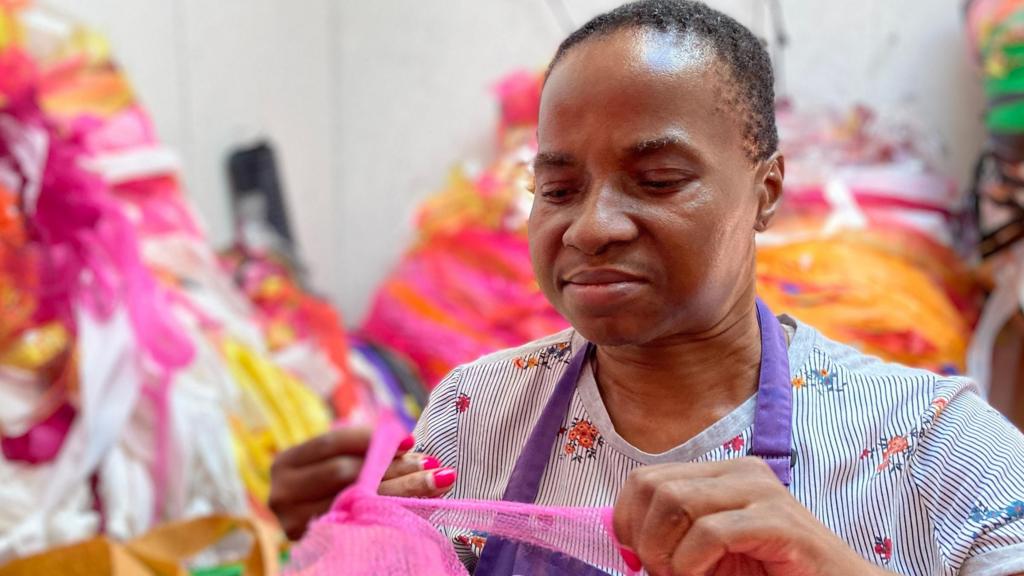
Nnena Kalu has been awarded this year’s Turner Prize, the UK’s most prestigious art accolade, for her “bold and compelling” sculptures and drawings. She becomes the first artist with a learning disability to achieve this distinction.
Judges lauded Kalu’s vibrantly colored sculptures, characterized by their intricate layering of ribbon, string, card, and repurposed VHS tape, as well as her captivating drawings featuring swirling, tornado-like forms.
Kalu, aged 59, is an autistic artist with a learning disability who has limited verbal communication.
Charlotte Hollinshead, who has collaborated with Kalu for 25 years, stated at the awards ceremony: “This is a momentous occasion for many. It’s a seismic shift, breaking down a long-standing barrier.”
In a heartfelt speech delivered alongside Kalu, she added: “This extraordinary woman has dedicated herself to her craft for an extended period.
“It is truly gratifying to see her receive the recognition she rightfully deserves.”
Kalu, who was born in Glasgow and is now based in London, was announced as the winner of the prize, accompanied by £25,000 in funding, at a ceremony held in Bradford, the current UK City of Culture, on Tuesday.
She accepted the award wearing a rosette displaying her photograph and the words: “Idol, legend, winner, whatever.”
Kalu’s artistic recognition has steadily grown in recent years, following her residency with Action Space, an organization supporting artists with learning disabilities, which began in 1999.
Hollinshead, Kalu’s studio manager and artistic facilitator, commented: “We are thrilled that Nnena’s talent and exquisite work are now accessible to a wider audience, showcasing this complex artist who creates stunning, intricate forms, often accompanied by loud disco music.”
“Nnena’s career reflects the lengthy and frequently challenging journey we have undertaken together to challenge preconceptions about artists with disabilities, particularly learning disabled artists, a valuable creative community that is often underestimated.”
“When Nnena first joined Action Space in 1999, the art world showed little interest.”
“Her work lacked respect, visibility, and was certainly not considered fashionable.”
“Nnena has encountered significant discrimination, which persists to this day, so we hope this award will dismantle those prejudices.”
“Nnena Kalu, you have made history!”
While Kalu’s work has elicited varied responses from art critics, the Turner Prize judges were impressed by the “genuinely compelling sculptures and drawings that could only have been created by Nnena,” according to jury chairman Alex Farquharson, director of Tate Britain.
He described her drawings, often presented in sets of two or three near-identical shapes, as possessing “a beautiful intricacy” and resembling “swirling vortexes.”
Her sculptures, in contrast, consist of hanging forms enveloped in layers of repurposed materials, including fabric, rope, parcel tape, cling film, and paper.
Farquharson likened them to three-dimensional interpretations of abstract expressionist paintings.
“However, they transcend mere paintings; they are not confined to the wall. They are suspended within the space you occupy, resembling brightly colored rocks or creatures.”
“Positioned almost at eye level, these forms, devoid of figurative elements, appear to communicate among themselves and with the viewer.”
“The use of materials is highly unconventional, including video tape that is meticulously wrapped around and around.”
“The colors and lines created by these materials evoke brushstrokes translated into three dimensions. They are highly gestural, expressive, and compelling.”
Farquharson stated that the judges deliberated for two to three hours, emphasizing that their decision was solely based on artistic merit.
“The primary motivation was not simply to award the prize to Nnena as a neurodiverse artist. That was not the driving force,” he explained.
“Instead, it stemmed from a genuine interest in and belief in the quality and uniqueness of her artistic practice, which is inextricably linked to her identity.”
He acknowledged that it is a historic moment, telling BBC News.
“It dismantles the barriers between neurotypical and neurodiverse artists, emphasizing the power and quality of the work itself, irrespective of the artist’s identity.”
“Perhaps its historical significance lies in its contribution to a more inclusive representation of exceptional neurodiverse artists in the contemporary art landscape.”
The announcement took place at a ceremony at Bradford Grammar School, the alma mater of artist David Hockney.
Works by all four shortlisted artists are currently featured in the Turner Prize exhibition at the nearby Cartwright Hall gallery, on display until 22 February 2026.
The other nominees, Rene Matić, Zadie Xa, and Mohammed Sami, will each receive £10,000.
Since its inception in 1984, the Turner Prize has remained the UK’s most coveted and controversial art award. Past winners include Lubaina Himid, Jeremy Deller, Grayson Perry, Steve McQueen, and Damien Hirst.
Sign up here to receive our weekly newsletter highlighting uplifting stories and remarkable people from around the world.
Using body-tracking sensors, visitors can interact with futuristic sea creatures in glowing waters.
Debbie Carr has painted about 20 windows in Dudleston Heath this Christmas.
Brazilian officials say thieves held up a security guard and an elderly couple before making off with the artworks, including some by the famed French artist Henri Matisse.
A council wants to reopen the facility under a new name, but some say the plan is a waste of money.
The parish council wanted to bring the shelter to life after it was damaged.
“`