

The U.S. Federal Reserve has implemented a third interest rate cut this year, amidst internal disagreements that are casting doubt on the likelihood of further reductions in the near term.
On Wednesday, the central bank announced a 0.25 percentage point decrease to its benchmark lending rate, placing it within a target range of 3.50% to 3.75% – the lowest it has been in three years.
However, a divide has emerged among policymakers regarding the Fed’s approach to balancing potentially conflicting objectives: a softening labor market versus the risk of rising inflation.
Economic projections released by the Fed on Wednesday indicate a potential rate cut in the coming year, although this remains subject to change based on evolving economic data.
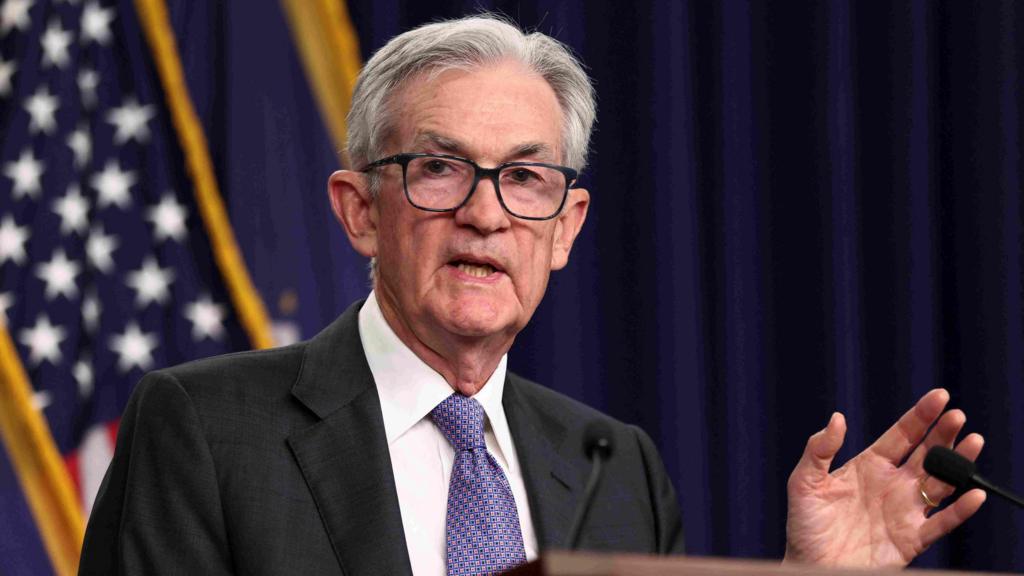
Fed Chair Jerome Powell stated that policymakers need time to assess the full impact of the three rate cuts implemented this year on the U.S. economy. He added that incoming data will be closely monitored in advance of the Fed’s next meeting in January.
“We are well-positioned to wait to see how the economy evolves,” Powell told reporters during a press conference.
Those anticipating further interest rate cuts, including President Donald Trump, may need to exercise patience.
Powell acknowledged that the Fed is navigating a “very challenging situation” as it grapples with the dual risks of rising inflation and unemployment, stating that “you can’t do two things at once.”
The decision to lower rates on Wednesday was not unanimous, highlighting increasing divergence among central bankers regarding the outlook for the U.S. economy.
Three Fed officials dissented from the majority decision.
Stephen Miran, currently on leave from his position leading Trump’s Council of Economic Advisers, advocated for a more substantial 0.5 percentage point reduction.
Austan Goolsbee, president of the Federal Reserve Bank of Chicago, and Jeffrey Schmid, president of the Federal Reserve Bank of Kansas City, both voted to maintain rates at their current levels.
President Trump, who has consistently urged Powell to lower rates, commented after the meeting that the Fed’s cut could have been “at least doubled.”
“Our rates should be much lower,” he asserted during a roundtable discussion at the White House. “We should have the lowest rates in the world.”
The absence of comprehensive economic data during the recent U.S. government shutdown, which concluded in November, has left policymakers with an incomplete picture of the economy’s current state. However, concerns surrounding a potential slowdown in the job market appear to be outweighing inflation concerns, at least for the time being.
According to Labor Department figures released in a delayed report last month, the unemployment rate edged up from 4.3% to 4.4% in September. Lowering interest rates is intended to stimulate job creation by reducing borrowing costs for businesses.
Earlier in the year, fears of tariff-driven inflation took precedence as President Trump implemented extensive tariffs on goods from many of the country’s major trading partners.
Inflation remains above the Fed’s 2% target, reaching 3% in September for the first time since January.
Analysts suggest that while tariffs appear to be contributing to some consumer price increases, recent inflation readings that have been milder than anticipated have allowed the Fed to prioritize bolstering the labor market through interest rate reductions.
Despite this shift in focus, policymakers remain divided regarding the appropriate path forward for interest rates.
When questioned about the internal disagreement among policymakers, Powell acknowledged that it is “unusual” to have “persistent tension” between the Fed’s dual mandate of maintaining price stability and minimizing unemployment.
“And when you do, this is what you see,” he said, referring to the growing divisions.
Nevertheless, Powell characterized the internal debate between Fed officials as thoughtful and respectful.
“We come together and we reach a place where we can make a decision,” he said.
The central bank’s “dot plot,” a quarterly summary of anonymous economic projections, revealed on Wednesday a median expectation for one additional 0.25 percentage point cut in 2026.
This forecast remained unchanged from the previous dot plot released in September.
Central bankers are expected to gain greater clarity next week with the anticipated release of official data on the labor market and inflation for November.
The incoming data could potentially shift policymakers’ outlook, potentially strengthening calls for further easing in the coming year if new evidence emerges suggesting a stalling job market.
President Trump’s search for a replacement for Powell as Fed chair, whose term concludes next May, is adding to the uncertainty surrounding the future direction of Fed policy.
Trump could announce his selection within the next few weeks.
Kevin Hassett, a long-time conservative economist and key economic advisor to Trump, is considered the leading candidate to succeed Powell.
A staunch loyalist to Trump, Hassett served as chair of the White House Council of Economic Advisers during Trump’s first term and currently leads the National Economic Council.
He has consistently defended Trump’s economic policies, dismissing data that indicates weakness in the U.S. economy, reiterating allegations of bias within the Bureau of Labor Statistics, and supporting Trump’s handling of the Fed.
Hassett’s allegiance to the president has raised concerns among analysts regarding his potential for independent action and the degree of influence he would wield with other members of the board.
Other individuals who have been mentioned as potential candidates for Fed chair include economist Kevin Warsh, current Fed Governor Christopher Waller, and even Treasury Secretary Scott Bessent.
Trump is “still making up his mind, and he’s looking for someone who will be in his way of thinking,” Thomas Hoenig, a distinguished senior fellow at the Mercatus Center, told the BBC.
He added that the candidates “have to project that they will be independent, or the markets will become quite nervous – and that will create more volatility.”
When asked on Wednesday whether Trump’s search for a new Fed chair was hindering his job or influencing his thinking, Powell responded with a definitive “no.”
The plan would affect people from countries, including the UK, who can fill out a form in lieu of a visa.
The president escalates his immigration rhetoric in a speech his advisers, and party, had expected to focus on the economy.
The US State Department will be required to use Times New Roman instead of Calibri for official documents, starting 10 December.
A federal judge says materials from the investigation can be unsealed because of a new law passed by Congress last month.
The judge has ordered control of the the troops, which were deployed in June, to be returned to California’s governor.