

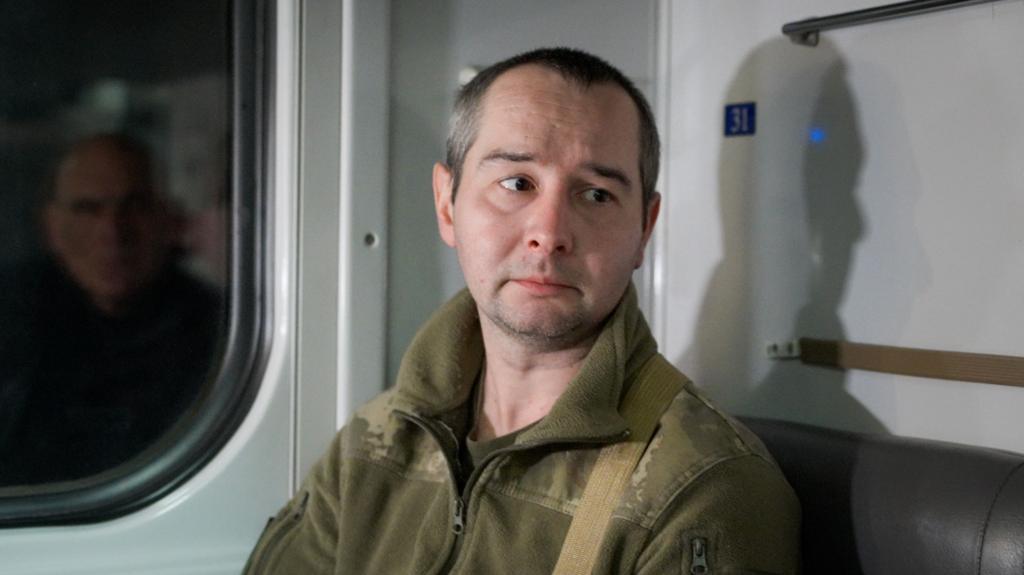
Train services to the eastern Donetsk region of Ukraine, a part of the Donbas region claimed in its entirety by Russian President Vladimir Putin, have been suspended. This cessation of transport signals a further advance by Russian forces.
The new terminus now lies on the western edge of the Donetsk border, where civilians and soldiers await transport to safer areas, marking their departure from the conflict zone.
President Putin has adopted a more assertive tone following the leak of U.S. proposals for a ceasefire, which are perceived to align with his maximalist demands. Ukrainian President Volodymyr Zelensky has identified territorial disputes as the primary obstacle in ongoing U.S.-led peace negotiations.
At the newly established last station, soldier Andrii bids farewell to his girlfriend, Polina, after a brief reunion. Andrii’s return to the front lines leaves their next meeting uncertain.
He responds with skepticism to mentions of potential peace talks, involving envoys of Donald Trump who have engaged with Ukrainian negotiators before proceeding to Moscow, dismissing them as “chatter.” He anticipates that a swift resolution to the conflict is unlikely.
Other soldiers also express skepticism, as they board trains westward for brief respites from the fighting, utilizing a portion of their allotted 20 days of leave. The majority appear visibly fatigued.
Currently, Russian forces control approximately 85% of the Donbas, which includes Luhansk and Donetsk. They recently announced the capture of Pokrovsk, a strategically important town within Donetsk on Tuesday, although Ukraine maintains that fighting persists within the city.
Denys, a two-year veteran of the Ukrainian army, remarked that “everyone’s drained, everyone’s tired mentally and physically.”
Some of his fellow soldiers have already fallen asleep. His unit has been actively engaged in the defense of the besieged city of Kostyantynivka.
“It’s scary, really scary,” he conveys, referencing drones that ubiquitously “like flies”. He affirms, however, that they are unwilling to concede territory after incurring substantial losses.
“Nobody will give Putin the Donbas. No way, it’s our land,” he asserted.
The cession of territories inhabited by an estimated quarter of a million Ukrainians—specifically, the strategically vital cities of Slovyansk, Kramatorsk, and Druzhkivka, known as the Donetsk “fortress belt”—is deemed unacceptable by the majority of Ukrainians.
Russia has been vying for Pokrovsk for more than a year, and Ukraine is unwilling to cede such important strategic hubs.
However, U.S. officials suggest that Ukraine is facing disadvantages in both personnel and equipment.
The civilian population has already experienced a mass exodus from the Donbas, an ongoing trend as peace talks proceed. Observers have noted the arrival of numerous individuals, both young and old, at a reception center in Lozova, situated just beyond the border.
These individuals capitalized on dense fog to facilitate their escape, thereby minimizing the likelihood of drone targeting. Approximately two hundred individuals arrive daily at this specific reception center, where they are provided with basic necessities and limited financial assistance.
Yevheniy and his wife, Maryna, have just arrived from Kramatorsk, accompanied by their two children. She recounts the increasing presence of drones, stating, “more drones now.” She continues, “It’s getting harder and harder to even go outside. Everything is dangerous. Even going to the shop, you might not come back.”
The family intends to relocate to Kyiv. Yevheniy expresses a lack of confidence in the peace talks, stating that “that side [Russia] won’t agree to our terms. We understand nothing good will come of it.”
Conversely, some appear more amenable to permanently relinquishing their homes in exchange for peace.
Oleksandr states that remaining is too hazardous. His children have already taken refuge in Germany. While he describes Russia’s maximalist demands as “probably unacceptable,” he appears receptive to considering elements of the leaked peace plan, which entails trading territory for peace. The initial U.S. proposal suggested that areas of the Donbas still under Ukrainian control be handed over to Russia de facto.
“Personally I would agree to those terms,” he admits.
Inna, who is fleeing with her five children, also believes that it is time to reach a settlement. She could no longer shield her children, aged between nine months and 12 years, from the perils of life in Kramatorsk. She had been attempting to explain to them that the explosions they heard while sheltering in their cellar were merely fireworks.
“The main thing is that there will be peace,” Inna emphasizes. When questioned about whether that would entail permanently giving up her home, she concedes, “in this situation, yes.” They are already developing strategies to rebuild their lives in an alternative location.
There is evidence of discontent amongst some soldiers, almost 300,000 cases of desertion, or soldiers going absent without official leave, since the start of Russia’s full scale invasion – and numbers have risen dramatically over the past year.
One of these individuals is Serhii—a pseudonym used to protect his identity. He was located in hiding, having transformed his home into a self-imposed prison in an effort to avoid apprehension. Serhii volunteered for military service at the beginning of the year, in contrast to the majority of men in his unit who were forcibly conscripted—”taken off the street.”
He reports that his unit was already understaffed at the time it was dispatched to the front lines near Pokrovsk, and that the soldiers had not received adequate training or sufficient equipment. “I ended up in a battalion where everything was a mess,” he acknowledges, while also emphasizing that he believed this to be an isolated incident rather than the norm.
Serhii deserted in May, following the unauthorized absences of two of his comrades.
“I wouldn’t have gone if we had proper leadership and someone experienced in charge,” he asserted. “I came to serve, not to run.”
Serhii is currently contemplating his next steps, including the possibility of returning to military service. He corroborates recent U.S. warnings that the odds in this conflict are stacked against Ukraine.
When asked whether he believes Ukraine can achieve victory, he expresses reservations: “If you think logically, no. A country of 140 million against us with 32 million—logically it doesn’t add up.”
Additional reporting by Mariana Matveichuk
The foreign minister says the EU is downplaying its concerns and over the plan which Belgium sees as “fundamentally wrong”.
A report into the death of Dawn Sturgess, poisoned by the nerve agent Novichok in Salisbury in 2018, will be released on Thursday.
Five hours of talks between Putin and US negotiators were “constructive”, Kremlin officials say, but “a lot of work lies ahead”.
The announcement was made by Taoiseach Micheál Martin at a press conference on Tuesday.
The group has been charged under a law which prohibits people from joining foreign armies.