

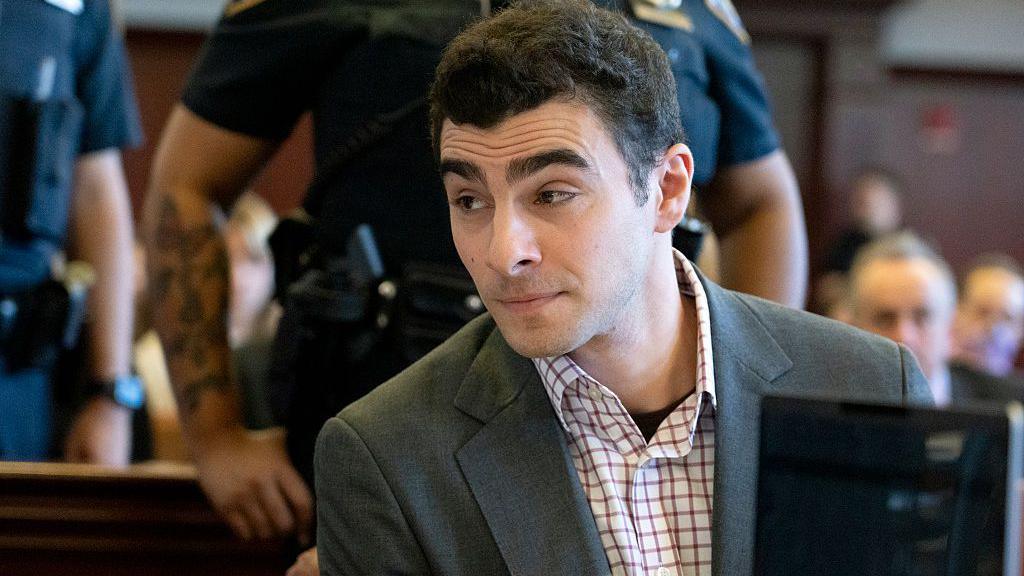
Luigi Mangione, accused of the fatal shooting of United Healthcare CEO Brian Thompson in Manhattan a year ago this week, appeared in court on Monday. His legal team is challenging the admissibility of key evidence in the case.
Mr. Mangione, 27, has pleaded not guilty to both state and federal murder charges, which could carry the death penalty.
The pre-trial hearing is expected to last several days, with defense attorneys planning to call witnesses, including individuals from Pennsylvania, where Mr. Mangione was apprehended at a McDonald’s.
In September, a judge dismissed state terrorism-related murder charges against Mr. Mangione, citing a lack of sufficient evidence presented by prosecutors.
Mr. Mangione’s defense is now seeking to exclude evidence, including a firearm and a notebook, which prosecutors allege outlines a motive.
The defendant was arrested days after the alleged shooting of Mr. Thompson, a father of two, as he entered an investors’ conference on a busy Manhattan street on December 4, 2024.
A trial date for either the state or federal case has not yet been scheduled.
Upon entering the courtroom on Monday, Mr. Mangione was wearing a grey suit and shirt. Court personnel removed his restraints at the request of his attorneys before he was seated.
This week’s hearing centers on whether prosecutors illegally obtained evidence from Mr. Mangione during his arrest in Altoona, Pennsylvania, and whether that evidence should be suppressed.
Defense attorneys are aiming to suppress statements Mr. Mangione made to police after his arrest, including allegedly providing a false name.
They contend that these statements were made before he was informed of his rights, including the right to remain silent.
His legal team is also seeking to exclude a 9mm handgun, which prosecutors claim matches the weapon used in the killing, as well as writings discovered in Mr. Mangione’s backpack.
Prosecutors have asserted that Mr. Mangione – a graduate of an Ivy League university and member of a prominent Maryland family – wrote in his notebook about “the deadly, greed fueled health insurance cartel”.
Defense lawyers argue that his backpack was searched without a warrant, making any items found therein inadmissible.
Excluding this crucial evidence – potentially linking Mr. Mangione to a murder weapon and motive – would be a significant victory for his defense team.
However, Dmitriy Shakhnevich, a criminal defense attorney in New York, suggests that the likelihood of this occurring is “virtually non existent”.
He explained that numerous exceptions exist to the constitutional requirement for law enforcement to secure a warrant for personal searches, and some of these exceptions may apply to this case.
“In a case like this where there’s a manhunt for a violent suspect who committed this alleged crime in plain view in New York City, nobody’s getting a warrant,” Mr. Shakhnevich stated.
“When they get him, they’re going to search him.”
Prosecutors maintain they possess other key evidence against Mr. Mangione, including DNA or fingerprints found on items discarded near the crime scene.
Mr. Shakhnevich believes Mr. Mangione’s attorneys are likely aware of the long odds of having evidence excluded.
He added that the primary purpose of such proceedings for defense lawyers is often to preview trial testimony from law enforcement.
The court has heard testimony from New York Police Department Deputy Commissioner of Public Information Sgt. Chris McLaughlin, who was asked to review surveillance images from after the shooting.
Prosecutors also presented CCTV footage of the killing. A worker who managed security cameras at the McDonald’s in Altoona testified as well.
Prosecutors played a 911 call for the court from a manager at the fast food restaurant who said customers had told her one patron looked like the suspect in Mr Thompson’s killing. The manager said she had looked online for pictures of him but could only make out Mr Mangione’s eyebrows as he ate in the restaurant, since he wore a hat and face mask.
The court also heard from a correctional officer at the jail where Mr Mangione was being held who said he appeared “unbothered and logical” as the two discussed literature and health care, though Mr Mangione did not give his opinion on the latter topic.
The officer said Mr Mangione was placed under a high level of security because they wanted to avoid an “Epstein-style situation”, a reference to convicted sex offender Jeffrey Epstein, who killed himself while in a federal detention centre.
Mr. Shakhnevich stated that the legal team aims to gather this type of information from witnesses to anticipate potential trial testimony and identify any inconsistencies in their statements.
“The benefit of the hearing is that you get to have law enforcement officials testify, and you get to bind them to testimony for a trial later on,” he said.
Mr. Mangione’s legal team has also been advocating against the federal government seeking the death penalty.
They argue that public comments from high-ranking officials, including Attorney General Pam Bondi, accusing Mr. Mangione of the murder have prejudiced his case, alleging it is motivated by political considerations.
“They deserve to be in jail. They deserve to go to hell,” she said of the person who killed four people at the party for her two-year-old.
Thirteen other people were also safely lowered to the ground after a power outage hit the Sunburst Ski Area in the US state of Wisconsin.
The strike has prompted concerns that US forces may have violated laws governing armed conflict.
The donation will help seed new Trump-branded investment accounts.
Juan Orlando Hernández, once called the key figure in a drug trafficking scheme that flooded America with over 400 tonnes of cocaine, walks free after the pardon.