

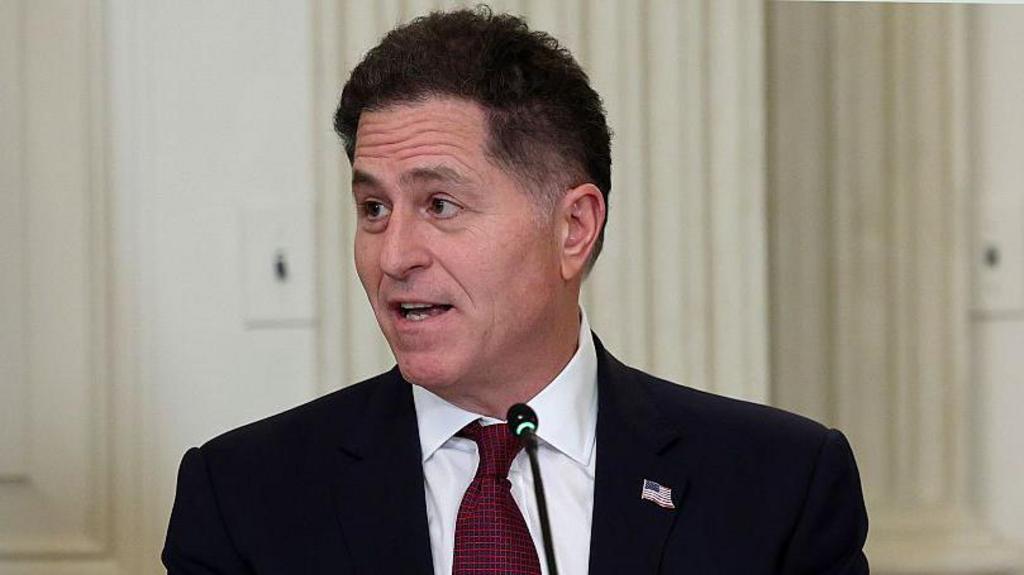
Tech billionaire Michael Dell and his wife, Susan, have announced a philanthropic initiative committing $6.25 billion to provide $250 for 25 million children across the United States.
This substantial donation is intended to bolster Trump-branded investment accounts, recently authorized by Congress as part of a broader tax and spending bill. These accounts aim to encourage families to save for their children’s long-term financial security.
The congressional scheme also stipulates that children born between 2025 and 2028 will be eligible to receive $1,000 from the government to seed these accounts.
The Dells stated that their gift, specifically targeting children aged 10 and under, seeks to amplify the impact of these accounts and extend the opportunity for savings to a wider demographic of children.
“We’ve seen the transformative effect when a child gains even a modest financial head start – it broadens their horizons,” Michael Dell remarked in a video released on Tuesday via social media, formally announcing the donation.
The funds will be channeled through the new Trump-branded accounts, which are accessible to any child under 18 and, by legal requirement, must be invested in a low-cost index fund mirroring the broader stock market.
The Dells clarified that children aged 10 and under, born before January 1, 2025, are eligible for the gift, provided they reside in areas where the median household income is below $150,000.
The philanthropic endeavor is projected to reach nearly 80% of children in the specified age range across the US, marking it as one of the most significant private donations ever directly benefiting American citizens.
Mr. Dell, CEO of Dell Technologies and possessing an estimated fortune of nearly $150 billion according to Forbes, expressed his hope that other philanthropists and employers would emulate this commitment.
“This initiative will provide middle-class families with a stake in American prosperity, benefit from the upward trajectory of the stock market, and enhance their pursuit of the American dream,” stated President Donald Trump at a White House event celebrating the donation and the accounts.
He further added that children holding these accounts would, hopefully, “become very wealthy one day.”
The White House Council of Economic Advisers had previously estimated that an initial deposit of $1,000 could potentially grow to over $5,800 over an 18-year period, assuming a 10.3% rate of return.
Based on the same projections, a $250 contribution could potentially grow to approximately $1,600, according to widely available online calculators.
While the establishment of Trump accounts is not yet feasible, the Treasury Department released a form on Tuesday that enables parents to initiate the process during tax filing.
The department indicated that comprehensive details regarding the administration of these accounts would be released in the coming year.
Parents are eligible to contribute up to $5,000 to these accounts, with the figure being adjusted for inflation. Employers, charitable organizations, and other entities can also contribute to the accounts, which are slated for launch in July.
The funds become accessible to the child upon reaching the age of 18, at which point the account is converted into a retirement savings vehicle. While the money grows tax-free, withdrawals are subject to taxation and potential penalties if made before the age of 59 and a half.
The introduction of Trump accounts has been met with skepticism from critics, who posit that the program will disproportionately benefit wealthier families with discretionary income, offering less flexibility compared to existing savings options.
Earlier this year, Treasury Secretary Scott Bessent faced criticism from Democrats for promoting the program as an alternative to government-funded retirement benefits, characterizing it as a “backdoor to privatizing Social Security.”
The Tax Foundation, a tax policy think tank, described Trump accounts as “well-intentioned” but cautioned that they “add another layer to an already overcomplicated savings account system in the United States.”
“Trump Accounts do not offer much of an additional incentive to save,” the foundation stated. “Rather, the main benefit is in the form of the $1,000 initial deposit from the federal government and whatever employers choose to contribute.”
Grayson Chester, a new father, shared a similar perspective.
The Seattle-based tax lawyer suggested that alternative savings plans, such as the education-focused 529 plans, may provide more favorable options for now. However, he affirmed his intention to accept the $1,000 government contribution.
“I will gladly accept $1,000 and keep it invested,” stated the 35-year-old, whose first child was born two months ago. “However, whether I would contribute my own funds remains uncertain, as I currently see no distinct advantages.”
He noted that charitable contributions, such as the donation announced by the Dells, potentially make the program more compelling for parents like himself. Dell Technologies is also among the employers committing to contribute to employees’ accounts.
“Any component that resembles or embodies ‘free money’ will invariably enhance the program’s appeal,” Mr. Chester concluded.