

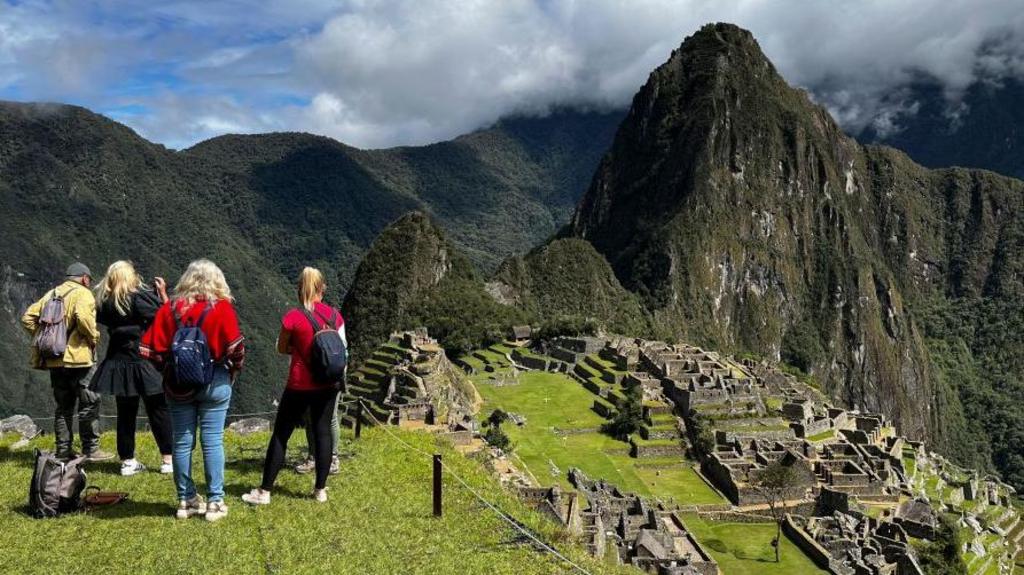
Machu Picchu, the iconic 15th-century Inca citadel and UNESCO World Heritage site, remains Peru’s premier tourist destination. However, a protracted dispute concerning the bus services transporting visitors to the mountaintop location recently resulted in the evacuation of approximately 1,400 stranded tourists.
Cristian Alberto Caballero Chacón serves as the head of operations for Consettur, the bus company that for the past three decades has conveyed around 4,500 individuals daily from the town of Aguas Calientes to Machu Picchu.
The journey is a brief 20-minute ride, with the sole alternative being a challenging, steep, two-hour trek.
Mr. Caballero acknowledges that in recent months, “there have been some conflicts between people from different communities here.”
The core of this conflict stems from Consettur’s loss of its transportation license to a competing bus operator in this remote region of Peru, where public transport is the only option besides traversing the Andean mountain range.
To reach Machu Picchu without hiking, tourists must initially take a train to Aguas Calientes, a journey lasting between two and three-and-a-half hours. Subsequently, they transfer to a bus for the final segment.
In September, local protestors, displeased with the replacement of Consettur following what they perceived as an insufficiently transparent bidding process, barricaded the railway line to Aguas Calientes with rocks.
Consequently, Peruvian authorities were compelled to clear the tracks and facilitate the evacuation of tourists via special train services.
Several local sources, preferring to remain anonymous, indicate that the protestors were discontented with Consettur’s monopoly on the lucrative bus service, alleging that its position as the exclusive provider was simply being transferred to a new entity, San Antonio de Torontoy. A round-trip bus ticket is priced at $24 (£18) for foreign visitors and $15 for Peruvian nationals.
Despite the expiration of Consettur’s license in September, the company continues to operate its bus fleet. Due to ongoing legal challenges, San Antonio de Torontoy has yet to commence operations.
The situation is complex, involving various local communities vying for a share of the bus service revenues. However, Mr. Caballero insists that Consettur is not a monopoly.
“The owners of the business have been running the company for the past 30 years, and they are people who come from around here,” he states. “This is not a monopoly. Consettur is made up of 12 different companies with various partners.”
These partners include the local district council, which holds a 38% stake in Consettur.
Meanwhile, San Antonio de Torontoy is based further afield in the broader Urubamba Province.
As the dispute and legal proceedings surrounding the bus services persist, Australian tourist Annalise Jaksic expresses dissatisfaction with the cost of train travel to Aguas Calientes. The most economical round-trip ticket is priced at $140, escalating to $2,000 for luxury first-class accommodations.
Speaking from Aguas Calientes, she comments, “We thought it was one train [all the way to Machu Picchu]. And we thought if there was any more transport to get up there it would all be included, because you pay so much money for the train.”
Her travel companion, Todd Carland, adds that securing entry tickets to the site “was a nightmare for us,” citing difficulties encountered due to their decision to forego an expensive guided tour. A standard adult ticket to Machu Picchu costs $57.
The mayor of Aguas Calientes, Elvis La Torre, also voices concerns regarding the entry ticket system, asserting that the majority of revenues fail to benefit the local community.
“Only 10% of the ticket sales stay in the region. The rest of the money goes to the Ministry of Culture to look after other archaeological sites around Peru and pay for wages.”
He advocates for increased financial allocation to his community and the surrounding region to bolster tourism and fund local development projects. The Ministry of Culture has been contacted for comment.
Outside, on a side street lined with stalls offering tourism souvenirs such as alpaca plush toys and scarves, Dina Huillca sits on the pavement selling roses, tomatoes, and mint. She travels from her village to conduct her business, emphasizing that “more needs to be done for the local communities.”
She elaborates, “We don’t have basic services like running water, or a hospital, and the schools need to be in better condition.”
Carlos González, president of the chamber of tourism for the Department of Cusco, the region encompassing Machu Picchu, advocates for enhanced state oversight of public transport in Peru.
“We are pushing for an update in the law so that the vice ministry of tourism can take care of all the travel resources in our country,” he explains. “If we don’t have a unified approach to Peru as a destination we can’t be competitive in the long term.”
He also seeks to transform the tourist experience at Machu Picchu by creating more entrances and designating separate areas for different visitor profiles.
“[Such as] spiritual travellers going and having meditative rituals in one area,” says Mr. Gonzalez. “And let’s not forget the younger crowd who are more inclined to do their Tik Toks and their stories for Instagram. They also need a place for doing that and enjoying themselves in a young fashion.”
However, he acknowledges that Peru’s unstable national governments hinder progress. The country has seen six different presidents in the past six years.
“I’ve been a leader of the tourism sector for five years now, and I have lost count of how many ministers, vice ministers and congress people I have spoken to.”
Back in Aguas Calientes, Mr. Caballero expresses his willingness to see both Consettur and San Antonio de Torontoy operate bus services to and from Machu Picchu.
“If they are given the final approval we don’t have a problem with working with them. We won’t stop them.”
Non-residents will soon have to pay $100 per person to enter 11 of the United States’ most popular parks.
The label is going into business with tech start-up Suno after settling a lawsuit against the company.
TripZapp founder Rory Okoli wants to make it simple for tourists to book and pay for African travel.
The country once led the world in semiconductors and electronics, but over the years it fell behind Taiwan, South Korea and China.
Strong sales at artificial intelligence chip giant Nvidia did little to quell investor worries.