

“`html
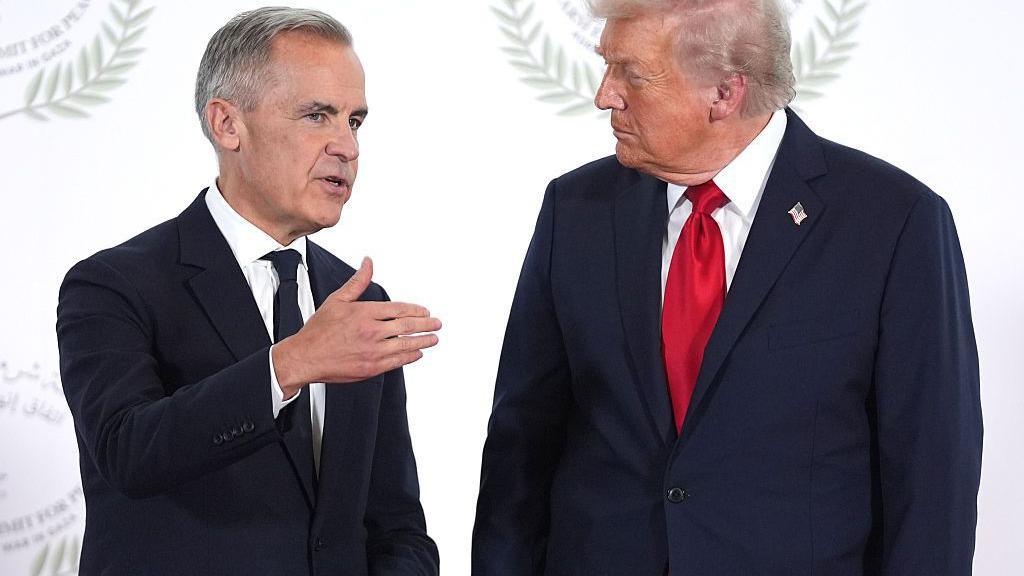
Canadian Prime Minister Mark Carney appears to be in no rush to resume trade negotiations with the United States.
Over the weekend, he dismissed a question about when he last spoke with U.S. President Donald Trump, stating, “Who cares? It’s a detail. I’ll speak to him again when it matters.”
Carney further added that he does not believe there is any “burning issue” that necessitates immediate discussion with his U.S. counterpart.
The Prime Minister’s apparent lack of urgency has drawn criticism, raising questions about whether Canada is shifting its approach to trade talks with the U.S.
However, Carney is scheduled to travel to Washington next week for the FIFA World Cup draw, where he indicated to reporters on Wednesday that he and Trump could potentially meet.
Canada is one of the host countries for the international tournament next year, along with Mexico and the U.S.
Carney mentioned that he and Trump communicate briefly from time to time, including via text messages on Tuesday.
However, he stressed that he does not want people to fixate on “every little exchange,” and that the focus should be on negotiations if and when they resume.
“This is one of those negotiations where there’s a great deal of posturing on both sides,” observed Chris Sands, Director of the Center for Canadian Studies at Johns Hopkins University.
“Trump doesn’t want to look like he needs a deal too badly. Carney doesn’t want to look too desperate either, and so they kind of play each other out trying to look nonchalant. But of course, there’s money on the table, and there’s a lot to be negotiated.”
Discussions between the two nations came to a halt last month after Trump reportedly took offense to an anti-tariff advertisement featuring former U.S. President Ronald Reagan, commissioned by the province of Ontario and aired in the U.S.
Despite the standstill, Canadian representatives are continuing to advocate for the country’s interests with U.S. lawmakers on Capitol Hill, according to Richard Madan, the trade representative for the province of Manitoba, speaking to the BBC.
However, Madan added that formal trade negotiations have not progressed beyond that point.
Ontario’s Reagan ad – in which former President Ronald Reagan says tariffs “hurt every American” – likely struck a chord with Trump, in part because many Americans are reportedly feeling financially strained, said Mr. Sands.
This discontent arises at a politically sensitive time for Trump, with the U.S. midterm elections approaching next year.
Madan noted that many members of Congress are already engaged in campaign activities. “They’re facing some political headwinds on affordability, and these tariffs aren’t helping,” he said.
A November Fox News poll indicated that 76% of U.S. voters hold a negative view of the economy, up from 67% in July, and many believe Trump’s economic policies have been detrimental to them.
The President rolled back tariffs on numerous food items earlier this month and has expressed openness to lowering tariffs on imported metals from Canada and Mexico, provided that certain conditions regarding shifting production to the U.S. are met.
Prior to the abrupt suspension of talks, Trump and Carney were discussing a possible agreement on metals and energy, which Canadian officials had hoped would alleviate the tariffs on Canada’s steel and aluminum sectors.
The U.S. has imposed a 35% levy on all Canadian goods – though most are exempt under an existing free trade agreement. It has also levied sector-specific tariffs on Canadian goods, including a 50% levy on metals and 25% on automobiles.
Approximately three-quarters of Canada’s exports are sold to the U.S., making its economy particularly susceptible. However, Carney has pointed out that, due to the tariff exemption under the current free trade agreement, Canada faces lower tariffs compared to other countries.
Carney’s primary focus has been on his commitment to double Canada’s non-U.S. exports over the next decade. The Prime Minister recently embarked on a series of international trips to promote Canada overseas, including visits to the United Arab Emirates and the G20 summit in South Africa.
In the interim, the Carney government has signaled its intention to provide financial assistance to sectors affected by U.S. tariffs as they navigate the trade challenges.
This relief would be welcomed by Canadian aluminum producers, who have absorbed initial tariff-related costs to fulfill their contractual obligations with U.S. customers.
However, Jean Simard, president and chief executive of the Aluminum Association of Canada, told the BBC that Americans are beginning to feel the pressure as their stockpiles of the metal decrease. He highlighted that the U.S. consumes significantly more aluminum than it produces, making it reliant on imports.
“Time is on our side and pain is on their side,” Mr. Simard stated.
“We can stay the course, and we think it is to the benefit of Canada to take its time and not rush into a deal prematurely.”
Nevertheless, Carney faces external pressure to reach a swift resolution.
Madan noted that U.S. tariffs on heavy machinery have had a significant impact in Manitoba, and individuals in that sector “are deeply concerned.”
The opposition Conservatives have criticized Carney’s recent remarks, alleging that he has “dismissed and derided thousands of job losses as none of his concern.”
They have also accused him of failing to negotiate and deliver a “win” for Canada, as promised during the campaign.
On Tuesday, Carney conceded that his weekend remarks about talks were a “poor choice of words.”
However, with both the U.S. midterm elections and a review of a long-standing free trade agreement between Canada, the U.S., and Mexico scheduled for 2026, some are hopeful that a resolution may be on the horizon.
Mr. Sands noted that the Office of the United States Trade Representative will hold public hearings in early December regarding the free trade agreement, known as USMCA (or CUSMA in Canada).
He believes that both Canada and the U.S. are likely to hear from business organizations advocating for the continuation of free trade.
This could create an opportunity for Carney to state, “The private sector says they want a deal. What can we do?” said Mr. Sands.
The state charges were the last remaining criminal case against the US president stemming from the 2020 election.
The West Virginia Republican and coal magnate has previously called the collection attempts “politically motivated”.
A video by six Democratic lawmakers has set off an acrimonious partisan debate over what constitutes treason.
The Trump administration seems serious about reaching a deal despite all the apparent chaos around its efforts.
Non-residents will soon have to pay $100 per person to enter 11 of the United States’ most popular parks.
“`