

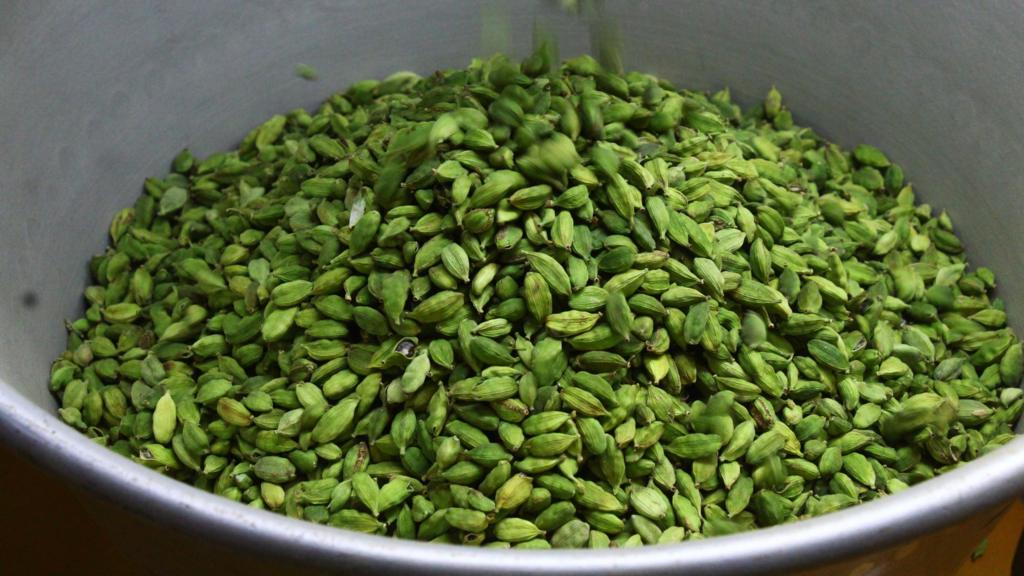
“Cardamom is often perceived as a lucrative crop, and it can be. However, it’s also the most challenging crop a farmer can cultivate,” states Stanley Pothan, a seasoned cardamom farmer in Kerala, India.
The spice, coveted for its complex and aromatic flavour for centuries, presents formidable cultivation challenges.
“Cardamom plants are exceedingly delicate, highly susceptible to diseases and pest infestations. Constant vigilance in the field is required, observing every leaf and flower. It demands daily attention,” Mr. Pothan explains.
The crop is also notably sensitive to weather conditions.
“Last year’s summer was exceptionally harsh, resulting in significant crop losses due to the heat. Guatemala, the world’s leading cardamom producer, experienced nearly 60% crop loss that season, and Kerala suffered substantially as well,” he adds.
This diminished harvest contributed to a 70% surge in cardamom prices, reaching 1,178 rupees (£10; $13) per kilogram, according to India’s Spice Board figures.
Cardamom has historically been an expensive spice, typically ranking as the third most costly by weight, following saffron and vanilla.
Farmers are eager to increase their output, but the obstacles are considerable.
“A severe summer or unexpected rainfall can negate all efforts. This is the stark reality of cardamom farming,” Mr. Pothan emphasizes.
The Indian Cardamom Research Institute (ICRI), a government-funded entity, is working to alleviate the burdens associated with cardamom cultivation.
“Our focus is on enhancing crop quality, monitoring pests and diseases, managing soil, building capacity, and transferring technology pertinent to cardamom,” states Dr. A. B. Reema, Director of the ICRI, an arm of the Spices Board of India.
One tool the ICRI provides is an app that enables farmers to monitor their soil health, offering tailored recommendations for optimal management.
“Technology is now integral to farming. Cardamom growers use digital tools daily, from assessing soil health via apps to monitoring rainfall and disease alerts on their phones,” Dr. Reema notes.
“Even small farmers are now leveraging digital tools. They are no longer solely reliant on local advice; they can assess soil quality, moisture levels, and even identify disease symptoms directly from their fields.”
Simultaneously, scientists are pursuing more resilient cardamom varieties.
“Our primary goal is to develop cardamom varieties resistant to major diseases and pests, while maintaining high yields and climate resilience,” explains Preity Chetty, assistant professor at the Department of Plant Breeding and Genetics, Kerala Agricultural University.
They have achieved initial success by identifying a cardamom variety capable of thriving with limited water.
Researchers are also investigating the genetic makeup of cardamom to pinpoint genetic markers for desirable traits, which should accelerate the breeding process for more productive plants.
“Unlike other spices, cardamom studies are limited, particularly at the molecular level. There is a scarcity of molecular markers for reproductive or yield traits, which we are now addressing,” Dr. Chetty adds.
A crucial step in cardamom farming is the drying of pods post-harvest.
Traditionally, only larger farms could afford to establish their own dryers, often fueled by wood.
“Smaller farmers had to depend on middlemen or neighbours for drying, which often compromised quality,” says Annu Sunny, who founded Graamya, a social enterprise dedicated to assisting Kerala farmers, in 2016.
“Given cardamom’s status as the ‘queen of spices’ and a profitable cash crop, many have ventured into its cultivation,” she notes.
“It’s a very challenging crop. Mastering cardamom—understanding its behaviour, needs, and timing—takes 10 to 12 years. Each season is a new experiment,” she adds.
To improve the drying process, Graayma has introduced heat-pump dryers.
Graayma charges 10 rupees per kilogram, significantly less than the 14 rupees per kilogram cost of wood drying.
“The product finish is superior; there’s no smoke, no uneven heating, and the pods retain their natural green colour, which is crucial for determining price.”
While cultivating cardamom with fertilisers and pesticides presents sufficient challenges, some farmers are embracing organic methods.
“When I first started, I was unaware of the challenges ahead,” says Mathews George, a former banker who transitioned to farming in Kerala in 2020.
“Initially, scientists at the Cardamom Research Institute discouraged me, citing cardamom’s sensitivity and difficulty to grow organically.”
Their concerns initially proved valid; approximately 90% of his first crop was destroyed by pests, and local traders rejected his cardamom due to its perceived poor condition.
After two years of experimentation, he adopted Vrikshayurveda, an ancient Indian cultivation method, which he says has brought more success. However, the process remains challenging.
“Even now, I wouldn’t claim to have mastered cardamom farming. It remains a challenge. Some seasons are favourable, others are not. But I now understand the crop’s rhythm—when to act, when to wait, and when to allow nature to take its course.”
Ultimately, Mr. George believes organic farming can compete with traditional methods.
“Sustainable farming begins with reducing input costs. While many believe organic farming is costly, making your own inputs and understanding your soil can result in better earnings with less reliance on chemicals.”
One aspect of cardamom farming that is unlikely to change soon is the need for skilled workers.
Mr. Pothan estimates that labour represents 75% of his costs, with most of it incurred during harvest.
“Harvesting is a skilled task, primarily performed by women. They can precisely identify which capsules are ready. They may pluck only one or two from a bunch and return to the same plant after 45 days for the next harvest. This makes it highly labour-intensive,” Mr. Pothan explains.
Ms. Sunny believes these jobs are secure.
“Mechanisation in cardamom farming is limited. Spraying and de-weeding can be mechanised, but not pruning or harvesting. Innovators who visit our farm often express interest in ‘solving this’, but nothing concrete has emerged yet.”
Mr. Pothan concurs, adding that cardamom demands more than just efficient processes.
“Cardamom farming offers no shortcuts. It cannot be fully automated. It is a crop that requires both science and soul.”
The Gregory family are concerned about their livelihood ahead of the Budget.
England will face tournament debutants Italy at the 2026 Men’s T20 World Cup, while defending champions India and Pakistan will renew their rivalry in the group stage.
South Africa are on the brink of a first Test series win in India for 25 years after reducing the hosts to 27-2 in pursuit of 549 on day four in Guwahati.
Armed men posing as bank officials robbed a van transporting cash between bank branches in Bengaluru city.
India’s aviation regulator has asked airline operators to “strictly avoid” volcanic ash affected areas.