

“`html
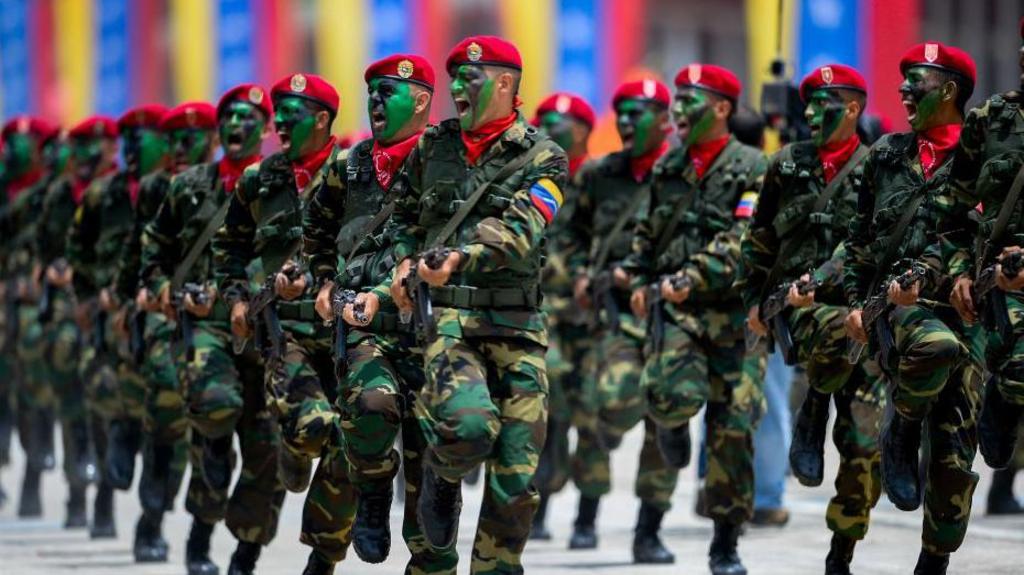
The United States has designated the Cartel de los Soles (Spanish for Cartel of the Suns) – an organization allegedly headed by Venezuela’s president, Nicolás Maduro, and senior figures within his government – as a foreign terrorist organization.
This designation grants U.S. law enforcement and military agencies expanded authority to target and dismantle the group.
In recent months, the U.S. has intensified pressure on Maduro, asserting that his government is illegitimate following an election last year widely regarded as rigged. The terrorist designation provides an additional avenue to escalate this pressure.
However, questions have arisen regarding the actual existence of the Cartel de los Soles. Venezuela’s foreign ministry has “categorically, firmly, and absolutely rejected” the designation, dismissing it as a “new and ridiculous lie.”
Venezuela’s interior and justice minister, Diosdado Cabello, long alleged to be a high-ranking member of the purported cartel, has consistently labeled it an “invention.”
Cabello has accused U.S. officials of exploiting the cartel narrative to target individuals they oppose.
“Whenever someone bothers them, they name them as the head of the Cartel de los Soles,” he stated in August.
Gustavo Petro, the left-leaning president of neighboring Colombia, has also refuted the cartel’s existence.
“It is the fictional excuse of the far right to bring down governments that do not obey them,” he posted on X in August.
The U.S. State Department, however, maintains that the Cartel de los Soles not only exists but has “corrupted Venezuela’s military, intelligence, legislature, and judiciary.”
Experts consulted by the BBC suggest the reality is more nuanced.
The term Cartel de los Soles first emerged in the early 1990s.
It was coined by Venezuelan media following drug-trafficking allegations against a general overseeing counter-narcotics operations within Venezuela’s National Guard, referencing the sun-shaped insignia generals wear on their epaulettes to denote rank.
Mike LaSusa, an expert in organized crime in the Americas and deputy content director at Insight Crime, explains that the term soon encompassed all Venezuelan officials with alleged drug-trafficking connections, regardless of membership within a unified organization.
Raúl Benítez-Manau, an organized crime expert from Mexico’s UNAM university, notes that the group’s activities began in the late 1980s and early 1990s in response to developments in Colombia, the world’s leading cocaine producer.
As the powerful Medellín Cartel faced dismantling and counter-narcotics efforts intensified in Colombia, Mr. Benítez-Manau argues, the Cartel de los Soles provided alternative cocaine transportation routes. This strengthened during the early years of Hugo Chávez’s presidency, Venezuela’s left-wing leader from 1999 to 2013.
“Chávez liked to challenge the United States and cut all military co-operation ties between the Venezuelan army and the US,” he explains.
Without oversight from the U.S. Drug Enforcement Administration (DEA), “some [Venezuelan] army officers felt free to do business with criminals,” Mr. Benítez-Manau says.
Chávez’s sympathies with Colombia’s left-wing Farc guerrillas – largely financed through cocaine smuggling – also contributed to re-routing drug trafficking through Venezuela, he adds.
Facing military pressure in Colombia, the guerrilla group moved operations into Venezuela, confident that the Venezuelan president “saw them as leftist ideological allies,” Mr. Benítez-Manau explains.
Wesley Tabor, a former DEA agent who worked in Venezuela, observes that the Farc not only found “a safe haven in Venezuela” but also partnered with numerous government officials, “from street-level police to the military aviation,” in drug trafficking.
Together, they “began flooding the US with hundreds of tonnes of cocaine,” he states.
Mr. LaSusa notes that the Cartel de los Soles differs from other drug networks by lacking a formal structure.
He argues that it’s not a group per se but rather “a system of widespread corruption.”
He adds that it has been exacerbated by the economic crisis that has engulfed Venezuela under President Maduro.
“The Maduro regime cannot offer security forces a decent salary and, to keep their loyalty, it allows them to accept bribes from drug traffickers,” Mr. LaSusa explains.
Mid- and lower-ranking officers controlling key Venezuelan entry and exit points, such as airports, constitute the Cartel de los Soles, Mr. Benítez-Manau says, placing them in prime positions to facilitate drug flow.
U.S. officials, however, maintain that the tentacles of the Cartel de los Soles extend to the highest levels of the Maduro government, including the president himself.
In 2020, the U.S. Justice Department accused Maduro and 14 others of conspiring with armed Colombian groups to ship cocaine to the United States.
Among the high-ranking officials named were Defence Minister Vladimir Padrino and the former head of Venezuela’s Supreme Court, Maikel Moreno.
In the indictment, U.S. prosecutors also alleged that since at least 1999, the Cartel de los Soles was led and administered by Maduro, Interior Minister Diosdado Cabello, former military intelligence chief Hugo Carvajal, and former General Clíver Alcalá.
They assert that information provided by former high-ranking Venezuelan military officials – including Carvajal and Alcalá – supports this claim.
Leamsy Salazar, a former security chief for Hugo Chávez, provided U.S. officials with information about the Cartel de los Soles as early as 2014.
Salazar, who left Venezuela with DEA assistance, stated that Interior Minister Cabello led the Cartel de los Soles.
Cabello denied the allegation, claiming it was part of an “international conspiracy.”
However, accusations from former Venezuelan officials continued.
In 2020, Gen. Alcalá surrendered to DEA agents, having fallen out with the Maduro government, and pleaded guilty to supporting the Farc and their cocaine-trafficking operations.
Earlier this year, former Venezuelan spymaster Carvajal – who also fled Venezuela after disagreeing with Maduro – pleaded guilty in a U.S. court, as well, to charges of drug-trafficking and narco-terrorism.
“Over the years, he and other officials in the Cartel de los Soles used cocaine as a weapon, flooding New York and other US cities with poison,” a federal prosecutor said during the trial of Carvajal, known as “El Pollo” (The Chicken).
Maduro and Interior Minister Cabello remain in Venezuela, but the U.S. recently increased its rewards to $50 million and $25 million, respectively, for information leading to their capture.
The BBC contacted the Venezuelan government for comment on the U.S. allegations but did not receive a response before publication.
However, the Maduro government has long dismissed the drug-trafficking accusations leveled against it as an attempt by the U.S. to justify ousting Maduro.
In a statement released on Monday, the Venezuelan foreign ministry called the designation of the Cartel de los Soles as a terrorist organization “a ridiculous fabrication.”
It insisted the Cartel de los Soles was “non-existent” and that the move was a “vile lie to justify an illegitimate and illegal intervention against Venezuela.”
The youngest-ever US army secretary has been thrust into the spotlight as the face of renewed efforts to end the years-long war.
Police tried to find Travis Turner after he disappeared last week; he is now considered a fugitive.
The Tulsa Race Massacre of 1921 is regarded as one of the worst episodes of racial violence in US history.
The last congressional election of the year is taking place in the state’s 7th District, where Trump won by 22% in the 2024 election.
During a White House ceremony the president ceremoniously pardoned the turkeys Waddle and Gobble.
“`