

Reports indicate that Donald Trump is actively seeking a resolution to the conflict in Ukraine.
While Kyiv also desires peace, it seeks a resolution that aligns with its national interests and sovereignty.
Sources suggest that when the United States initially pressed Ukraine to accept a deal by Thanksgiving, perceived by some as resembling surrender terms, Kyiv resisted.
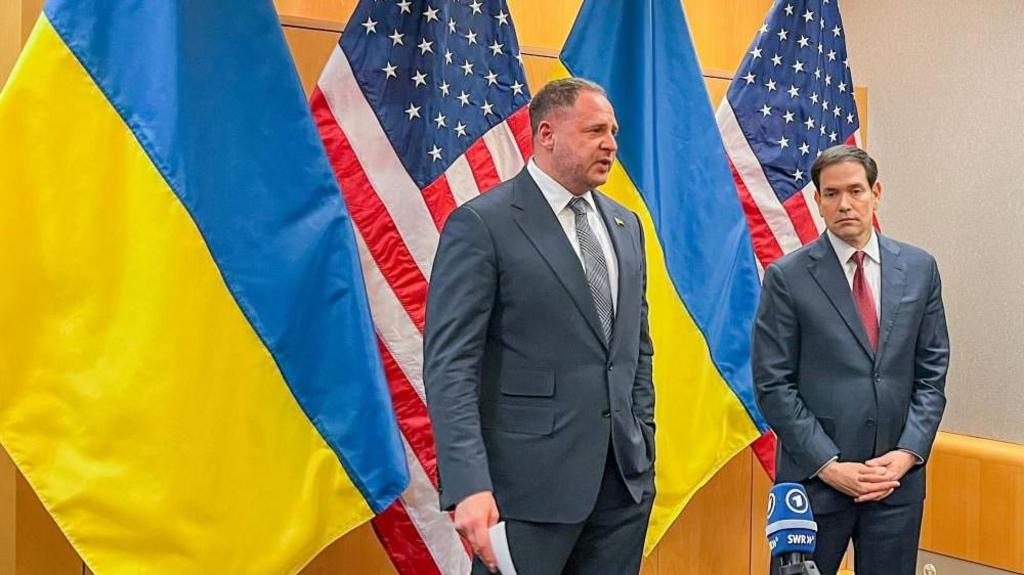
In response, Ukraine dispatched senior officials to Geneva for negotiations. Delegates from the U.S. and Ukraine were observed shuttling between key locations in Geneva, accompanied by national security advisers from Germany, France, and the United Kingdom.
The head of Kyiv’s negotiating team, Andriy Yermak, appeared reportedly somber, according to one observer.
The initial proposal reportedly leaned heavily towards Russia’s demands, prompting U.S. Secretary of State Marco Rubio to publicly deny that the Kremlin had authored the draft.
However, given Donald Trump’s insistence on a swift agreement, coupled with potential consequences for non-compliance, Kyiv engaged in the discussions.
Following Sunday’s talks, Marco Rubio described “tremendous progress,” with only a “couple of things” remaining unresolved, while refraining from specifying the details due to the “delicate” nature of the situation.
A joint statement from Ukraine and the U.S. indicates the emergence of a new “updated and revised framework document.”
While the specifics remain undisclosed, The Financial Times quotes Ukraine’s deputy foreign minister, Sergiy Kyslytsya, referencing a 19-point plan that significantly departs from the original draft.
This new document likely incorporates revisions proposed by European nations. Reuters news agency suggests that the revised version is more amenable to Kyiv.
Reportedly, the automatic veto on future Ukrainian NATO membership has been removed, along with caps on the size of the country’s armed forces.
While no Western troops would be permanently stationed in Ukraine, a complete ban on deployment is not specified.
Concerning the contentious issue of territory, Ukraine would not cede the remainder of the Donbas region to Russia without a negotiated settlement and would pursue the recovery of occupied areas through diplomatic channels, a position previously accepted by President Volodymyr Zelensky.
The proposed blanket amnesty for war crimes has also been reportedly eliminated.
Critically, the revised plan includes a reference to security guarantees.
Multiple officials, including UK Prime Minister Sir Keir Starmer, have mentioned the possibility of Ukraine receiving Article 5-style protection, obligating the U.S. to defend Ukraine in the event of a future Russian invasion.
Ukraine maintains that it cannot compromise on this key issue.
While the extent to which these European proposals have been integrated into the new plan remains unclear, German Chancellor Friedrich Merz characterized the deal as “significantly modified” in a positive light.
The shift from a perceived pro-Russian deal to the current version in a single day raises questions. Some speculate that figures like President Trump’s envoy, Steve Witkoff, played a role.
The original plan reportedly stemmed from Witkoff’s prior visit to Russian President Vladimir Putin, during which he echoed Russian narratives.
Now, the proposed plan appears potentially acceptable to Ukraine, contingent upon further negotiations.
Consequently, President Trump has seemingly shifted from criticizing Kyiv officials for alleged “zero gratitude” to expressing optimism that “something good” is emerging.
However, the true extent of this “good” remains uncertain, as there is no indication that Russia is prepared to cease hostilities unless compelled to do so.
Tatiana Stanovaya of the Carnegie Russia Eurasia Center suggests that “Putin is much more self-confident militarily, right now.”
She cites a corruption scandal and political crisis in Kyiv, mobilization issues, and military gains for Russian forces as factors influencing Putin’s perspective.
At best, Trump’s push for a deal may have injected renewed momentum into peace efforts, which Ukrainians urgently desire.
However, the recent flurry of diplomatic activity seemingly returns the situation to its initial state.
Stanovaya asserts that “Russia’s position is, ‘we have laid out our demands, so do you take them or not? If so, we will stop the war – if not, we’ll just wait until you’re ready.'”
President Trump states the initial peace plan has been “fine-tuned” and that his envoy, Steve Witkoff, will be dispatched to Moscow.
The youngest-ever US army secretary finds himself in the spotlight as the focal point of revived efforts to bring the protracted conflict to a close.
Authorities sought Travis Turner following his disappearance last week; he is currently considered a fugitive.
The Tulsa Race Massacre of 1921 remains recognized as one of the most egregious instances of racial violence in United States history.
The final congressional election of the year unfolds in the state’s 7th District, where Trump secured a 22% victory in the 2024 election.