

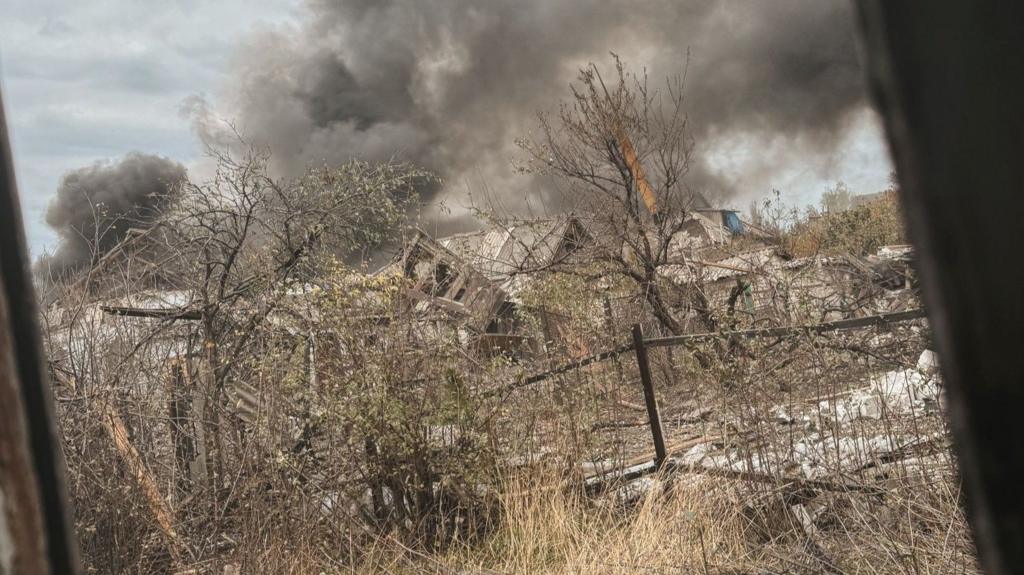
“The toy is delivered,” a Ukrainian soldier whispers into his radio.
Under the cover of darkness, the soldier and his partner swiftly unload their cargo from a van, mindful of the ever-present threat of Russian drones.
The Fifth Brigade’s new “toy” is an unmanned ground vehicle (UGV), a robotic platform vital for resupplying Ukrainian forces on the front lines near Pokrovsk and Myrnograd, a key strategic area in eastern Ukraine.
Russian forces are intensifying efforts to sever Ukraine’s crucial supply routes in the region.
A disruption in the flow of essential supplies like food and ammunition would leave Ukrainian soldiers with untenable choices: surrender or a potentially devastating retreat.
Kyiv has deployed special forces, elite assault units, and drone teams to reinforce its troops in Pokrovsk and its surroundings; however, Russia’s control over access routes renders the use of armored vehicles a near-suicidal proposition.
Transporting substantial supplies on foot is an equally perilous undertaking.
Enter the land drone, a robotic substitute for conventional troop deployments.
The battle for Pokrovsk may be remembered as a landmark event, representing the significant deployment of unmanned ground vehicles for resupply missions and the evacuation of wounded personnel.
Compact enough to navigate bicycle lanes, the robot resembles a miniature tank sans turret.
UGVs present several advantages: their small size makes them difficult to detect, they are more resistant to jamming than aerial drones, and crucially, soldiers can operate them remotely from safer locations.
Ihor, the head of unmanned systems for the Ukrainian army’s 7th Corps, asserts that they save lives and represent the future of warfare.
He estimates that approximately 90% of all supplies reaching the Pokrovsk front lines are now transported by UGVs.
Simultaneously, Russian forces are attempting to capture the city by isolating supply lines and unleashing remote-controlled drones in what is often referred to as “the kill-zone” to target any movement.
This 30km-wide swathe of territory along the front lines is within striking distance of drones deployed by both sides.
Constant aerial surveillance ensures that any activity within the kill-zone is swiftly identified and targeted by drones, as well as conventional weaponry such as artillery, mortars, and aerial bombs.
Military doctor Vitsik and his land drone operator Auditor are intimately familiar with this reality. These designations are their call signs, not their given names.
During a mission last month to evacuate wounded Ukrainian soldiers from Pokrovsk, they were quickly identified and forced to take cover in a nearby building as Russian drones buzzed overhead.
“One drone after another attacked us,” Vitsik recounted. “As soon as a drone hit the ground and exploded, another one immediately appeared. They also fired with artillery and mortars, trying to kill us.”
The walls where Vitsik and Auditor sought shelter vibrated with each successive explosion. The barrage continued for nearly an hour before they managed to slip into an adjacent building and escape.
Inside Pokrovsk, the threat from above is ever-present.
“We run from bush to bush, house to house, street to street,” says Vitsik.
Utilizing first-person view drones, Russian forces are nearing the point of severing all approaches to Pokrovsk.
They claim to have encircled the entire area, allegations Kyiv has repeatedly refuted.
Kyrylo Budanov, the head of Ukraine’s HUR intelligence agency, told local media that the situation in Pokrovsk is “extremely difficult” but that Ukrainian forces are “still holding on.”
Nevertheless, troop movements into and around the city are extremely hazardous, and Ukrainian forces have attempted to limit troop rotations given the elevated risks.
As a result, soldiers are often stationed on the front lines for weeks, and sometimes months, at a time.
This has increased the urgency of resupply efforts, augmenting the demand for unmanned ground vehicles.
A single unit within the 5th Brigade can conduct multiple logistical missions with UGVs in a single day.
Every operation begins in an old, dilapidated garage, and the mission I observed entailed delivering water, ammunition, and fuel to drone pilots.
Supplies are loaded onto a land drone known as Termit, capable of carrying approximately 200kg. The operator pilots the robot by remote control into the back of a van, which transports it closer to the front lines to conserve battery power.
Under the cover of darkness, two soldiers exit the van and deploy the UGV.
One of the soldiers informs the control room via radio that the land drone has been offloaded.
Within seconds, the operator, positioned several kilometers away, confirms connectivity with the machine, and Termit proceeds toward its destination.
Machines such as Termit have been in service with some Ukrainian brigades since last year, but their use has expanded significantly in recent months.
At a workshop for the 79th Brigade, engineers who previously focused on building aerial drones are now tasked with upgrading unmanned ground vehicles for use in combat zones.
They implement camouflage, weld new platforms, and incorporate hardware to enhance communication capabilities. However, even with these enhancements, UGVs remain susceptible to drone attacks.
“Regardless of camouflage, connection type, or speed,” says an UGV operator with the call sign “Lawyer,” “the machine can still be detected and destroyed.”
During a mission to evacuate a wounded soldier from Pokrovsk, his unmanned vehicle struck a landmine, damaging its tracks.
Another land drone was dispatched on a rescue mission from a different unit, but it too was destroyed. Lawyer still lacks confirmation as to whether the wounded soldier survived.
Ihor, from the 7th Corps’ unmanned systems department, estimates that only one in three UGVs successfully reaches the city.
Despite the high attrition rate of the small robots, troops on the front lines have grown increasingly reliant on those few that manage to get through.