

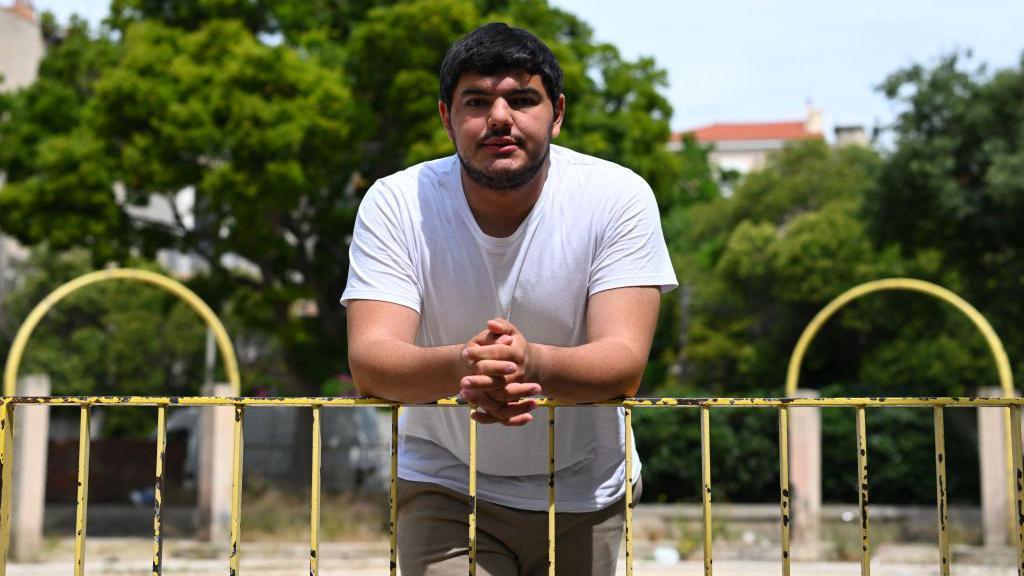
A prominent French anti-drugs campaigner, whose brother was murdered by drug criminals last week, five years after the killing of his elder brother, has pledged to resist intimidation and “keep telling the truth about drugs violence.”
Amine Kessaci, 22, voiced his resolve in an opinion piece in Le Monde, published a day after the funeral of his younger brother Mehdi. The government has characterized Mehdi’s murder as a turning point in France’s escalating war on drugs.
“Yesterday I lost my brother. Today I speak out,” he declared in his article.
“[The drug traffickers] strike at us to break, tame, and subdue. They want to eliminate any resistance, crush any free spirit, and extinguish any spark of revolt.”
Mehdi Kessaci, 20, was fatally shot last Wednesday while parking his car in central Marseille, an act believed to be a warning or punishment directed at his older brother, Amine, by the city’s drug gangs.
Following a ministerial meeting on drug crime at the Elysée Palace on Tuesday, Interior Minister Laurent Nuñez stated, “We all agreed that this premeditated murder was something entirely new. It’s clearly a crime of intimidation, marking a new level of violence.”
Mehdi was the second Kessaci brother to fall victim to drug criminals. In 2020, the body of Brahim Kessaci, then 22, was discovered in a burnt-out vehicle.
That earlier tragedy spurred Amine to establish Conscience, an association dedicated to exposing the harm inflicted on working-class communities by drug gangs.
Marseille is known for its intensifying drug conflicts, and Amine Kessaci recently authored a book titled “Marseille Wipe Your Tears – Life and Death in a Land of Drugs.”
In his Le Monde piece, Amine revealed that police had recently advised him to leave Marseille due to threats against his life.
He attended his younger brother’s funeral wearing a bullet-proof vest and under tight police security.
“I speak because I have no choice but to fight if I don’t want to die. I speak because I know that silence is the refuge of our enemies,” he wrote, urging both courage from citizens and decisive action from the government.
Mehdi Kessaci’s murder has once again focused national attention on the drug trafficking crisis, which French experts and government officials agree is reaching nearly unmanageable proportions.
According to Senator Étienne Blanc, author of a recent study, the turnover in the French drug trade now amounts to €7 billion (£6 billion), equivalent to 70% of the entire budget of the Justice Ministry.
He estimated that around 250,000 people in France derive their living from the drug trade, a figure exceeding the total number of police and gendarmes, which stands at 230,000. Le Monde reports that the country has 1.1 million cocaine users.
President Emmanuel Macron on Wednesday criticized these consumers, stating at the weekly cabinet meeting that “sometimes it is the city-center bourgeoisie that is funding the traffickers.”
Macron convened a special drug summit the day before in response to Mehdi’s murder, and to assess progress on a new anti-drug law passed in June.
The law establishes a specialized prosecutor’s office dedicated to organized crime, mirroring the structure used to combat terrorism, which will eventually include 30 specialized magistrates.
Under the law, senior drug convicts are required to serve their sentences in isolation within a specially converted prison, designed to make it more difficult to continue managing operations from behind bars.
According to Laurent Nuñez, there is evidence that the crackdown on drug crime is having a tangible impact, with homicides in Marseille declining from 49 in 2023 to 24 in 2024.
He added that the number of dealing points in the city has halved, from 160 to 80.
“The war is not won, but we do have results.”
According to the author of “Narcotraffic, Europe’s poison,” France “is at the heart of the geopolitics of drugs. With its two major ports of Marseille and Le Havre, it has an ideal geographical position in this Europe of free movement.”
Mathieu Verboud stated that the growth in global cocaine production has triggered an “explosion of supply and demand. The market has gone through the roof and so have the profits.”
The immense wealth of drug organizations allows them to corrupt everyone from dockworkers to local politicians, the author warned, a process he claims is already well-advanced in countries like the Netherlands and Belgium.
Several French politicians have suggested that the army should be called in to address drug-trafficking and the gangs that dominate many high-immigration urban estates.
Christian Estrosi, mayor of Nice, said: “Narcotrafficking has transformed into narcoterrorism. Its aim now is to terrorize, subjugate and rule.”
“We have already successfully deployed the means to fight terrorism. It’s time to act with determination against narcoterrorism.”
Estrosi was referencing the wave of deadly jihadist attacks in the mid-2010s, during which France deployed hundreds of soldiers to patrol the streets of numerous cities, a practice that continues today.
An unsealed federal indictment sheds light on how former Canadian snowboarder Ryan Wedding allegedly runs a billion-dollar drug empire.
A woman is jailed for five years for importing nearly 2.5kg of cocaine into Jersey.
Joshua Bromwell was jailed for 20 years at Croydon Crown Court on 21 November.
The family of Wilmer “Pipo” Chavarria had claimed that he died in 2021 from a Covid-related heart attack.
The three men will be sentenced at Maidstone Crown Court on 11 March next year.